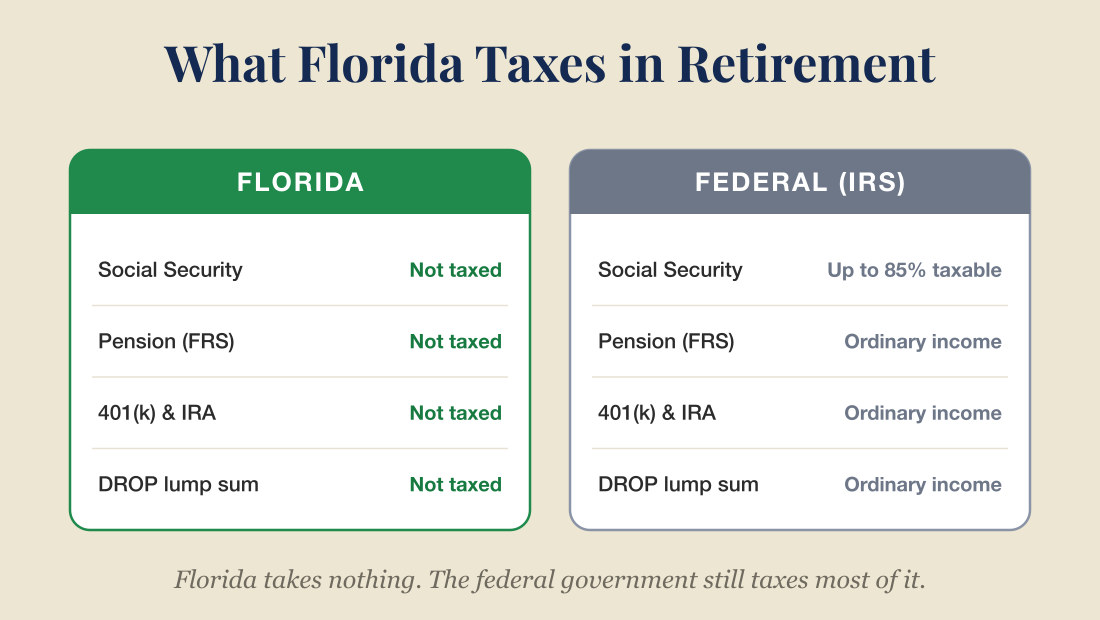
Here is the short answer, and it is genuinely good news: Florida does not tax your retirement income. Not your Social Security, not your pension, not your 401(k) or IRA withdrawals, not your annuity payments. Florida’s constitution prohibits a state income tax on individuals, so at the state level the number is zero across the board.
But “no state tax” is not the same as “no tax,” and treating the two as the same is the mistake that quietly costs Florida retirees the most. Below is the line-by-line answer, income type by income type, with the federal side made clear, because the federal side is the only side left standing once you retire in Florida. For the full strategy, see our pillar guide, Tax-Free Retirement Income in Florida.
Social Security
Florida tax: none. Florida does not tax Social Security benefits.
Federal tax: possible, up to 85 percent of the benefit. Once your combined income crosses the federal thresholds, up to 85 percent of your Social Security can be taxed by the IRS. What pushes you over those thresholds is usually withdrawals from a traditional 401(k) or IRA. So while Florida leaves your Social Security alone, the way you draw your other accounts can still make a large part of it federally taxable.
Pensions, including FRS
Florida tax: none. A private pension, a government pension, a military pension, and a Florida Retirement System benefit are all free of Florida income tax.
Federal tax: yes, as ordinary income. Pension income is taxed at your ordinary federal rate. For FRS members this matters at the payout: whether you took the Pension Plan, the Investment Plan, or a DROP lump sum, the state does not tax it, but the federal government fully does. A large DROP payout landing in a single year can push you into a higher federal bracket, so the timing and the rollover choice are worth planning before the money moves.
401(k), 403(b), and traditional IRA withdrawals
Florida tax: none.
Federal tax: yes, every dollar, as ordinary income. These are the classic tax-deferred accounts. You never paid tax on the money going in, so the IRS taxes all of it coming out. Starting at age 73, required minimum distributions force the withdrawals whether you need the cash or not, which stacks federal income and can drag more of your Social Security into the taxable column at the same time.
Roth IRA and Roth 401(k)
Florida tax: none.
Federal tax: none on qualified withdrawals. Roth accounts are the exception. You already paid the tax going in, so qualified withdrawals in retirement come out free of federal income tax, and Florida does not touch them either. This is the one bucket that is truly tax-free on both sides, which is exactly why building it before you retire is so valuable.
Annuities
Florida tax: none.
Federal tax: depends on the type. Payments from a qualified annuity held inside an IRA or 401(k) are federally taxable as ordinary income. A non-qualified annuity is only taxed federally on its gains, not on the money you originally put in. Either way Florida adds nothing, and under Florida law the proceeds of an annuity carry strong creditor protection, which is a separate advantage worth knowing about.
Investment income, capital gains, and dividends
Florida tax: none. Florida has no state tax on interest, dividends, or capital gains.
Federal tax: yes. Interest is taxed federally as ordinary income, and long-term capital gains and qualified dividends get their own federal rates. A brokerage account is fully in play at the federal level every year, but the state takes nothing.
Wages from part-time work
Florida tax: none. If you pick up part-time or consulting work in retirement, Florida does not tax the wages.
Federal tax: yes, plus payroll tax. Earned income is subject to federal income tax and to Social Security and Medicare payroll taxes, and it counts toward the combined-income figure that can make your Social Security taxable. Working in retirement is fine, but it is worth knowing it can raise the tax on your other income.
How Florida compares to states that tax retirement income
To see what the Florida advantage is really worth, put it next to a state that taxes retirement income. Many states tax pension and IRA withdrawals at rates that run from three to more than nine percent, and some tax Social Security on top of that. A retiree pulling 60,000 dollars a year from a pension and traditional accounts in a five percent state hands their state government about 3,000 dollars every year, year after year, for the length of their retirement. In Florida that number is zero. Over a twenty-five or thirty-year retirement, the difference is not a rounding error, it is a house.
Florida also compares well against the other no-income-tax states. Texas, Tennessee, and a handful of others also skip the income tax, but Florida pairs that with a homestead property-tax exemption, the Save Our Homes assessment cap, no estate or inheritance tax, and unusually strong creditor protection for cash value life insurance and annuities. For a retiree, that combination of a zero income tax and a stack of asset protections is one of the most complete packages in the country.
What no state tax means for your withdrawal strategy
Because Florida takes nothing, every planning decision you make in retirement is a federal decision. That actually simplifies things: you have one tax authority to manage instead of two, and you can focus entirely on controlling your federal bracket year by year. A Florida retiree who plans well decides which bucket to draw from in which year, keeps income under the thresholds that make Social Security taxable, and uses low-income years to convert traditional money to Roth without a state tax bill attached. Someone in an income-tax state has to weigh all of that against a state tax too, and often cannot convert as aggressively because the state takes its cut of every conversion. In Florida the road is clearer, which is exactly why it pays to have a plan rather than drift.
What Florida taxes instead
Florida still has to fund itself, and it does so through spending and property rather than income. For a retiree living off savings, that is close to the ideal setup, but it is worth knowing where the state does reach.
- Sales tax. Florida runs on a state sales tax plus local surtaxes added by many counties. You pay it when you spend, not when you draw income, so a retiree who controls their spending controls most of this.
- Property tax. Counties tax real estate, but homeowners get real protection. The homestead exemption removes up to 50,000 dollars of assessed value from your primary residence, and the Save Our Homes provision then caps how much your assessed value can rise each year at the lesser of the change in the Consumer Price Index or 3 percent, no matter how fast the market climbs. For a long-term Florida resident, that cap alone can be worth a great deal over a retirement.
- What it does not tax. No income tax, no estate tax, and no inheritance tax. The three taxes that hit a retiree’s savings and legacy the hardest are simply not on the Florida menu.
The one catch for newcomers
There is a trap that catches people who move to Florida partway through the year or split their time between two states. Florida’s zero income tax only helps you if Florida is genuinely your legal domicile. If you keep your domicile in an income-tax state, or you split your year and do not properly establish Florida residency, that other state may still try to tax your retirement income. Several high-tax states are aggressive about auditing former residents and will look at where you spend your days, where you vote, and where your home base really is.
If you moved here for the tax break, make the move real. File for homestead, change your driver’s license and vehicle registration, register to vote in Florida, move your banking and your mailing address, and update your estate documents to Florida law. The tax win is only as solid as the residency behind it, and the paperwork is what makes it stick.
The bottom line
Does Florida tax retirement income? No. Every line above reads the same on the state side: nothing. That is a real, permanent advantage that most states cannot match. But every one of those lines still has a federal answer, and for the accounts most retirees rely on the most, that federal answer is “yes, in full.” Florida handed you the state half of the solution for free. The half that is left, the federal half, is the one worth planning around, and it is the one you can actually control.
Frequently asked questions
Does Florida tax Social Security? No. Florida has no state income tax, so Social Security is untaxed at the state level. The federal government can still tax up to 85 percent of your benefit depending on your combined income.
Does Florida tax pensions or 401(k) withdrawals? No, not at the state level. Both are still taxed federally as ordinary income.
Does Florida tax military or government pensions? No. With no state income tax, military, federal, and state government pensions are all free of Florida tax.
If I live in Florida part of the year, do I still get the no-tax benefit? Only if Florida is your true legal domicile. Splitting your year while keeping ties to an income-tax state can leave that state trying to tax your retirement income, so establishing Florida residency properly matters.
Want to see how much of your retirement income is exposed on the federal side? Retirement Shield walks Florida savers through a short qualification quiz and connects you with one licensed professional who can map your accounts and your federal exposure. See if you qualify here.
This article is general education, not individualized tax, legal, or investment advice. State and federal tax rules, required distribution ages, and Social Security taxation change over time, and how any rule applies depends on your own situation and residency. Consult a licensed tax, legal, or insurance professional before making decisions. Retirement Shield is a marketing and education brand, not a law firm, accounting firm, or insurance carrier.