Most people think of life insurance as money their family gets after they are gone. Modern policies increasingly do something else: they let you use the money while you are alive, during exactly the kind of health crisis that drains a retirement. For many families, that feature matters more than the tax treatment.
Ask most people what life insurance is for and they will say the same thing: it pays your family when you die. That is still true, but it is no longer the whole story. Many modern policies carry living benefits, features that let you tap the policy while you are alive if your health turns. For a retiree, whose single biggest financial fear is often a long illness that eats through everything they saved, this can be the most valuable feature in the policy, and it is the one least talked about in the tax-focused sales pitch.
What are living benefits?
Living benefits, usually structured as accelerated death benefit riders, allow you to receive a portion of your policy’s death benefit before you die if you experience a qualifying condition, typically a terminal illness, a chronic illness that affects your ability to perform daily activities, or a critical illness such as a serious cardiac event or cancer diagnosis. Rather than the death benefit sitting untouched until your passing, you can access it when a health crisis hits, and use the money for care, bills, or anything else.
The amount you accelerate reduces what your beneficiaries eventually receive, so it is not free money in addition to the death benefit; it is early access to it. But for a family facing a six-figure medical or care event, early access to money they already own can be the difference between weathering the crisis and unwinding a retirement to pay for it.
Why living benefits matter in retirement
The financial risk that frightens retirees most is not usually running out of money slowly. It is a sudden, expensive health event, a stroke, a cancer diagnosis, a slide into needing daily care, that costs enormous sums and arrives without warning. Traditional retirement accounts offer no help with this except to be drained. A policy with living benefits offers a pool of money that becomes available exactly when that event occurs.
The retirement risk people fear most is a long illness. Living benefits put money where that fear lives, while you are still here to use it.
Are living benefits the same as long-term care insurance?
Not identical, but related, and for some families a practical alternative. Dedicated long-term care insurance is built specifically to pay for extended care, with its own rules and rising premiums that have made it harder to buy. Living benefits on a life insurance policy can cover some of the same ground, chronic-illness access to funds, without a separate policy, and with the advantage that if you never need the care, the death benefit still goes to your family. That “use it or your family gets it either way” quality is why some people prefer this route. Whether it fits depends on your health, your budget, and the specific triggers in the policy, which is part of the broader fit question we cover in the honest IUL guide.
Reading the fine print
Living benefits are genuinely valuable, and they are also where policies differ the most, so this is a section to read carefully rather than take on faith:
- What triggers them. Terminal only, or chronic and critical illness too? The broader the triggers, the more useful.
- What they cost. Some riders are included; others carry an extra premium or reduce the death benefit when used.
- How much you can access, and how the accelerated amount is calculated.
- What documentation is required to make a claim.
The feature is only as good as its terms. A policy with strong, broad living benefits can be a genuine safety net; one with narrow triggers may offer less than it appears. Ask specifically, and get the answers in writing.
Protection for the health event that scares retirees most.
The free masterclass covers how living benefits fit alongside tax-free income, and the 60 second quiz afterward checks whether it fits your situation.
Watch the MasterclassThe three events people do not plan for
Most people think of life insurance as something that pays out after they are gone. Living benefits flip that. They let the policy pay you, while you are alive, if one of the health events that derails a retirement actually happens.
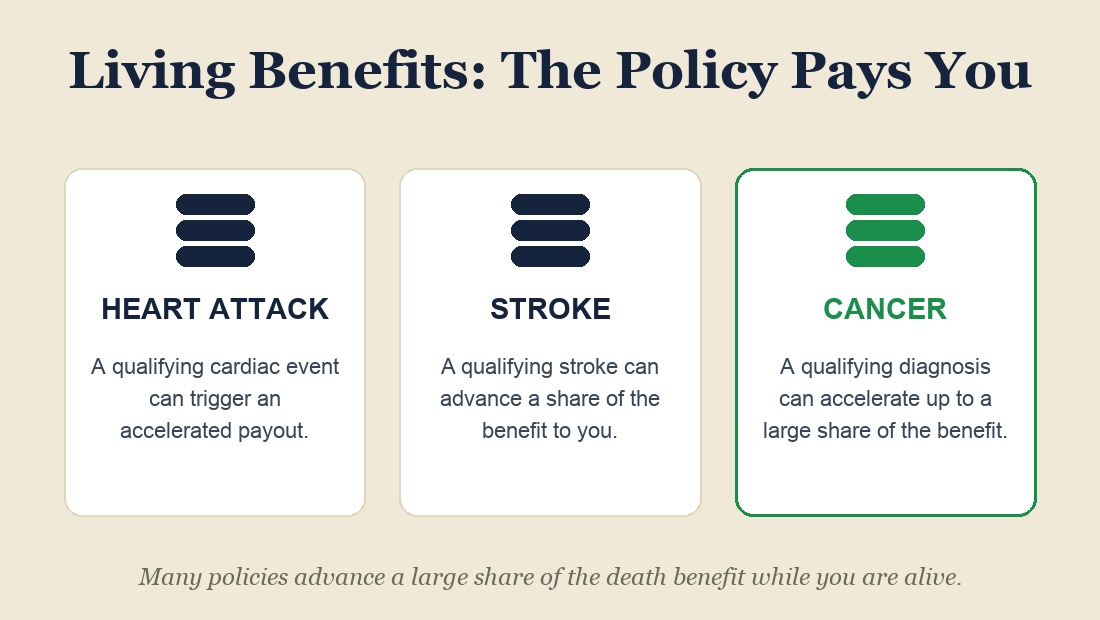
The three that show up most often are a heart attack, a stroke, and a cancer diagnosis. When a policy carries living-benefit riders and one of these qualifying events occurs, the insurer can advance a large share of the death benefit to you, often a substantial portion, to spend however the moment requires: treatment, time off work, keeping the mortgage paid while you recover. The money that was always meant for your family becomes money that protects the family while you are still here to see it.
This is the piece that changes how you should read a policy. A plan that only pays when you die is doing half a job, because the far more likely event during your working years is not death but a serious illness that costs you income right when you cannot afford to lose it. Living benefits close that gap. Not every policy includes them, and the exact triggers and amounts vary, so the one question worth asking about any coverage you own or are offered is simple: does this pay me if I get sick, or only if I die?
The fine print worth reading first
Living benefits are genuinely valuable, which is exactly why they deserve an honest reading rather than a sales pitch. The features are real, and so are the conditions attached to them, and knowing both is how you avoid a nasty surprise at the worst possible moment.
Start with the most important mechanic: acceleration is an advance, not a bonus. When a qualifying illness lets you pull a share of the death benefit forward, the money you take now is subtracted from what your family receives later. Accelerate a large portion during a cancer diagnosis, and the death benefit that remains is smaller by that amount. That is a fair trade when you need the money to live, but it is a trade, and a policy is doing you no favors if it lets you believe the living benefit is free.
Then read what actually triggers a payout, because the words matter. Riders usually fall into three buckets: critical illness, for events like a heart attack, stroke, or cancer; chronic illness, for the inability to perform daily activities like bathing or dressing; and terminal illness, for a diagnosis with a limited life expectancy. A policy may include one, two, or all three, and the definitions decide whether your specific situation qualifies. The size of the advance, any waiting periods, and whether a payout reduces future benefits dollar-for-dollar or by a formula all live in the contract language, not the brochure.
The reason to care is simple. During your working years, a serious illness is far more likely than an early death, and it attacks your finances from two directions at once, the cost of care and the loss of income. Living benefits exist to blunt that blow. But they only help if the riders you own actually cover the event you face, on terms you understood before you signed. The one question that cuts through all of it is the one worth asking out loud: exactly which events pay, how much, and what does it cost my family later?
What are living benefits on a life insurance policy?
Living benefits, often called accelerated death benefit riders, let you access part of your policy’s death benefit while you are still alive if you experience a qualifying event such as a terminal, chronic, or critical illness. Instead of the money only going to your family after death, you can use it during a health crisis.
Do living benefits cost extra?
Some accelerated death benefit riders are included at no additional premium, while others cost extra or reduce the eventual death benefit when used. The exact terms and triggering conditions vary by policy and should be reviewed carefully before you rely on them.
Can living benefits replace long-term care insurance?
Not exactly. Living benefits can help with the costs of a chronic or terminal illness, and for some families they are a practical alternative to a standalone long-term care policy. But the triggers, amounts, and rules differ from dedicated long-term care coverage, so compare them for your specific needs.
How do I use a living benefit?
You file a claim with the insurer and provide documentation of the qualifying condition, such as a physician’s certification. If approved, you receive an accelerated portion of the death benefit, which reduces the amount later paid to your beneficiaries.