The short answer: Louisiana is one of the more tax-friendly states in the country for retirees, but “tax-friendly” hides an important split. The state gives you a lot. The federal government does not. Here is the line-by-line breakdown.
If you are planning to retire in Louisiana, or already have, one of the first practical questions is simple: how much of my retirement income does the tax man take? The good news is that Louisiana treats retirees generously by national standards. The important news, the part that decides most retirement tax bills, is that the state is not where the real bite comes from. Let us go through it income type by income type.
Does Louisiana tax Social Security?
No. Louisiana does not tax Social Security benefits. Whatever you collect from Social Security, the state takes none of it. This alone puts Louisiana ahead of the handful of states that still tax benefits.
Federal tax is a separate matter. Depending on your total income, up to a portion of your Social Security can be taxable at the federal level, which is one reason your other income sources matter so much: they can drag your Social Security into taxation even though Louisiana never touches it.
Does Louisiana tax pension income?
Public pensions are exempt from Louisiana income tax. If you draw a pension from TRSL, LASERS, another Louisiana public retirement system, or a federal government pension, that income is not subject to state income tax. For the large number of Louisiana retirees who spent a career in public service, this is a significant, ongoing benefit.
Private pensions and annuity income are treated differently. Residents 65 and older can exempt a limited amount of other retirement income from state tax each year, but beyond that exemption, private retirement income is generally subject to Louisiana tax, and always to federal tax.
Does Louisiana tax 401(k) and IRA withdrawals?
Generally yes, with a break for seniors. Withdrawals from traditional 401(k)s and IRAs are ordinary income and are generally subject to Louisiana income tax, though residents 65 and older can shelter a limited amount of retirement income each year under the state exemption. At the federal level, every dollar withdrawn from a traditional account is fully taxable, which is the larger issue for most people, and the reason the tax-free bucket matters.
Louisiana taxes your retirement lightly. The federal government is the partner most retirees forget to plan around.
What is Louisiana’s income tax rate for retirees?
Louisiana taxes personal income at a low rate, and recent state tax reform moved it toward a flat structure. Combined with the exemptions above, the practical effect is that Louisiana is simply not where a typical retiree’s large tax bill comes from. Confirm the current rate and exemption amounts when you plan, since these figures are adjusted from time to time.
The federal reality
Here is the whole point in one sentence: everything Louisiana exempts, the federal government can still tax. Your public pension is federally taxable. Your 401(k) withdrawals are federally taxable. Your Social Security can become federally taxable once your income is high enough, and it is your pension and withdrawals that push it there.
So the honest answer to “does Louisiana tax retirement income” is: barely, at the state level, and that is genuinely good. But it means the retirement tax problem for Louisianans is almost entirely a federal one, and the fix is a federal one too: building income that is not federally taxable, so you control the bill. That is the subject of our complete Louisiana tax-free income guide.
The state gets out of the way. Here is how to handle the federal side.
The free masterclass covers building income that is not federally taxable, and the 60 second quiz afterward checks whether it fits your situation.
Watch the MasterclassHow Louisiana compares to its neighbors
One of the quickest ways to understand Louisiana’s approach to taxing retirement income is to look across the state line. The states that border us do not agree on how to treat the money you live on in retirement, and those differences add up over a long retirement. If you are weighing where to spend these years, or you split time between states, the comparison is worth understanding in plain terms.
Texas is the simplest case. It has no state income tax at all, which means Social Security, pension income, and withdrawals from your retirement accounts are not taxed at the state level. That sounds like an easy win, but remember the money has to come from somewhere. States without an income tax often lean harder on property taxes and sales taxes, so the full picture depends on more than one line item.
Mississippi takes a different route. It broadly exempts qualified retirement income, so distributions from many retirement plans are generally not taxed once you meet the conditions the state sets. Other neighbors treat retirement income in their own ways, with their own rules about what counts and what does not. The point is not to crown a winner. It is to see that “retirement friendly” means something specific in each state, and the details decide whether it applies to you.
Where does Louisiana land? Louisiana treats several categories of retirement income favorably, and it does not tax Social Security benefits. That places it on the friendlier end for many retirees, though not because it ignores retirement income entirely. The state’s treatment is category by category, which is exactly why a broad label can mislead you.
Here is the honest caution. State tax rules change, and the thresholds, exemptions, and definitions that matter to you can shift from one year to the next. Do not plan around a number you read in an old article or heard at a dinner table. If you are comparing states, or deciding whether a move actually lowers your tax picture, confirm the current rules with each state’s revenue department or a tax professional before you make a decision you cannot easily undo. The comparison is a starting point, not a conclusion.
The part that trips people up: what the state does not exempt
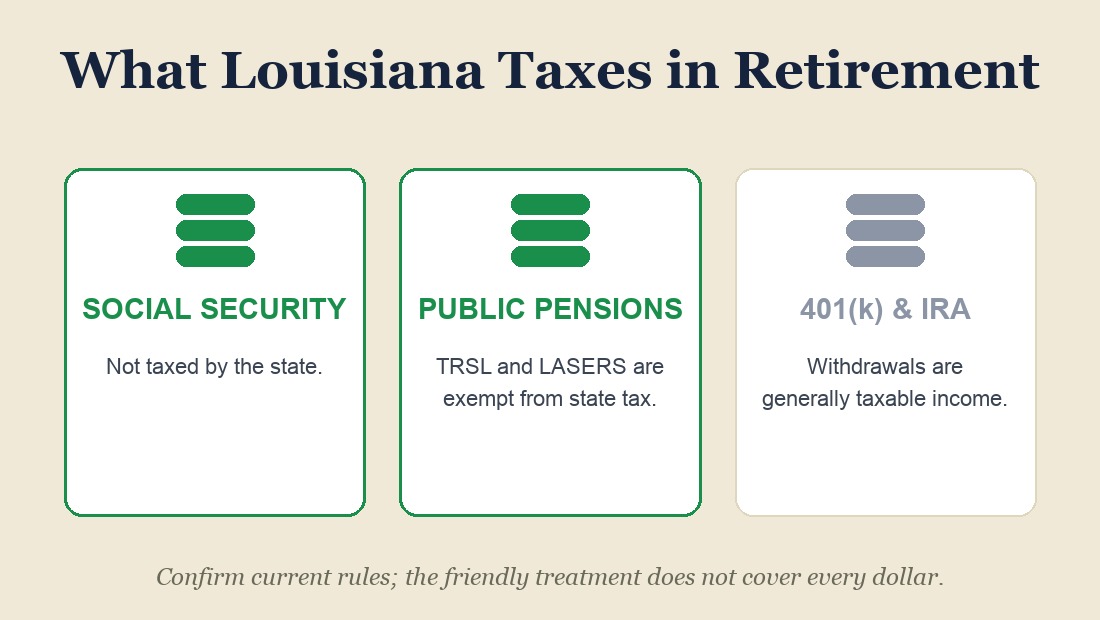
Louisiana has a reputation for treating retirees kindly, and for good reason. The state does not tax Social Security benefits, and it extends favorable treatment to certain public pensions. That reputation is accurate. The trouble starts when people assume the friendly treatment covers every dollar they will draw in retirement. It does not, and the gap is where planning either helps you or catches you off guard.
Here is the piece that surprises people. Withdrawals from a traditional 401(k) or a traditional IRA are generally treated as taxable income. That money went in before taxes and grew without being taxed along the way, so when you take it out, it is generally counted as income at both the federal and state level. The exempt categories that make Louisiana attractive, like Social Security and some public pensions, do not automatically extend to your personal retirement accounts. Two retirees with the same total income can face very different tax pictures depending on where that income comes from.
Why does this matter beyond the tax bill itself? Because the income you report can ripple into other parts of retirement. A large withdrawal in a single year can push more of your income into a higher bracket, and it can affect other calculations that look at your income. When people take a big lump sum to cover a truck, a roof, or a medical bill, they sometimes discover the tax cost of that single choice only when the return is prepared.
This is where thoughtful sequencing earns its keep. Deciding which accounts to draw from, and in what order, can shape how much of your income is taxable in a given year. Spreading withdrawals out, or coordinating them with your other income, is a conversation worth having before you take the money, not after. The goal is not to avoid taxes you legitimately owe. It is to avoid surprising yourself with a bill you could have smoothed out.
None of this is a reason to fear your retirement accounts. It is a reason to plan around them with clear eyes. Treat the exempt categories as a helpful feature, not a blanket, and confirm how your own mix of income will be taxed. If your situation is at all complicated, sit down with a tax professional or check the current guidance from the Louisiana Department of Revenue before you decide how to draw your money.
Does Louisiana tax Social Security benefits?
No. Louisiana does not tax Social Security benefits at the state level. Federal tax may still apply once your combined income crosses certain thresholds.
Does Louisiana tax pension income?
Louisiana exempts public pension income, including TRSL, LASERS, and federal government pensions, from state income tax. Private pensions and other retirement income may qualify for a partial exemption for residents 65 and older, but are otherwise subject to state tax and always to federal tax.
Does Louisiana tax 401(k) and IRA withdrawals?
Withdrawals are generally subject to Louisiana income tax, except that residents 65 and older can exempt a limited amount of retirement income each year. All withdrawals from traditional accounts remain subject to federal income tax.
Is Louisiana a tax-friendly state for retirees?
On the state level, yes. Louisiana does not tax Social Security, exempts public pensions, offers a senior retirement-income exemption, and has a low flat income tax rate. The larger tax burden for most Louisiana retirees comes from federal tax, not state tax.
Related reading on protecting your money in Louisiana: Is life insurance protected from lawsuits and creditors in Louisiana? and our complete guide to Louisiana life insurance creditor protection.