You built the practice, the firm, or the shop. You carry the licenses, the key accounts, the bank note with your name personally on it. So here is the question most Louisiana owners never get a straight answer to: if you or your business partner died next week, who writes the check that keeps the business standing, and who ends up owning the other half?
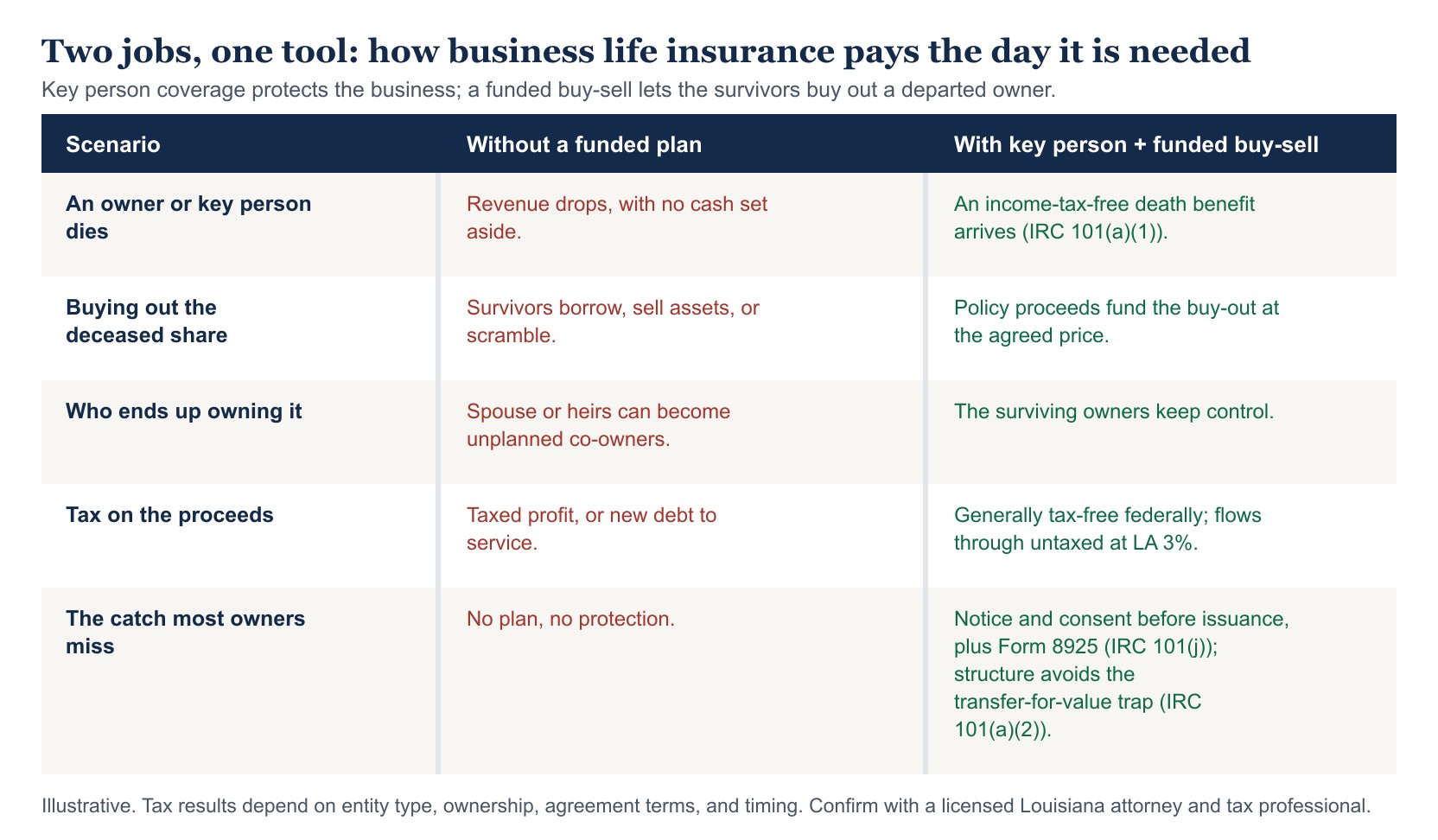
Short answer: without a funded plan, the business absorbs the shock and the survivors scramble. They borrow from a bank at the worst possible moment, drain the company’s cash, or end up in business with a deceased partner’s spouse or heirs. Life insurance does two separate jobs here. It protects the company against the loss of an owner or a key employee (key person coverage), and it funds a buy-sell agreement so the surviving owners can buy out a deceased owner’s share with cash that shows up the day it is needed.
This is general education, not legal or tax advice. Business continuation planning turns on your entity type, your ownership structure, and the exact wording of your agreements, so confirm any move with a licensed attorney and tax professional before you make it. With that said, here is the framework every Louisiana business owner with partners or key people should understand.
What is key person coverage, and why does a Louisiana business need it?
Key person coverage is life insurance the business owns on a person it cannot easily replace, usually an owner, but sometimes a top producer, a lead engineer, or the one employee who holds the client relationships. The business pays the premium and is the beneficiary, and if that person dies, the death benefit goes to the company.
Why it matters is simple. When a key person dies, revenue does not just pause, it can fall off a cliff while the team covers the gap, recruits a replacement, and reassures nervous clients and lenders. The death benefit gives the company a cushion to survive that stretch without laying people off or defaulting. For a Louisiana business built around one or two people, that can be the difference between a hard year and a closed door. The coverage can be written as plain term insurance or as a properly structured permanent policy that also builds usable value while everyone is alive, a choice covered below.
What is a buy-sell agreement, and how does life insurance fund it?
A buy-sell agreement is a contract among the owners that spells out what happens to an owner’s interest when a triggering event hits, most importantly death. It sets who may buy the departing owner’s share, fixes or formulas the price, and obligates the parties to go through with the sale. Done right, it turns a chaotic event into a pre-agreed transaction.
The missing piece in most agreements is the money, and that is where life insurance comes in. Policies are placed on each owner so that when one dies, the death benefit provides the exact cash needed to buy that owner’s share at the agreed price. The survivors keep control of the business, and the deceased owner’s family receives fair value in cash instead of an illiquid stake in a company they cannot run. In Louisiana this cuts deeper, because our community property and succession rules can route a deceased owner’s interest to a surviving spouse or heirs. Without a funded buy-sell, you can wake up with an unplanned co-owner. (How Louisiana forced heirship interacts with a business interest is fact-specific, so confirm your situation with a licensed Louisiana attorney.)
Not sure whether your business is actually protected? Retirement Shield walks Louisiana owners through a short questionnaire and connects you with one licensed professional who can show you how key person and buy-sell funding would work for your numbers, then points you to your own attorney and tax advisor to confirm the structure. See where your business stands →
Does the death benefit really arrive tax-free?
This is the part that makes life insurance the preferred funding tool. Under IRC section 101(a)(1), the death benefit is generally excluded from the recipient’s gross income. The company or the surviving owners receive the proceeds free of federal income tax, which is why a dollar of death benefit buys a full dollar of business value, unlike a dollar borrowed or a dollar of taxed profit.
Louisiana does not add a tax on top. Because the state’s income tax starts from your federal adjusted gross income (La. R.S. 47:293) and runs at a flat 3 percent for tax years beginning on or after January 1, 2025 (La. R.S. 47:32(A)), an amount the IRS excludes under section 101 flows through untaxed at the state level too. That is a flow-through result, not a dedicated Louisiana exemption, but the effect is the same.
There is a trap most owners have never heard of. Section 101(a)(1) has an exception called the transfer-for-value rule in IRC section 101(a)(2). If a policy or an interest in it is transferred for valuable consideration, the income-tax-free treatment can be lost, and the death benefit above what was paid becomes taxable. The statute carves back safe transfers where full tax-free treatment survives: a transfer “to the insured, to a partner of the insured, to a partnership in which the insured is a partner, or to a corporation in which the insured is a shareholder or officer.” Those carve-backs are exactly why buy-sell structure is not a detail you improvise.
Cross-purchase or entity redemption: why the structure changes the tax
There are two common ways to build a funded buy-sell, and they behave very differently, both for taxes and for the transfer-for-value rule.
- Cross-purchase. Each owner personally owns a policy on each of the other owners. When one dies, the survivors collect the proceeds and buy the deceased owner’s share directly. A general feature is that the survivors take a cost basis in the interest they purchase, which can reduce their taxable gain if they later sell. The downside is complexity: with several owners, the number of policies multiplies fast.
- Entity (stock) redemption. The business entity owns one policy on each owner and is the beneficiary. When an owner dies, the entity collects the proceeds and redeems, or buys back, that owner’s interest. Fewer policies, simpler administration. The common trade-off is that the surviving owners generally do not pick up added basis in their own interests the way they would in a cross-purchase.
Here is where the transfer-for-value rule bites. Moving an existing policy into or out of one of these structures can be a transfer for value. The safe harbors in 101(a)(2) protect transfers to the insured, to a partner of the insured, to a partnership in which the insured is a partner, or to a corporation in which the insured is a shareholder or officer. Notice what is not on that list: a plain transfer of a policy between two co-shareholders who are not also partners. That gap is why a cross-purchase among corporate shareholders has to be designed carefully, and why you never shuffle policies between owners without running it past a tax professional first. Which structure fits depends on your entity type, the number of owners, your basis situation, and your goals, so treat it as a decision for your advisor, not a default to assume.
The rule most business owners miss: notice and consent
No honest overview of business-owned life insurance can skip this one, because missing it quietly turns a tax-free benefit into a taxable one. Under IRC section 101(j), when a business owns life insurance on an employee (an employer-owned life insurance contract issued after August 17, 2006), the income-tax-free treatment is capped at the premiums the business paid unless two things happen.
- Notice and consent, in writing, before the policy is issued. The insured employee must be told in writing that the business intends to insure their life and will be a beneficiary, and must give written consent, before issuance. Consent after the fact does not fix it.
- An exception applies. The common ones cover a person who was an employee within 12 months of death, or a director or highly compensated individual at issuance, and proceeds paid to or used to buy an equity interest from the insured’s family, heirs, or estate.
The business also reports these contracts annually to the IRS on Form 8925. The takeaway is blunt: if your company holds, or is about to buy, a policy on an owner or a key employee, the notice and consent paperwork has to be done correctly and before the policy is issued. It is cheap to do right and expensive to discover you got wrong. Confirm the requirements with your tax professional.
Term for pure coverage, or permanent for coverage plus usable value
Key person and buy-sell needs can be funded with term insurance, the lowest-cost way to put a death benefit in place for a set number of years. For many businesses that is the right starting point. But term covers only the death benefit and expires, with nothing to show for the premiums if the event never happens in the term.
The alternative is a properly structured permanent life insurance policy, what Retirement Shield calls the VAULT System. A permanent policy keeps the death benefit in force for life and also builds cash value the business or owner can access while living, growing tax-advantaged inside the contract. For a Louisiana owner that can be one tool that funds the buy-sell, backstops the key person, and builds accessible value along the way. It costs more per dollar of death benefit than term, so the right answer depends on your cash flow and goals. For the deeper version, see our guide to permanent life insurance for Louisiana business owners and the honest guide to the VAULT System in Louisiana. To see how Louisiana law shields the cash value inside these policies from creditors, our guide to creditor protection under R.S. 22:912 walks through the statute.
Who this matters most for
If you are a Louisiana business owner or professional in any of these situations, funded continuation planning is built for your reality:
- Two or more owners. Any time ownership is shared, a death forces a transaction. A funded buy-sell decides the price and the buyer in advance, in calm times, not in a crisis.
- A practice built around a rainmaker. Medical, dental, legal, accounting, and engineering practices often ride on one or two people. Key person coverage buys the business room to survive the loss and recruit.
- Personal guarantees on business debt. If you signed personally for a loan or lease, a death benefit can retire that obligation so it does not fall on your family or the survivors.
- Family businesses with uneven involvement. When some heirs work in the business and some do not, life insurance can buy out the inactive heirs so the working owners keep control.
Want a straight answer for your own business? Take the two-minute Retirement Shield questionnaire. You will see how key person and buy-sell funding would fit your ownership and your numbers, and get connected with one licensed professional, no pressure and no obligation. Start the questionnaire →
Frequently asked questions
What is the difference between key person and buy-sell life insurance?
Key person insurance protects the business itself against the loss of an owner or an irreplaceable employee. The company owns the policy and receives the death benefit to cover lost revenue and the cost of recovering. Buy-sell life insurance funds a legal agreement among the owners, providing the cash the surviving owners need to buy out a deceased owner’s share at an agreed price. Many businesses use both.
Is the death benefit from business life insurance really income-tax-free?
Generally yes, under IRC section 101(a)(1). But for a business-owned policy on an employee issued after August 17, 2006, section 101(j) limits the tax-free amount to premiums paid unless written notice and consent were obtained before the policy was issued and an exception applies. The business also reports the contract on Form 8925. Getting the paperwork right in advance is what preserves the tax-free treatment.
What is the transfer-for-value rule and does it affect a buy-sell?
Under IRC section 101(a)(2), transferring a life insurance policy for valuable consideration can make the death benefit above what was paid taxable. The law carves back safe transfers, including a transfer to the insured, to a partner of the insured, to a partnership in which the insured is a partner, or to a corporation in which the insured is a shareholder or officer. Because moving policies to set up or change a buy-sell can trip this rule, the structure should be designed with a tax professional.
Should we use a cross-purchase or an entity redemption?
It depends on your entity type, the number of owners, your basis situation, and your goals. A cross-purchase can give surviving owners added cost basis in the interest they buy but means more policies. An entity redemption is simpler to administer but generally does not add basis for the survivors. Both interact with the transfer-for-value rule. There is no single right answer, so decide it with your attorney and tax advisor.
Can the same policy also build value we can use while we are alive?
Yes, if you use a properly structured permanent policy, the VAULT System, rather than term insurance. Term funds only the death benefit for a set period. A permanent policy keeps coverage for life and builds tax-advantaged cash value the business or owner can access while living. It costs more per dollar of death benefit, so the choice depends on your cash flow and goals.
Is this legal or tax advice?
No. This article is educational. Business continuation and the tax treatment of business-owned life insurance turn on the specific facts of your entity, ownership, and agreements, so confirm how these rules apply to you with a licensed Louisiana attorney and a tax professional before acting.
This article is general education, not individualized legal, tax, or insurance advice, and not a recommendation to buy any product. Business continuation outcomes and the tax treatment of business-owned life insurance depend on the specific facts, entity type, ownership structure, beneficiary designations, agreement terms, timing, and applicable law, including Internal Revenue Code sections 101(a)(1), 101(a)(2), and 101(j), IRS Form 8925 reporting, and Louisiana Revised Statutes sections 47:32 and 47:293. Tax rules and state rates can change and are subject to interpretation. Consult a licensed Louisiana attorney and a licensed tax or insurance professional before making decisions. Retirement Shield is a marketing and education brand, not a law firm, accounting firm, or insurance carrier. Linh Tuong Nguyen is licensed in Louisiana (License #1276760).