A TRSL pension is one of the best retirement benefits left in America, and it comes with two blind spots that can cost a Louisiana teacher tens of thousands of dollars. This is the full guide: how the pension works, what the 2025 Social Security change means, and the tax gap nobody warns you about.
If you teach in Louisiana, you are part of a system that still does something most of the private sector abandoned decades ago: it promises you a defined monthly income for the rest of your life. The Teachers’ Retirement System of Louisiana, TRSL, is a genuine benefit, and this guide is not here to scare you about it. It is here to make sure you see the two places where good teachers lose money, because both are avoidable and both are invisible until it is too late.
How the TRSL pension works
TRSL is a defined benefit plan. Your monthly pension is calculated from a formula, not from how a market performed. The three ingredients are your years of service, your final average compensation, usually the average of your highest consecutive years of salary, and an accrual rate set by the plan you were hired under. Multiply them together and you have your annual benefit.
The practical takeaways: every additional year of service raises the benefit, your final years of salary matter more than your early ones, and the exact accrual rate depends on when you were hired, so two teachers with identical service can have different benefits. Your TRSL member statement shows your specific numbers, and it is worth reading closely rather than assuming.
One more feature that matters for planning: your TRSL pension is exempt from Louisiana state income tax. That is a real advantage. It is also the beginning of the tax blind spot we will get to, because the federal government does not offer the same courtesy.
DROP, and the decision most teachers rush
The Deferred Retirement Option Plan, DROP, lets an eligible teacher effectively freeze their pension calculation and, for a limited window, have those monthly pension payments accumulate in a separate account while they keep working and drawing a salary. At the end of the window, you have a lump sum in addition to your ongoing pension.
DROP can be powerful, but it is a decision with permanent consequences and real tax complexity. The lump sum that builds up has to go somewhere at the end, and how you handle it, whether you leave it, roll it, or draw it, has significant tax implications. Many teachers make the entry decision based on a rule of thumb and the exit decision under time pressure. Both deserve real planning, ideally years before the window opens.
The DROP account is where a large, fully taxable sum lands in a short window, exactly the kind of money that benefits most from a plan made in advance.
Social Security after the 2025 repeal
Most TRSL-covered teaching does not pay into Social Security. For decades, that created a trap: if you also earned Social Security from other work, a first career, a summer job, a side business, two federal rules called the Windfall Elimination Provision and the Government Pension Offset reduced or erased those benefits.
In January 2025, both were repealed. If your retirement plan was built before then, its Social Security line is very likely wrong in your favor, and a spousal or survivor benefit you were told you could not collect may now be payable. We cover exactly what changed, with the numbers, in our full briefing on the WEP repeal for TRSL members. If you have not read it, read it before your next Social Security conversation.
The tax gap TRSL leaves open
Here is the blind spot that costs the most, and almost no one raises it while you are still teaching. Your TRSL pension is exempt from Louisiana income tax, but it is fully taxable at the federal level. Your restored Social Security can be federally taxable too, once your income crosses certain thresholds. Add a 403(b) withdrawal on top, the account many Louisiana school employees save in, and you have three taxable income streams arriving at once.
The system was built to give you income. It was never built to manage the tax on that income. For a teacher with a strong pension, that can mean a larger federal tax bill in retirement than expected, and a bigger share of Social Security taxed, simply because everything is landing in the same taxable bucket. We explain the buckets and the fix in the Louisiana tax-free income guide.
What to do before you retire
None of this is a reason to worry about your pension. It is a reason to plan around it while you still can. In practical terms:
- Pull a current Social Security estimate now that the WEP and GPO are gone. The number you were shown years ago is likely too low.
- Plan the DROP decision early, both entering and exiting, so the lump sum is not handled under pressure.
- Build a tax-free income source alongside the pension, so in retirement you can control which bucket you draw from and manage your own federal tax bill.
- Coordinate the whole picture, pension, Social Security, 403(b), and any DROP money, rather than treating each in isolation.
The tax side of a TRSL retirement is the part nobody walks you through.
The free masterclass covers how to build tax-free income alongside a pension, and the 60 second quiz afterward checks whether it fits your situation. If it does not, you will hear that.
Watch the MasterclassHow to read your TRSL benefit estimate
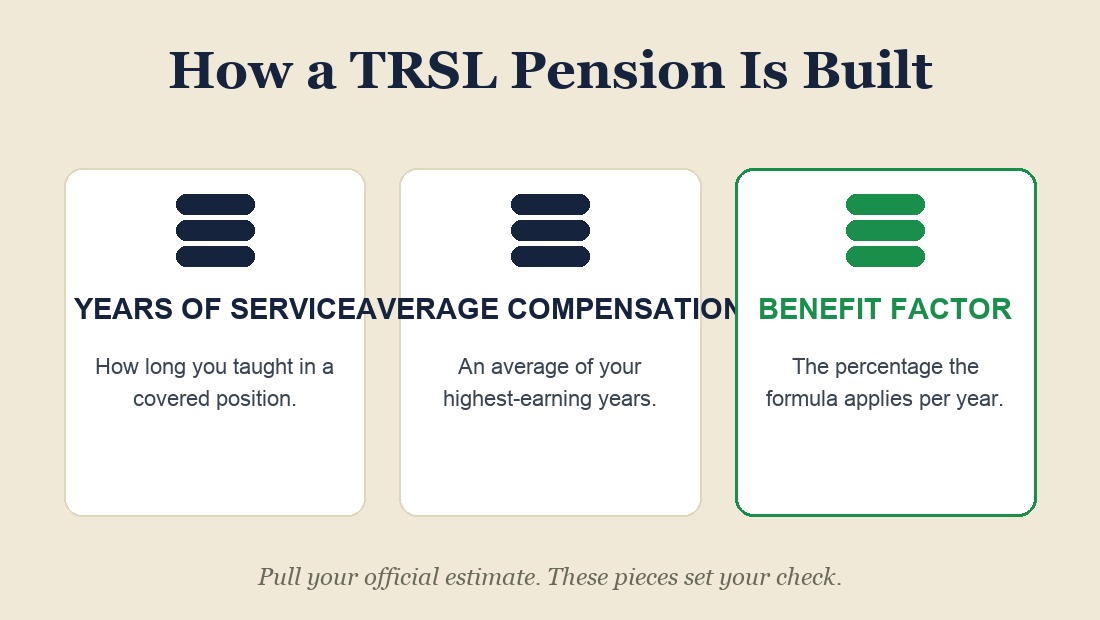
A TRSL benefit estimate can look intimidating, but the pension at its center is built from a straightforward idea. Your monthly benefit is generally the product of three pieces: your years of service, a final average compensation figure, and a benefit factor. Understanding what each piece means makes the whole document readable, and it tells you which numbers actually move your outcome.
Start with years of service. This is the credited time you have earned in the system, and it is the piece you have the most direct influence over, because working longer adds to it. Next is final average compensation. Rather than using a single year’s salary, the formula uses an average of your highest-earning years over a defined period. This smooths out any single unusual year and ties your benefit to the later, typically higher, stretch of your career. The exact averaging period and the rules around it are set by TRSL and can depend on when you entered the system, so this is a place to read carefully rather than assume. The third piece is the benefit factor, sometimes called an accrual rate. It is a percentage applied per year of service, and the specific factor that applies to you depends on your membership details and enrollment date.
Here is where honesty matters more than precision. The exact benefit factor, the exact averaging window, and the exact multipliers vary by member and by the plan provisions in effect for your enrollment. This publication will not hand you a number, because a wrong number is worse than no number. What you should do instead is pull your own official benefit estimate directly from TRSL. That estimate reflects your actual service credit, your actual salary history, and the provisions that apply to you specifically. When you read it, look for the three components above and confirm each one against your own record. If your credited years look short, ask about service you may be able to purchase or transfer. If your final average compensation looks off, check which years are being counted.
The reason to learn to read the estimate is control. Once you can see how the pieces combine, you can ask better questions before you retire, when there is still time to act, rather than after, when the number is fixed. Treat the estimate as the single most important document in your retirement planning, verify it with TRSL directly, and revisit it as your service and salary change over the years.
The tax surprise many TRSL retirees miss
Louisiana teachers get a genuinely favorable deal on one front: the state does not tax your TRSL pension. For a Louisiana resident who retires in Louisiana, that pension income arrives without a state income tax bite, which is a real advantage and worth appreciating. But it is exactly this good news that sets up the surprise, because many retirees hear “not taxed” and stop listening before the sentence finishes.
The federal government still taxes your TRSL pension as ordinary income. Your monthly benefit lands in your federal return, gets added to any other income you have, and is taxed at your federal rate. If Social Security is now part of your picture, a portion of that may be federally taxable too, depending on your total income. So the honest framing is not “your pension is tax-free,” it is “your pension is state-tax-free in Louisiana and federally taxable.” Those are very different statements, and planning around the wrong one leads to an underestimate of what you will actually keep.
The deeper gap is not the federal tax itself, it is the lack of tax diversification behind it. Consider a teacher whose entire retirement is the TRSL pension. Every dollar of retirement income comes from one source, taxed one way, with essentially no lever to pull. You cannot choose to take less from the pension in a high-income year to manage your bracket, because the pension pays what it pays. There is no tax-free bucket to draw from when a large expense would otherwise push you into more taxable income. The pension is dependable, which is its great strength, but dependability and flexibility are not the same thing, and a plan with only one income type has no flexibility at all.
This is the gap worth planning around, ideally years before you retire. The goal is not to distrust the pension. It is to build something alongside it that is taxed differently, so that in retirement you have more than one tap to open. Sources that are tax-free in retirement, or that you contribute to with after-tax dollars, sit in a different tax category than the pension and give you room to manage your federal income year by year. Nothing here is investment advice, and everyone’s situation differs. The practical step is to confirm exactly how your pension will be taxed at the federal level, look honestly at whether it is your only source, and if it is, start thinking early about how to add tax variety before the choices narrow.
Is my TRSL pension taxed?
Your TRSL pension is exempt from Louisiana state income tax but is fully taxable at the federal level.
Should I enter DROP?
DROP can be valuable, but it is a permanent decision with real tax consequences at the exit. Plan both the entry and the exit well in advance rather than deciding under a deadline. Review your specific numbers with a qualified professional.
Did the 2025 law change my pension?
No. The Social Security Fairness Act repealed the WEP and GPO, which affected Social Security benefits, not your TRSL pension. Your pension is unchanged; your Social Security calculation may improve.
How do I lower the federal tax on my retirement income?
The most effective approach is to build a tax-free income source before you retire, so you can control which accounts you draw from each year. The right tool depends on your income, age, and health.
Related reading on protecting your money in Louisiana: Is life insurance protected from lawsuits and creditors in Louisiana? and our complete guide to Louisiana life insurance creditor protection.