A Louisiana teacher with a pension and a little extra to save faces a question the 403(b) rep almost never frames correctly: should that money be taxed now or later? For a teacher specifically, the usual answer is often the wrong one.
If you teach in Louisiana and you have managed to save something beyond your TRSL pension, you have already done better than most. But the next decision, where that extra money goes, quietly determines how much of it you keep, and the person who signed you up for a 403(b) in the teachers’ lounge almost certainly never explained the choice. For a teacher, the math tilts in a direction the default option ignores.
Why a teacher’s situation is different
Start with what you already have coming: a TRSL pension, which is fully taxable at the federal level, and, thanks to the 2025 repeal of the WEP and GPO, likely more Social Security than you were told, which can also be taxed once your income is high enough. In other words, you are already scheduled to have a stack of taxable income in retirement.
That changes the calculation for every additional dollar you save. When you already have taxable income streams lined up, adding more taxable income on top is the last thing your future tax bill needs. What it needs is balance: a source that is not taxable, to sit alongside the pension and give you control.
The 403(b) most teachers are handed
The default savings vehicle offered to teachers is usually a traditional 403(b). It works like a traditional 401(k): you get a tax deduction now, and every dollar you withdraw in retirement is taxed as ordinary income. For a teacher, that means the extra money you saved lands in the same taxable bucket as your pension, stacking more taxable income onto a retirement that already has plenty.
A traditional 403(b) is not a bad account. The deduction has value while you are working. But for a teacher who will already have a taxable pension, defaulting the extra savings into another fully taxable account can be exactly the wrong direction, and it is the direction the default quietly points.
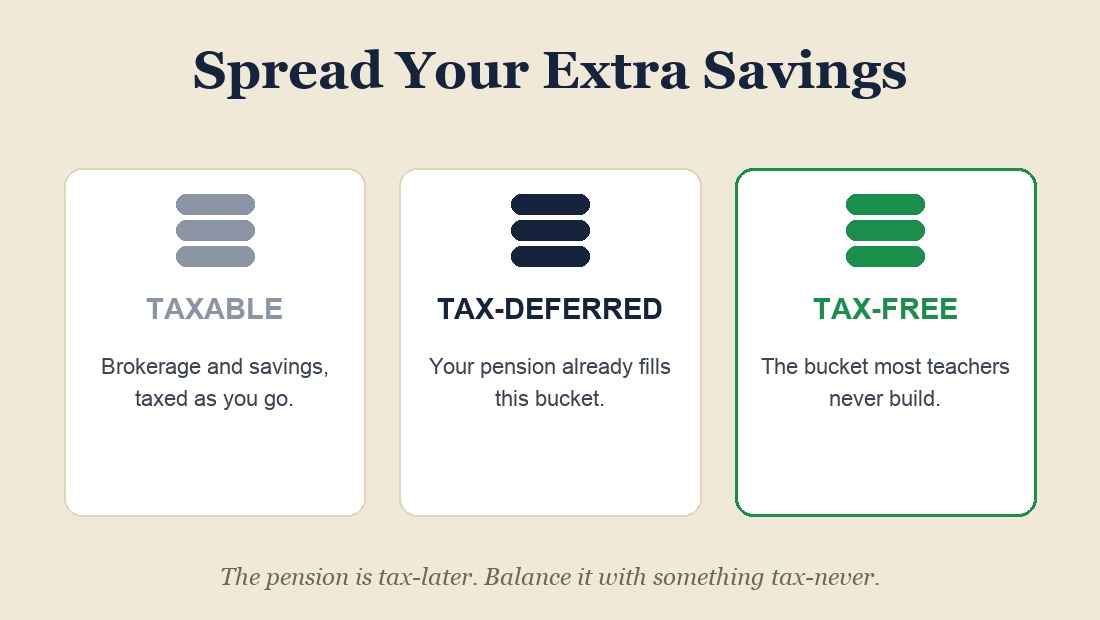
A teacher’s pension already fills the taxable bucket. Extra savings usually belong in the one that stays empty.
The case for tax-free instead
The alternative is to route extra savings into the tax-free bucket, where the money and its growth will not be taxed again. Many Louisiana school employers now offer a Roth 403(b) option alongside the traditional one, and a Roth IRA is available independently. Either one flips the tax treatment: you save with money you have already been taxed on, and in retirement it comes out tax-free, balancing the fully taxable pension.
For a teacher, that balance is the whole point. In retirement, you could draw your taxable pension up to a sensible level, then pull tax-free money on top without pushing yourself into a higher bracket or making more of your Social Security taxable. That control is worth far more than the modest deduction a traditional 403(b) offers today. The broader framework, including where a properly structured insurance policy can play the same role for higher earners, is in the Louisiana tax-free income guide.
How to decide
A reasonable order for most teachers with extra money to save:
- Capture any employer match first, in whatever account offers it. Free money beats tax strategy.
- Then favor the tax-free option, a Roth 403(b) or Roth IRA, for the reasons above.
- Reassess if you are in an unusually high-income year, where the traditional deduction is temporarily more valuable.
The single most important thing is to make the decision on purpose, rather than letting the lounge sign-up sheet decide for you. For a teacher, the default and the right answer are often not the same.
Balancing a taxable pension with tax-free income.
The free masterclass covers how teachers can build tax-free income alongside a TRSL pension, and the 60 second quiz afterward checks whether it fits your situation.
Watch the MasterclassWhy the 403(b) many teachers are handed can be the wrong bucket
Walk into many Louisiana school break rooms and you will find a familiar figure: the representative who signs teachers up for a 403(b). The 403(b) is the retirement savings plan built for public education employees, and having one is not the problem. The problem is what often gets sold inside it and what that choice does to the overall shape of your retirement. The classic teacher 403(b) is frequently a high-fee, tax-deferred product, and both of those words deserve a closer look.
Start with tax-deferred. A tax-deferred account lets you contribute money before tax and pay the tax later, when you withdraw in retirement. That can be sensible, but here is the catch for a TRSL member: your pension is already a tax-later source of income at the federal level. When you pile a tax-deferred 403(b) on top of a pension, you are stacking more money into the same bucket that will be taxed when you draw it. You are not diversifying your tax exposure, you are concentrating it. Come retirement, both streams land as taxable income in the same years, and you have no source that comes out tax-free to balance them.
Now the fees. Many of the annuity-based 403(b) products marketed to teachers carry costs that are high and not always obvious: expense ratios, administrative charges, and surrender penalties that lock your money in for years. Fees are corrosive precisely because they are quiet. A percentage skimmed every year, compounding against you over a career, can quietly erode a meaningful share of what you would otherwise keep. This is not a claim about any single product, and some 403(b) menus do include low-cost options. It is a caution to read what you were handed rather than assume the person who enrolled you optimized it for you.
The better question is not “should I save more,” it is “which bucket should the extra savings go into.” If your pension already fills the tax-later side of your retirement, then adding a tax-free source, such as a Roth, may diversify your position better than deepening the tax-deferred pile. A Roth is funded with after-tax dollars, and qualified withdrawals in retirement come out without federal income tax, which gives you a lever the pension and a traditional 403(b) cannot. None of this is a recommendation for your specific situation, and eligibility and limits apply. The honest move is to open your 403(b) paperwork, find the fees, notice that it is tax-deferred like your pension, and ask whether a different bucket would serve your retirement better before you send another dollar into the same one.
A teacher’s tax-diversification playbook
Tax diversification sounds like jargon, but the idea is simple and it is one of the most useful lenses a TRSL teacher can bring to extra savings. Think of your retirement money as living in three different tax buckets, and think of your job as deciding how full each one should be.
The first bucket is taxable. This is ordinary savings and brokerage money, funded with after-tax dollars, where you pay tax on the earnings along the way. It is the most flexible bucket, because there are no withdrawal rules tied to age and no penalties for using it when you need it. The second bucket is tax-deferred. This is your traditional 403(b) or similar account, funded before tax, taxed when you withdraw. The third bucket is tax-free, such as a Roth account, funded with after-tax dollars, where qualified withdrawals in retirement come out without federal income tax.
Here is the insight that changes the plan for a teacher specifically: your TRSL pension already fills the tax-later side. The pension behaves like a large, dependable stream of ordinary taxable income in retirement, much like the tax-deferred bucket does. So for many teachers, that side of the picture is already well covered without adding a dollar. If your only extra savings vehicle is a traditional 403(b), you are essentially reinforcing a wall that is already built, while leaving the other two buckets empty.
A balanced way to think about it, not a prescription, is to let the pension count as your tax-deferred foundation, then use your extra savings to fill the buckets the pension leaves thin. That often points toward building the tax-free bucket, so you have a source in retirement that does not add to your taxable income, and keeping some money in the taxable bucket for flexibility and access before retirement age. The payoff shows up in retirement, when having money in different tax buckets lets you choose where each year’s income comes from. In a high-income year you can lean on tax-free or taxable withdrawals to avoid pushing yourself into more federal tax. In a low-income year you can do the opposite.
The right mix depends on your income, your timeline, your other household resources, and rules and limits that apply to each account type, so treat this as a framework rather than advice for your situation. Confirm your pension details with TRSL, and if you want specifics for your own numbers, work them through with a qualified professional. The takeaway is the framework itself: three buckets, a pension that already fills one, and extra savings aimed at the ones that are empty.
Is a traditional 403(b) a bad choice for a teacher?
Not bad, but often not ideal. It adds fully taxable income on top of a taxable pension. For many teachers, a tax-free option balances the retirement better.
Should a teacher use a Roth?
Frequently, yes, after capturing any employer match. A Roth 403(b) or Roth IRA produces tax-free income that balances the taxable TRSL pension.
What about the tax deduction I get from the traditional 403(b)?
It has value while you are working, but for a teacher already facing a taxable pension, the long-term benefit of tax-free income often outweighs the upfront deduction.
Does the 2025 Social Security change affect this decision?
It can. With more Social Security now payable to many teachers, there is even more taxable income scheduled for retirement, which strengthens the case for saving extra money in the tax-free bucket.