
Property taxes can climb every year even when your income does not. Louisiana offers two protections many retirees never claim: the homestead exemption and a senior assessment freeze that can lock your taxes in place for life.
Property taxes are one of the few costs that can rise every year in retirement even when your income does not, and for a retiree on a fixed income, that steady climb is a real threat to staying in the home. Louisiana offers two protections that many residents never claim: the homestead exemption, which every homeowner should have, and a senior assessment freeze that can lock your taxes in place for the rest of your life. Both require you to apply. Neither is automatic beyond the basics, and money is left on the table every year by people who simply did not know.
What is the homestead exemption?
The homestead exemption removes a portion of your primary residence’s value from the parish property tax calculation. It applies to the home you own and actually live in as your main residence, one per household. For most Louisiana homeowners it meaningfully lowers the annual bill, and it is the baseline every homeowner should make sure is in place with their parish assessor. If you bought your home and never confirmed the exemption was applied, that is worth a phone call today.
The senior assessment freeze
This is the one retirees most often miss. Louisiana’s Special Assessment Level, widely called the senior freeze, lets qualifying homeowners lock in the assessed value of their primary residence. Once frozen, that assessed value does not rise even as the home’s market value climbs, which means your property taxes stop growing with the market. In a rising-value neighborhood, over a long retirement, that can be worth a great deal.
A frozen assessment can hold your property taxes steady for the rest of your life, while a neighbor’s bill climbs every year.
Who qualifies for the freeze?
The freeze is generally available to homeowners who are 65 or older, who own and occupy the home as their primary residence, and whose adjusted gross income is below an annual threshold that the state updates each year. Certain disabled homeowners and disabled veterans may qualify under related provisions, and qualifying disabled veterans can receive additional relief that substantially reduces or eliminates the property tax on a primary residence.
The key requirements, age, residence, and income, are checked when you apply, and in some cases you may need to reapply or verify income periodically. Because the income threshold changes and parishes handle the paperwork, the reliable move is to contact your parish assessor directly and ask specifically about the Special Assessment Level.
How to claim it
Both benefits run through your parish assessor’s office, not the state, and both require action from you:
- Confirm your homestead exemption is applied to your primary residence. If you have moved or refinanced, verify it carried over.
- Apply for the senior freeze the year you become eligible. It is not automatic, and every year you wait is a year the assessment could have been locked lower.
- Bring proof of age, residence, and income as your assessor requires, and ask whether you must reapply.
This is one of the simplest, highest-return moves a Louisiana retiree can make, and it costs nothing but a form. Reducing a recurring, rising expense is every bit as valuable as earning more income, and the freeze does exactly that for as long as you own the home.
See what a tax-free retirement plan looks like for your situation.
The free masterclass walks through the structure honestly, and the 60 second quiz afterward checks whether it fits. If it does not, you will hear that.
Watch the MasterclassTwo different breaks that people confuse
A lot of Louisiana homeowners talk about the homestead exemption and the senior freeze as if they were the same thing. They are not, and treating them as one break is how people end up disappointed or caught off guard. They are two separate protections, they do two different jobs, and you can qualify for one without the other. Understanding the distinction is the first step to using both correctly.
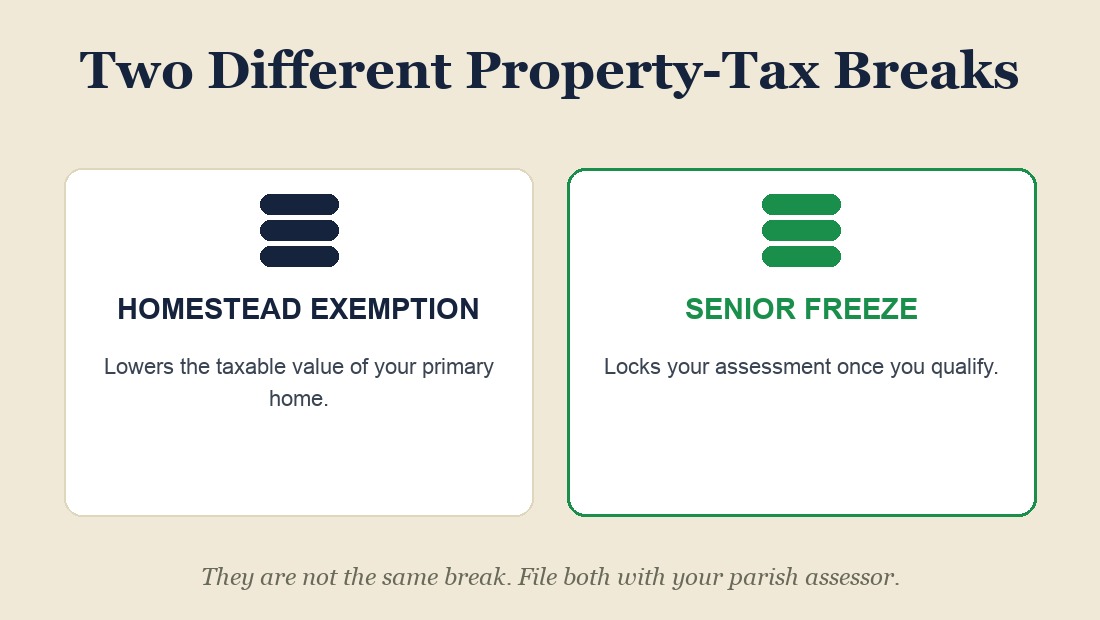
The homestead exemption reduces the taxable value of your primary home. In plain terms, a portion of your home’s assessed value is set aside and not counted when your parish figures the taxes you owe. It applies to the home you actually live in as your main residence, not a camp, a rental, or a second property. Most Louisiana homeowners who live in their own home are eligible for it, and it is the more familiar of the two breaks. It lowers what you are taxed on, but it does not stop your assessment from changing over time.
The special assessment level, which people often call the senior freeze, does something different. Once you qualify, it locks in the assessed value of your home so that later increases in that assessment do not raise your taxable value the way they otherwise would. The idea is to protect longtime homeowners, especially those on fixed incomes, from being taxed out of a home simply because values in the neighborhood climbed. It is a freeze on the assessment, not a freeze on your actual tax bill, and that is an important difference. Millage rates and other factors can still move.
Here is the part that matters for eligibility. The special assessment level generally has both an age component and an income component. You typically need to reach a qualifying age, and your income generally needs to fall at or below a set limit. Those thresholds are adjusted over time, so the number you heard a few years ago may not be the number that applies today. Do not assume you do or do not qualify based on old information.
The clean way to think about it: the homestead exemption shrinks what you are taxed on, and the special assessment level holds your assessment steady once you meet the age and income tests. Many seniors benefit from both at the same time. Before you count on either one, confirm the current eligibility rules and thresholds with your parish assessor, because the specifics are exactly what decide whether these breaks apply to your situation.
How to actually claim them, and the mistakes that cost people
Knowing these breaks exist is not the same as having them applied to your home. In Louisiana, both the homestead exemption and the special assessment level are handled through your parish assessor, and you generally have to file for them. The most common and costly mistake is simply assuming the break happens automatically. For many homeowners it does not, and a year of taxes paid without an exemption you were entitled to is money you usually cannot get back.
The starting point is your parish assessor’s office. That is where you file, and it is where your questions get answered with rules that actually apply to your parish. When you go in, be ready to show that the property is your primary residence. Assessors want to confirm you live there, so expect to provide documentation that ties you to the home as your main residence. The exemption is meant for the place you live, so anything that blurs that connection can create a problem.
That leads to the second common mistake: letting the exemption drift away from your primary residence. If you move, if you change how the property is owned, or if the home stops being your main residence, your eligibility can change. People sometimes keep an exemption on a house they no longer live in, or fail to move it to a new home after they relocate. Both create headaches later. Keep the exemption tied to the home you actually live in, and update the assessor when your situation changes.
For the special assessment level, remember the age and income tests, and know that some breaks require you to re-certify. Do not assume that qualifying once means you are set for life without ever checking back. If your parish asks you to re-certify or to confirm your continued eligibility, missing that step can cost you the protection. Put any renewal or re-certification on your calendar the same way you would a tax deadline.
None of this is complicated, but it does reward attention. Keep your records tidy, file on time, and treat your parish assessor as the authority on what your parish requires. If you are unsure whether you have claimed everything you are entitled to, a short call or visit to the assessor’s office is worth it. The rules and thresholds change, so confirm the current requirements rather than relying on what a neighbor told you or what was true a few years ago.
What is the Louisiana homestead exemption?
The homestead exemption exempts a portion of your primary residence’s value from parish property taxes. It applies to the home you own and occupy as your main residence. The exemption covers a set amount of the home’s value, reducing your property tax bill.
Can Louisiana seniors freeze their property taxes?
Yes. Louisiana offers a Special Assessment Level, often called the senior freeze, that locks in the assessed value of a primary residence for qualifying homeowners age 65 or older whose income is below an annual threshold. Once frozen, the assessed value does not rise even if the home’s market value does.
What is the income limit for the Louisiana senior property tax freeze?
There is an adjusted gross income limit that changes each year. Homeowners 65 and older who own and occupy their home and whose income is under the limit can apply through their parish assessor. Confirm the current figure with your assessor.
Do disabled veterans get a property tax break in Louisiana?
Louisiana provides additional property tax relief for qualifying disabled veterans, which can substantially reduce or eliminate the property tax on a primary residence. Eligibility and amounts depend on disability rating and are handled through the parish assessor.