Louisiana is the only state in the country that still enforces forced heirship, a civil-law rule that guarantees certain heirs a share of your estate no matter what your will says. Here is how it works, and the tool that lets you plan around it.
Louisiana does estate planning differently from every other state in the country, and most people do not find out until it is too late to plan around it. We are the only state that kept forced heirship, a rule from our French and Spanish civil-law roots that guarantees certain heirs a share of your estate whether your will says so or not. For a retiree deciding where their money should go, understanding this is not optional. It changes what a will can and cannot do, and it makes one common financial tool unusually powerful here.
What is forced heirship, and why only Louisiana?
Every other state lets you leave your property to whomever you choose. Louisiana, alone, still enforces forced heirship, a civil-law principle inherited from the Napoleonic Code. It guarantees that a class of heirs, called forced heirs, receives a minimum portion of your estate, called the legitime, no matter what your will says. You can direct the rest, the disposable portion, freely, but the forced portion is protected by law.
Who is a forced heir?
The category is narrower than it once was. A forced heir is generally a child who is 23 or younger at the parent’s death, or a child of any age who is permanently incapable of caring for themselves because of a mental or physical condition. In some cases, grandchildren step into the role if their parent has already died. If you have a young child, or a child with a lasting disability, forced heirship almost certainly applies to your estate, and planning around it becomes essential.
In Louisiana, a will alone cannot fully control where your estate goes. The law reserves a share for forced heirs.
How life insurance fits Louisiana estate planning
Here is where a financial tool becomes a legal one. Life insurance proceeds paid to a named beneficiary generally pass outside the succession. They are not part of the estate that forced heirship divides, which means life insurance lets you direct a specific sum to a specific person, cleanly, regardless of the forced-portion rules. For a Louisiana family with a blended household, a business to pass on, or a wish to provide for someone the forced-heirship rules would not, this is one of the most useful planning tools available, and it is one reason a permanent policy carries extra weight here, alongside the creditor protection Louisiana law provides. The honest picture of that structure is in our IUL guide.
Usufruct and your surviving spouse
Another Louisiana concept worth knowing is usufruct: the right to use property and receive its income for a period, while ownership eventually passes to someone else. A common arrangement gives a surviving spouse usufruct over the deceased spouse’s share, letting them live in the home and use the assets for life, with the property ultimately going to the children. Usufruct is a powerful, uniquely Louisiana tool, and it interacts with forced heirship in ways that reward careful planning and punish the do-nothing approach.
What to do about it
The single most important step is to plan with a Louisiana estate attorney, because these are legal instruments, not financial products, and the details decide everything. But from the financial side, know this: how you title accounts and name beneficiaries determines what passes through the succession and what bypasses it. Life insurance and properly structured accounts can move money to chosen people outside the forced-heirship system, which is exactly why they belong in the conversation. Do not assume a will handles it. In Louisiana, it often cannot on its own.
See what a tax-free retirement plan looks like for your situation.
The free masterclass walks through the structure honestly, and the 60 second quiz afterward checks whether it fits. If it does not, you will hear that.
Watch the MasterclassHow retirement accounts and life insurance usually pass outside the will
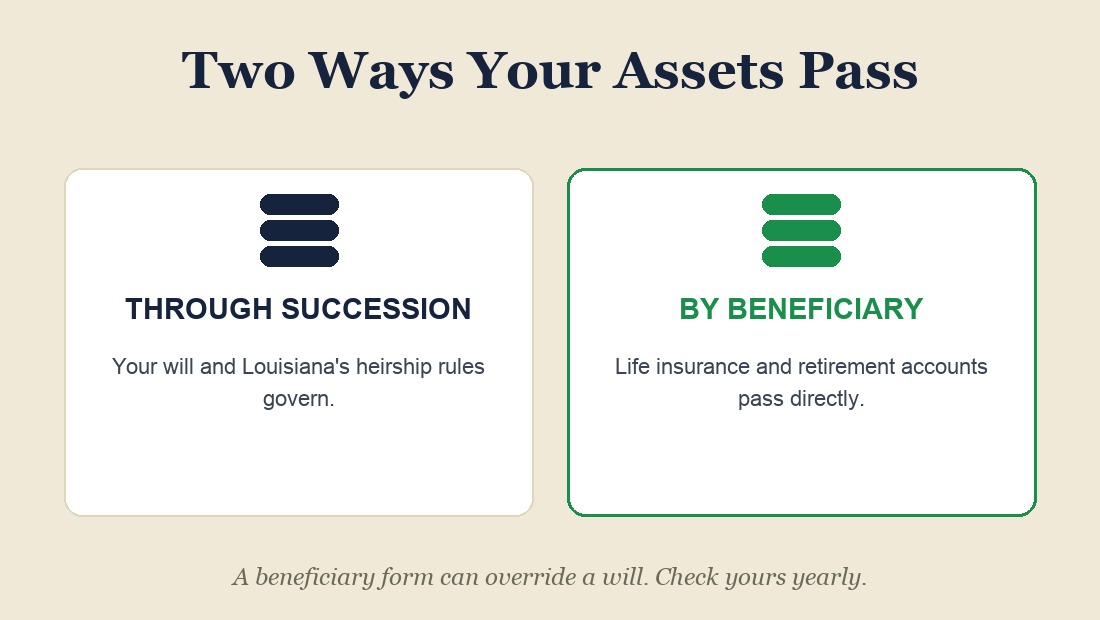
Most people picture their estate moving through a single document: the will. You write down who gets what, and someday it all flows according to those instructions. That picture is incomplete, and in Louisiana the gap between the picture and reality can matter a great deal. A large share of what many families own, particularly retirement accounts and life insurance, usually does not pass through the will at all. It passes by beneficiary designation.
Here is the general idea. When you open a retirement account or a life insurance policy, you name a beneficiary. At death, those assets typically transfer directly to the person named, outside the succession process that governs the rest of your estate. The will, in most cases, does not control them. This is often convenient, because it can move funds to a loved one relatively directly. It also means that a document you may have signed years ago, and perhaps forgotten, can quietly direct significant assets regardless of what your will says.
Now layer in Louisiana’s distinct legal tradition. Louisiana is a civil-law state, and it retains forced-heirship rules that have no real equivalent in most other states. In broad terms, these rules can reserve a portion of a person’s estate for certain heirs, such as children who are under a specified age or who have certain conditions. How assets that pass outside the will, like retirement accounts and life insurance, interact with these forced-heirship rules is a genuinely intricate question, and it is one where general intuition from other states is often simply wrong.
This is precisely the point where a general article has to stop short, and honesty requires saying so plainly. Whether and how a particular beneficiary designation interacts with forced-heirship protections in a specific family depends on facts, on relationships, on the type of asset, and on current Louisiana law. This is not a place for guesswork, borrowed advice from a friend in another state, or assumptions based on what seems fair. The rules are specific, and the stakes are your family’s security.
So take away the concept, not a conclusion. The concept is that much of your wealth may move by beneficiary designation rather than through your will, and that in Louisiana this interacts with forced-heirship rules in ways worth understanding early. The conclusion, the part about how it all applies to your actual family, belongs to a qualified Louisiana estate attorney. Bringing them a clear list of your accounts, policies, and current beneficiaries gives them what they need to spot problems you would never see coming on your own.
Why your beneficiary designations deserve a yearly look
If the previous section landed, this one is the practical follow-through. Since retirement accounts and life insurance usually pass by beneficiary designation rather than through your will, those designations quietly carry enormous weight. And unlike a will, which people at least think about occasionally, beneficiary forms tend to be signed once and never looked at again. That gap between their importance and the attention they get is where real problems are born.
Consider how life actually unfolds. People marry. People divorce. Children and grandchildren are born. Parents, siblings, and sometimes spouses pass away. Each of these events can make an old beneficiary designation not just outdated but actively wrong. The most painful examples are common: an ex-spouse still named on a policy years after a divorce, a deceased relative listed as the sole beneficiary, a new child never added, an intended heir accidentally left off entirely. Because these designations generally override your will, the form wins even when everyone knows it no longer reflects your wishes.
That last point deserves emphasis, because it surprises people every time. You can write a perfectly clear, recently updated will leaving everything to your current family, and it will not fix a stale beneficiary form on a retirement account or life insurance policy. The designation typically controls that particular asset. The will and the beneficiary form are two separate systems, and if they disagree, the beneficiary form usually governs the asset it names. Updating one does nothing for the other.
The remedy is refreshingly simple, which is part of why it is worth doing. Once a year, and always after any major life event, pull out your retirement accounts and life insurance policies and read who is actually named on each one. Confirm the primary beneficiaries are correct, and check that you have named contingent beneficiaries in case a primary one has died. Make sure the names match the life you are living now, not the life you were living when you first signed. It is a short task that prevents some of the most heartbreaking and avoidable estate outcomes.
One caution to close on, given where you live. In Louisiana, updating a beneficiary designation is not always as simple as writing in a new name, because forced-heirship rules and other state-specific considerations can shape what is appropriate for your family. So do the yearly review yourself, but treat anything that looks complicated as a signal to call a qualified Louisiana estate attorney rather than a puzzle to solve alone. The review is your job. The judgment calls belong with a professional who knows this state’s rules.
What is forced heirship in Louisiana?
Forced heirship is a Louisiana civil-law rule, rooted in the Napoleonic Code, that guarantees certain heirs, called forced heirs, a minimum share of a person’s estate. Louisiana is the only U.S. state with this rule.
Who is a forced heir in Louisiana?
A forced heir is generally a child who is 23 or younger when the parent dies, or a child of any age who is permanently unable to care for themselves due to a mental or physical condition. Grandchildren can qualify in certain cases where their parent has died.
Does life insurance avoid forced heirship in Louisiana?
Generally yes. Life insurance proceeds paid to a named beneficiary usually pass outside the succession and are not treated as part of the estate subject to forced heirship. This makes life insurance a common tool for directing money to chosen people. Confirm your specifics with a Louisiana attorney.
What is usufruct in Louisiana?
Usufruct is a Louisiana civil-law right to use property and receive its income for a time, often granted to a surviving spouse over the deceased spouse’s share, with the property itself eventually passing to the heirs. It is a key tool in Louisiana estate planning.