The largest banks in America hold tens of billions of dollars inside life insurance policies. It is not a loophole and it is not a secret. It is on their public filings, and it says something worth understanding about where careful money goes.
Here is a fact that stops most people the first time they hear it. Bank of America, Wells Fargo, and JPMorgan Chase each hold billions of dollars of life insurance as an asset on their own balance sheets. Not insurance they sell. Insurance they own. The category has a name, bank-owned life insurance, or BOLI, and once you understand why the most conservative institutions in the country park money there, you understand the principle behind a whole class of retirement strategy.
What bank-owned life insurance is
A bank buys permanent life insurance policies, typically on a group of its executives and key employees, with the bank as the owner and beneficiary. The bank pays the premiums. The cash value grows inside the policies, and when a covered person dies, the bank receives the death benefit. To the bank, it is not really about the insurance. It is about the way the money inside those policies grows and is taxed.
The reason this works for a bank is the same reason it can work for an individual: the cash value inside a permanent life insurance policy grows tax-deferred, and the death benefit is received income-tax-free. A bank looking for a stable, tax-efficient place to hold money it needs to offset the cost of employee benefits found one of the most tax-advantaged structures in the tax code, and used it at scale.
Why banks hold billions of it
Banks are not sentimental. They hold BOLI for cold reasons: the tax-deferred growth is more efficient than most alternatives available for that portion of their assets, the returns are stable rather than volatile, and the structure helps them fund the long-term benefit promises they have made to employees. Regulators permit it within limits, and banks report it openly on the call reports they are required to file.
The takeaway is not that you should copy a bank. Your situation is nothing like a bank balance sheet. The takeaway is what it reveals about the structure itself: when institutions with entire departments of accountants and lawyers look for a tax-efficient, stable place to hold money for the long term, a meaningful number of them choose the same tax treatment that sits at the center of certain personal retirement strategies.
The numbers, from public filings
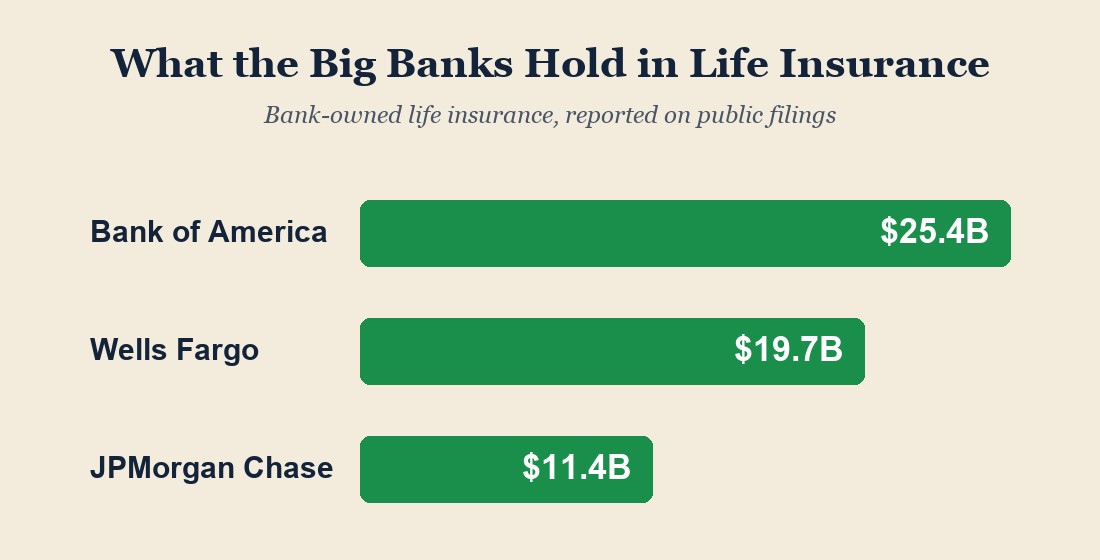
These are not marketing figures. Bank holdings of BOLI are reported in regulatory filings and run into the billions at the largest institutions, with Bank of America, Wells Fargo, and JPMorgan Chase among the biggest holders. The exact totals move each reporting period, but the scale does not: this is a real, multi-billion-dollar asset class hiding in plain sight on the balance sheets of the most-watched companies in America.
The most scrutinized institutions in the country quietly hold billions in the same tax structure most families have never had explained to them.
What it does and does not mean for you
Honesty matters here, because this is exactly the kind of fact that gets oversold. BOLI is an institutional product, structured for a bank, and it is not the same thing as a policy you would own. A bank buys it at scale, on other people’s lives, for corporate reasons. You cannot simply buy BOLI.
What carries over is the principle, not the product. The tax treatment banks are using, tax-deferred growth and a tax-free benefit, is the same treatment available inside a properly structured personal policy. Whether that structure is right for you depends entirely on your income, your health, your age, and whether you can fund it consistently, and for most of those questions the honest answer is covered in our guide to indexed universal life in Louisiana, including the cases where it is the wrong tool. The banks prove the structure is sound. They do not prove it is right for everyone.
See the structure the banks use, explained start to finish.
The free masterclass walks through how this tax treatment works and how the same principle applies to a personal plan. The 60 second quiz afterward checks whether it fits your situation.
Watch the MasterclassWhy the banks don’t save the way you do
There is a quiet pattern worth noticing about how banks make money off the rest of us. If you borrow from the bank, you pay it interest for years. If you save at the bank, you hand it your money for almost nothing and it lends that money out at a profit. Borrower or saver, the bank keeps the spread in the middle. That is not a criticism. It is the business, and it works because most people only ever play one of those two roles.
So the interesting question is not how the bank treats your money. It is where the bank puts its own. And a surprising amount of it does not sit in the checking and savings products they sell to you. It sits in cash value life insurance, held on their books under the name bank-owned life insurance, precisely because that structure grows steadily, shelters gains from tax, and does not lose value when markets fall. The institution that understands money better than anyone parks billions of its safest dollars in the exact tax structure it never markets to its depositors.
Be honest about the limits of the comparison. Institutional bank-owned life insurance is not identical to a policy an individual buys, the scale and terms differ, and no one should pretend otherwise. But the underlying tax principle is the same one, and that is the part worth sitting with. When the people who profit from your saving habits choose something different for their own reserves, it is at least worth asking why they never mentioned it.
What it means for a regular saver
So the banks hold billions in cash value life insurance. The fair question is what a person who is not a bank is supposed to do with that fact, and the honest answer sits between two exaggerations you will hear online.
The first exaggeration is that you can simply buy what the banks buy. You cannot. Institutional bank-owned life insurance is a specialized product, negotiated at enormous scale on the lives of executives, with terms no individual has access to. Anyone implying you can purchase the bank’s exact policy is overselling it. The second exaggeration runs the other way, from critics who wave the whole thing off as a gimmick. That is not right either, because it ignores the part that actually transfers.
What transfers is the tax code, not the scale. The favorable treatment of cash value life insurance comes from a section of the tax law, often referenced as 7702, and that same section is available inside a properly structured policy an individual can own. The growth that is sheltered from tax, the access through loans rather than taxable withdrawals, the death benefit that passes income-tax-free, the floor that avoids market losses, these are features of the structure, and the structure is available to a Louisiana family, not just to JPMorgan. The bank operates it at a scale you never will. You operate it at the scale of your own retirement, on the same tax foundation.
Which makes the takeaway modest and worth keeping. Bank-owned life insurance is not a secret you can copy dollar for dollar, and it is not proof of anything by itself. It is a signal. When the institutions that understand money best choose this tax structure for a meaningful share of their own safest reserves, it is at least worth asking whether a smaller, honestly built version of the same idea belongs somewhere in your plan, alongside, not instead of, the accounts you already have.
Is bank-owned life insurance real?
Yes. It is a recognized asset class reported on banks’ regulatory filings, and the largest U.S. banks hold billions of dollars of it.
Can I buy BOLI myself?
No. BOLI is an institutional product a bank owns on its employees. What you can access is a personal life insurance policy that uses the same underlying tax treatment, if it fits your situation.
Why do banks use life insurance instead of ordinary investments?
For the tax-deferred growth, the stability, and the tax-free death benefit, which together make it an efficient place to hold money set aside to fund long-term employee benefit obligations.
Does this mean life insurance is a good investment for me?
Not automatically. The bank example proves the tax structure is sound; whether a personal policy is right for you depends on your income, age, health, and funding consistency. See our honest IUL guide for who it fits and who it does not.