The 401(k) is a good savings account and a poor retirement plan, and almost nobody is told the difference until they retire. This is the honest accounting of what your 401(k) and IRA actually do, the silent partner they come with, and the piece they were never built to provide.
The 401(k) did something genuinely useful. It got a generation of Americans to save automatically, out of every paycheck, without thinking about it. If you have a balance in one, that is real money and it matters. But somewhere along the way, a savings account got mistaken for a retirement plan, and the difference between those two things is where a lot of retirements quietly go wrong. Your 401(k) is very good at accumulating money. It is not built to turn that money into reliable, tax-efficient income, and income is the entire point of retirement.
A savings tool, not an income tool
Everything about a 401(k) or traditional IRA is designed for the accumulation phase: automatic contributions, tax deferral, employer matching, decades of compounding. That machinery is excellent. But the day you retire, the job changes completely. Now you need to convert a pile of money into a paycheck that lasts as long as you do, survives bad markets, and does not hand an unpredictable share to the IRS. The 401(k) offers almost no help with any of that. It was never asked to.
This is why so many people arrive at retirement with a solid balance and no actual plan. They have been told to hit a number. Nobody told them the number is not the goal. The income the number produces is the goal, and that depends far more on structure and taxes than on the size of the pile.
The silent partner in your account
Here is the part the account statement never spells out. When you contributed to a traditional 401(k) or IRA, you got a tax deduction. In exchange, you agreed to pay income tax on every dollar you eventually withdraw, at whatever rate exists in that future year. You have a business partner in that account. He put in nothing, he takes none of the risk, and he decides his own share, later.
A one million dollar 401(k) is not a one million dollar retirement. It is a one million dollar balance with a tax bill attached, and you do not yet know the rate.
With the national debt where it is, betting that tax rates in twenty years will be lower than today is a real wager, and it is the wager every fully tax-deferred retirement quietly makes. That does not make the 401(k) a mistake. The match is free money and the deferral has value. It makes it a bucket that needs balancing, not the whole plan.
The withdrawals you do not control
Tax-deferred accounts come with required minimum distributions. Starting at a set age, the government forces you to withdraw a minimum amount each year, whether you need it or not, and to pay tax on it. For a retiree with a large balance, RMDs can push income into higher brackets and make more of their Social Security taxable, at exactly the age when many people want their income to be simple and low-stress. The account you built for freedom starts making decisions for you.
Why the market’s timing can wreck you
There is one more risk unique to drawing income from a market-based account, and it has a name: sequence-of-returns risk. If the market falls badly in the first few years of your retirement, while you are withdrawing income, you are selling assets at low prices to fund your living, and the account may never recover. Two retirees with identical average returns can end up in completely different places purely because of the order those returns arrived. The retiree who hit a crash early can run out. The 401(k) offers no protection against this. It is fully exposed to it.
The missing piece
None of this is an argument to abandon your 401(k). Take the match. Keep the balance. The argument is that a retirement built entirely inside the tax-deferred, market-exposed bucket is missing two things it badly needs: a source of income that is not taxable, so you can control your own tax bill, and a source that is protected from market crashes, so a bad year at the wrong time cannot sink you.
That is the role of the tax-free bucket, and most people have almost nothing in it. Filling it, through a Roth, or for the right person a properly structured life insurance policy, is what turns a pile of savings into a retirement you actually control. We lay out the full framework, including which tool fits whom, in the Louisiana tax-free income guide.
Your 401(k) built the pile. This is about the income.
The free masterclass covers how to build tax-free, market-protected income alongside your 401(k), and the 60 second quiz afterward checks whether it fits your situation.
Watch the MasterclassBuilt for employees, not for owners
The 401(k) was designed for one kind of person: a lifelong employee who stays put, contributes for forty years, and does not touch the money until the government says it is time. If that is your life, it can work. The trouble is that almost nobody actually lives that way anymore, and the plan does not bend when your life does.
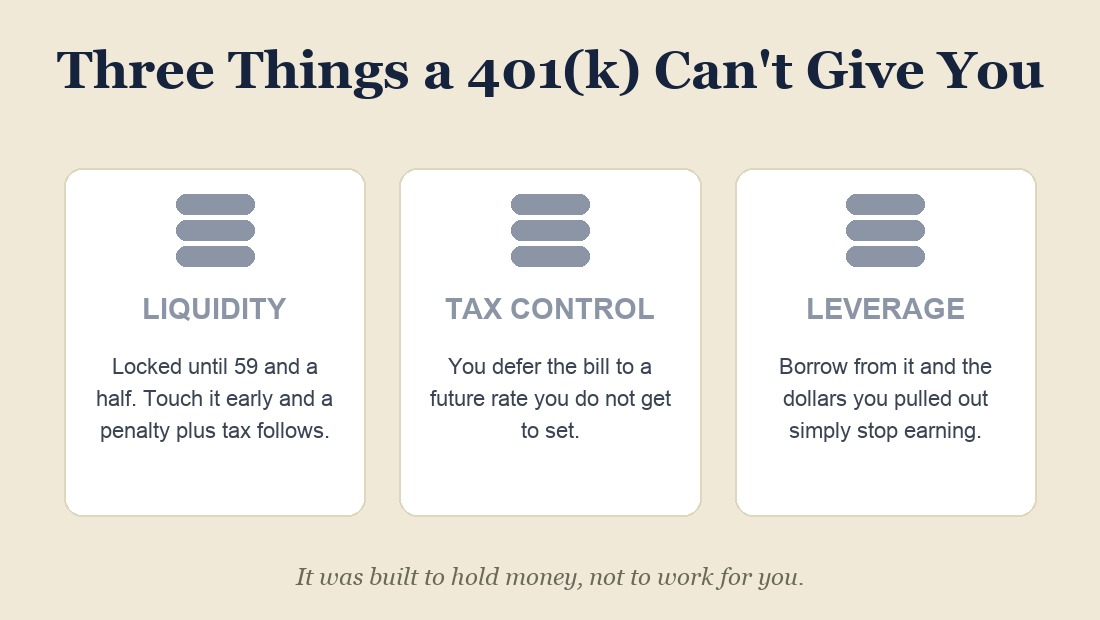
Look at it the way a business owner would, and three gaps show up fast. There is no liquidity: your money is locked until age fifty-nine and a half, and reaching it early means a penalty stacked on top of the tax. There is no tax control: you deferred the bill to a future rate that a future Congress will set, not you. And there is no leverage: borrow from a 401(k) and the dollars you pulled out simply stop earning, then you repay the loan with already-taxed money that gets taxed again on the way out.
There is also the part almost no one reads until it is too late. The employer match you were promised is not fully yours until you are vested, and leave before then and they take their portion back. A plan that punishes you for changing jobs is a plan built for the company’s retention, not your retirement. None of this makes the 401(k) worthless. It makes it a savings tool with a narrow set of rules, and the moment you think like an owner of your own money instead of a participant in someone else’s plan, you start asking whether all of your retirement should sit inside it.
What to do about it, without overreacting
None of this is an argument to empty your 401(k) tomorrow, and anyone who tells you to should lose your trust on the spot. The account has real strengths, and the point is not to abandon it but to stop treating it as the entire retirement plan when it was only ever built to be one piece.
Start with the free money. If your employer matches contributions, capture the full match before you do anything else, because that is an immediate, guaranteed return you will not find elsewhere, and walking away from it is its own mistake. Fund to the match, and let that part of the 401(k) do exactly what it is good at.
Past the match, the question changes from how much to where. Almost everyone’s retirement savings sit entirely in the tax-deferred bucket, which means almost everyone is making the same bet: that tax rates decades from now will be kind to them. Balancing that with even one other bucket, a Roth, or the kind of structured cash value plan this site covers, gives you sources of retirement income that a future tax rate cannot reach, and hands you liquidity and control the 401(k) simply does not offer. You are not betting against the account. You are refusing to put your entire future inside a single set of rules that someone else writes.
For a Louisiana family, the practical version is simple. Take the match. Then, with the next dollars, ask an honest question: does it make more sense to keep piling into an account you cannot touch until fifty-nine and a half and will be taxed on later, or to start building a second engine you control? There is no universal answer, because it depends on your income, your timeline, and your goals. But asking the question at all already puts you ahead of the version of you that just clicked the default box on the benefits form and never looked again.
Should I stop contributing to my 401(k)?
Usually not, especially up to any employer match, which is free money. The point is not to abandon the 401(k) but to balance it with a tax-free source so all your retirement money is not in one taxable bucket.
What is the silent partner?
The IRS. Traditional 401(k) and IRA withdrawals are taxed as ordinary income at whatever rate applies in the year you take them, a rate no one can promise today.
What are required minimum distributions?
Forced annual withdrawals from tax-deferred accounts beginning at a set age, taxed as income. They can push you into higher brackets and increase the tax on your Social Security whether you need the money or not.
What is sequence-of-returns risk?
The danger that a market drop early in retirement, while you are withdrawing income, permanently damages your savings. Two retirees with the same average return can end very differently based on the order of returns.