One of the quiet advantages of life insurance is that the money usually skips the slow, public process of settling an estate. In Louisiana that process is called a succession, and for most families the death benefit never touches it. There is one common mistake that drags the money straight into it.
Short answer: usually no, life insurance does not go through probate in Louisiana. When the policy is paid to a named living beneficiary, the proceeds pass directly from the insurer to that person. They do not become an asset of the succession, and under Louisiana R.S. 22:912 they are generally shielded from the insured’s creditors. The money goes through the succession only in one situation, and it is a situation you control: when the estate itself is the payee. Below is the plain explanation, the single mistake that undoes it, and the forced-heir wrinkle unique to Louisiana.
This is general education, not legal advice. How these rules apply turns on your beneficiary designation, your ownership, and the facts of your family, and the forced-heirship piece in particular is fact-specific. Confirm any estate decision with a licensed Louisiana attorney before you act. With that said, here is the framework.
A named beneficiary is paid directly
When you buy a life insurance policy you name a beneficiary, the person or people who receive the death benefit. In Louisiana, when that named beneficiary is a living person, the proceeds pass to them directly from the insurer. Under Louisiana R.S. 22:912, the beneficiary is entitled to the proceeds and avails of the policy as against the creditors and the heirs of the insured, “saving the rights of forced heirs.” In plain terms, the money does not become an asset of the succession waiting to be administered, and it is generally not reachable by the insured’s creditors.
Practically, that means the beneficiary files a claim, provides a death certificate, and the insurer pays, often in a matter of weeks. The rest of the estate may take many months to work through the succession. The death benefit lands with the people you chose, quickly, privately, and shielded, instead of sitting in a court process where creditors can line up. That is the design working the way it is supposed to, and for most Louisiana families it happens automatically because they named a spouse or their children on the application and never thought about it again.
The one mistake: naming your estate
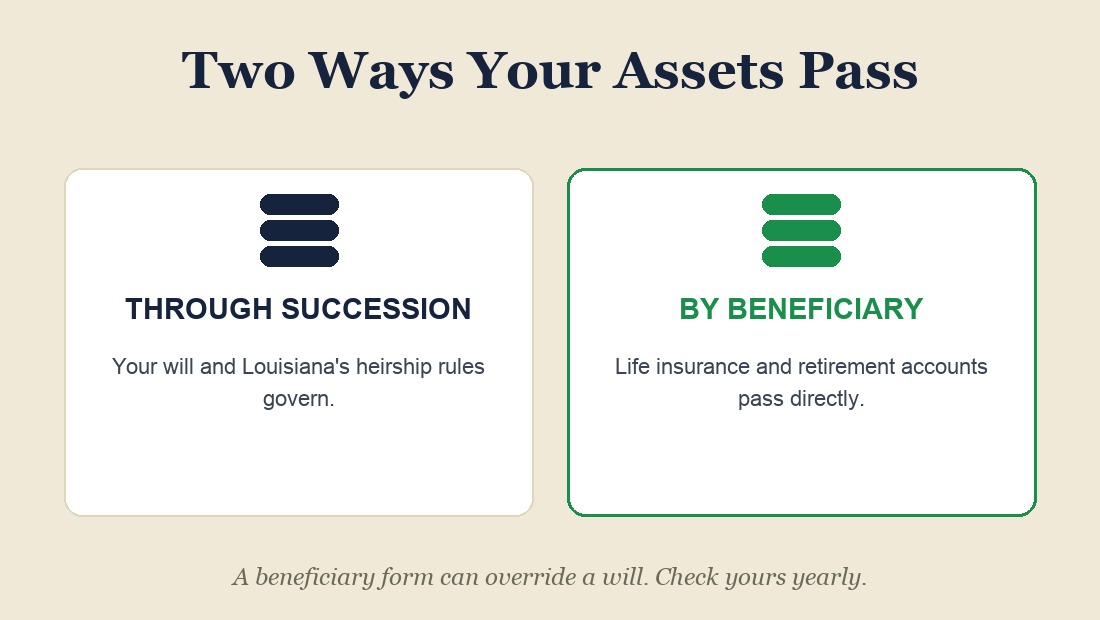
Here is what undoes all of it. If you name your estate, or your succession, as the beneficiary, or if you simply never name a valid living beneficiary and the proceeds default to the estate, the money is treated as property of the estate. Once it is estate property, it is administered in the succession like any other asset. It slows down, it becomes part of the public record, and it is reachable by the estate’s creditors, the exact exposure a named beneficiary was avoiding.
This is not a rare trap. It happens when someone leaves the beneficiary line blank, when the named beneficiary has already died and no contingent was listed, or when an old designation was never updated after a divorce or a death in the family. The single most important thing you can do to keep life insurance out of probate in Louisiana is make sure a valid, living beneficiary is named, and that the designation stays current through marriages, divorces, births, and deaths. It costs nothing and it is the whole ballgame.
Why staying out of the succession matters
Keeping the proceeds out of the succession is not just about speed, although speed matters when a family has bills to pay and a funeral to cover. There are three real advantages stacked on top of each other, and they only hold when a living beneficiary is named:
- Creditor protection. Proceeds paid to a named living beneficiary are generally shielded from the insured’s creditors under R.S. 22:912. Pull them into the estate and that shield is gone, because now they are the estate’s money and the estate’s creditors can reach them.
- Speed and privacy. A direct beneficiary payout does not wait on the succession to open and close, and it does not become part of the public court file the way estate assets do.
- Control over who receives it. A named beneficiary gets the money you intended for them. Routed through the estate, the proceeds follow the estate’s rules and get mixed in with everything else you owned and owed.
For the deeper, citation-by-citation version of how the creditor shield itself works, our cornerstone guide, Is Life Insurance Protected From Creditors in Louisiana?, walks through R.S. 22:912 line by line.
Not sure your beneficiary designations are set up right? Retirement Shield walks Louisiana families through a short questionnaire and connects you with one licensed professional who can help you get the structure clean, then points you to your own attorney to confirm it. Check your setup →
The Louisiana forced-heir footnote
Louisiana is one of the only states that still has forced heirship, a rule that reserves a portion of an estate for certain heirs. This is the piece people most often get wrong, in both directions. R.S. 22:912 does its work “saving the rights of forced heirs,” which is the statute’s own way of saying the creditor and heir protections do not quietly erase whatever a forced heir is owed.
How life insurance actually interacts with a forced heir’s rights is fact-specific and has been worked out in the courts rather than spelled out as a single bright-line rule. Do not assume a beneficiary designation cleanly cuts a forced heir out of the picture, and do not assume the proceeds always must be counted against the forced portion either. It depends on your family and your facts. If forced heirship could apply in your household, this is exactly the kind of question to put in front of a licensed Louisiana attorney, who can look at how your policy, your beneficiary form, and your succession plan fit together.
Can you name a trust instead?
Naming a person is not the only way to keep proceeds out of the succession. You can also name a properly drafted trust as the beneficiary, which can keep the money out of the estate and add control over how and when it is paid out, for example if your beneficiaries are young or you want the funds released over time rather than in one lump sum.
The catch is that the drafting has to be right, and the beneficiary designation on the policy has to match the trust. That is a conversation for an estate attorney, not a form you want to guess at. Done correctly, a trust gives you the clean, out-of-succession result of a named beneficiary plus a layer of instructions a simple designation cannot provide. Done sloppily, it can create the very confusion you were trying to avoid.
Keeping it clean
The practical takeaways are short, and none of them require a law degree to put in place today:
- Name a living beneficiary, or a properly drafted trust. Never leave the line blank and never default it to your estate.
- Name a contingent beneficiary. If your first choice dies before you and there is no backup, the proceeds can fall into the estate by default.
- Review the designation after every major life change. Marriage, divorce, a birth, a death. An outdated form is the most common way good intentions end up in the succession.
- Coordinate it with the rest of your plan. Make sure the designation does not contradict your will or your succession intentions, and that any trust language lines up.
- Get the forced-heir question answered. If it could apply to your family, confirm the details with a Louisiana attorney rather than assuming.
Done that way, the death benefit does the job you bought it for. It lands with the people you chose, quickly and privately, and it does it without a courtroom. If you want the broader picture of how a properly structured policy fits into a tax-aware Louisiana plan, see our honest guide to the VAULT System in Louisiana.
Want your life insurance to land with your family cleanly? Take the two-minute Retirement Shield questionnaire. You will see whether your current setup keeps the money out of the succession, and get connected with one licensed professional, no pressure and no obligation, who can point you to your attorney to finalize it. Start the questionnaire →
Frequently asked questions
Does life insurance go through probate in Louisiana?
Usually no. When the policy is paid to a named living beneficiary, the proceeds pass directly to that person outside the succession and are generally shielded from the insured’s creditors under R.S. 22:912. Life insurance goes through the succession only when it is payable to the estate.
What makes life insurance go through the succession in Louisiana?
Naming your estate or succession as the beneficiary, or having no valid living beneficiary so it defaults to the estate. Once the proceeds are estate property, they are administered in the succession and are exposed to the estate’s creditors, which is exactly the delay and exposure a named beneficiary avoids.
Can I name a trust as my life insurance beneficiary?
Yes. A properly drafted trust can keep proceeds out of the succession and add control over how and when the money is paid out. Have a Louisiana estate attorney draft it so the beneficiary designation and the trust work together, because the drafting has to be right.
Does forced heirship affect my life insurance in Louisiana?
It can. Louisiana reserves a share of an estate for certain forced heirs, and R.S. 22:912 does its work “saving the rights of forced heirs.” How life insurance interacts with those rights is fact-specific and court-developed, with no simple bright-line rule, so confirm your situation with a licensed Louisiana attorney rather than assuming.
Is the death benefit protected from the insured’s creditors in Louisiana?
Generally yes when it is paid to a named living beneficiary. Under R.S. 22:912 the beneficiary is entitled to the proceeds and avails as against the creditors and heirs of the insured. That protection is not absolute and does not apply the same way once the proceeds become estate property, so keeping a valid living beneficiary named is what preserves it.
Is this legal advice?
No. This article is educational. How succession, beneficiary, and forced-heirship rules apply turns on the specific facts of your situation, so confirm your estate plan and beneficiary designations with a licensed Louisiana attorney before acting.
This article is general education, not individualized legal, tax, or insurance advice, and not a recommendation to buy any product. The treatment of life insurance in a Louisiana succession depends on the beneficiary designation, ownership, forced-heirship rules, and the facts of your situation, and is subject to court interpretation. Creditor protection under Louisiana Revised Statutes section 22:912 is not absolute, and how forced heirship interacts with life insurance is fact-specific and case-law developed. Consult a licensed Louisiana attorney about your estate plan and beneficiary designations, and a licensed tax or insurance professional, before making decisions. Retirement Shield is a marketing and education brand, not a law firm, accounting firm, or insurance carrier. Linh Tuong Nguyen is licensed in Louisiana (License #1276760).