If you teach in a Florida public school, your retirement runs through the Florida Retirement System, the same FRS that covers most state and local employees. There is no separate teacher pension system in Florida. That is good news, because the FRS is a solid plan, but the choices you make inside it, especially around DROP, quietly decide how much of your retirement the federal government gets to tax. This is the plain guide.
For how this fits the whole tax picture, start with our pillar, Tax-Free Retirement Income in Florida.
Your first choice: Pension Plan or Investment Plan
As an FRS member you are in one of two plans, and the difference matters.
The Pension Plan is the traditional defined benefit. It pays you a monthly benefit for life based on your years of service and your salary. You become vested after eight years of service if you enrolled in the FRS on or after July 1, 2011, or six years if you enrolled before then. It is the plan that offers DROP.
The Investment Plan is a defined contribution account, more like a 401(k), that you direct and that moves with the market. It vests much faster, after just one year of service, which makes it the better fit for someone who may not stay in Florida education for a full career. It does not offer DROP.
Whichever you hold, remember the tax reality: Florida does not tax either one, but the federal government taxes every dollar of the Pension Plan benefit and every withdrawal from the Investment Plan as ordinary income.
The one-time plan switch: your second election
The FRS gives most members a single, one-time chance to switch from the plan they are in to the other one, called a second election. You can move from the Pension Plan to the Investment Plan or the other way, but only once in your career, and only while you are actively employed in an FRS-covered position. Moving into the Investment Plan transfers the value of your pension benefit into your account. Moving into the Pension Plan requires a buy-in from your Investment Plan balance, and if that balance does not cover the cost you have to make up the difference from your own funds within a set window. Because it can only be used once and the buy-in math can be significant, the second election is a decision to make with real analysis, not on a hunch.
DROP: the teacher’s advantage and the tax trap
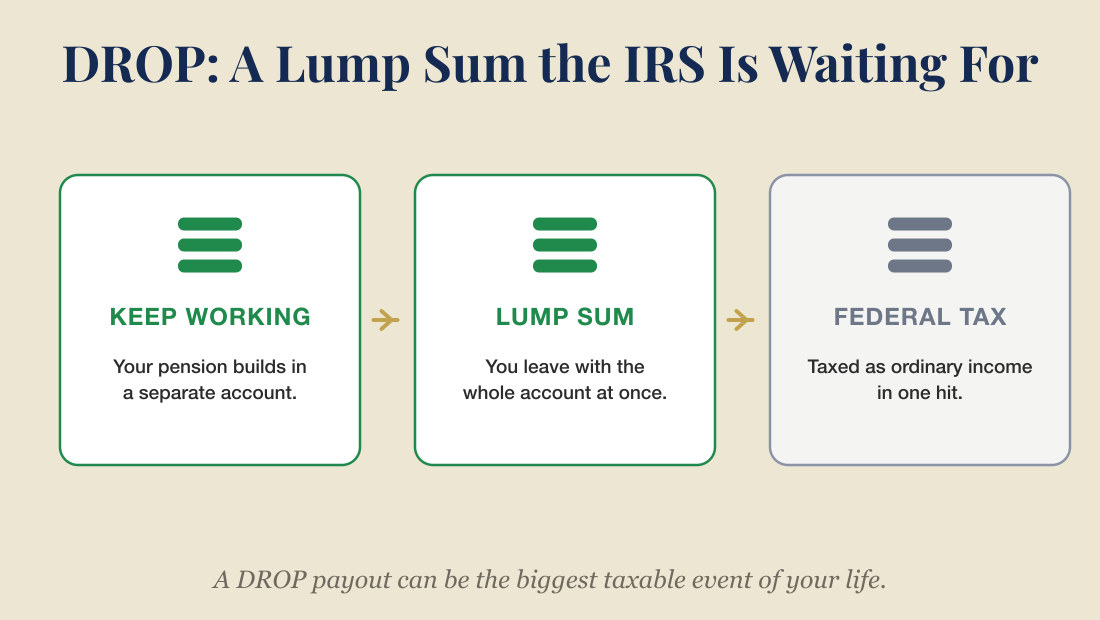
DROP, the Deferred Retirement Option Program, is where Florida teachers have a genuine edge, and also where the biggest tax surprise hides. DROP lets you keep working after you reach your normal retirement date while your monthly pension payments accumulate in a separate account instead of being paid to you. When you finally leave, you take that account as a lump sum on top of your regular pension.
Here is the teacher-specific part. General FRS members can participate in DROP for up to 96 months. Florida law lets K-12 instructional personnel, and certain instructional and administrative staff, extend DROP participation beyond that, up to a total of 120 months. More months in DROP means a larger accumulated account, which is a real advantage.
The trap is the tax. That DROP account is a lump sum of tax-deferred money, and the federal government taxes it in full. Take it all as cash in one year and it can land on top of your other income and push you into a much higher federal bracket. Roll it into an IRA and you defer the tax, but you have just created a large account that will drive required minimum distributions and can make your Social Security taxable later. Either way, a big DROP payout is a federal tax event waiting to happen, and it deserves a plan before you retire, not after.
Why the tax-free layer matters more for teachers
Put the pieces together and you can see the exposure. A career Florida teacher can retire with a lifetime pension, a DROP lump sum that may represent up to ten years of accumulated payments, and Social Security. Florida taxes none of it. The federal government taxes most of it, and the DROP payout can be the single largest taxable event of your life. The larger your DROP account, the more valuable it is to have a pool of money the IRS cannot touch to draw from alongside it.
That is the entire case for building a tax-free layer before you retire. It is not about replacing your FRS benefit, which is a strong foundation. It is about giving yourself a second source of income that does not add to your federal tax bill, so you control your bracket in the years your pension and any DROP rollover are pushing it up.
A DROP example, and why the timing matters
Consider a teacher who finishes a long career and leaves DROP with a 250,000 dollar account, on top of a pension and Social Security. This is a hypothetical illustration, not a projection of your results. Take that 250,000 dollars as cash in a single year and it lands on top of the pension and any other income, so a large slice of it can be taxed at the highest federal brackets that year, with more of the Social Security pulled into tax as well. Roll the same 250,000 dollars into an IRA and none of it is taxed that year, but it becomes a large tax-deferred account that will drive required minimum distributions starting at 73 and can keep the couple’s Social Security taxable for the rest of their lives. Neither path is wrong, and neither is free. The teacher who saw this coming and spent the years before retirement moving money into a Roth and other tax-free tools has a third option: draw the DROP money in a controlled way, blend it with tax-free income, and keep the whole picture in a lower bracket. The lesson is that the DROP decision is really made in the years before the payout, not in the month it arrives.
Building the tax-free layer
There are three main ways a teacher builds federal-tax-free income to sit alongside the FRS benefit.
- A Roth account. Many districts offer a Roth 403(b) or Roth 457, and a Roth IRA is available on your own. Contributions go in after tax and qualified withdrawals come out federally tax-free.
- Roth conversions. If you have traditional 403(b) or IRA money, converting some in lower-income years, including the window between leaving work and starting required distributions, moves it into the tax-free column at a rate you can see.
- Cash value life insurance. For a teacher who has funded the Roth options and wants more long-horizon, federal-tax-free income, a properly structured policy can provide it, along with a death benefit and, under Florida law, strong creditor protection. It is a long-term commitment, so it fits people who can fund it consistently.
A simple order for a Florida teacher
- Know your plan. Confirm whether you are in the Pension Plan or the Investment Plan and what your vesting status is.
- Plan DROP before you enter it. If you are Pension Plan and eligible, understand how many months you can participate and, more importantly, how you will handle the lump sum when it pays out.
- Fund the Roth options your district offers and a Roth IRA if you qualify.
- Build a tax-free layer deliberately, so a large DROP payout does not have to be drawn in the highest-tax way.
- Coordinate Social Security timing with the rest, since your other income affects how much of it is federally taxed.
Frequently asked questions
Are Florida teachers in a separate pension system? No. Florida public school teachers are members of the Florida Retirement System, the same FRS that covers most state and local employees. There is no standalone teacher system.
Does Florida tax my FRS pension or DROP payout? No. Florida has no state income tax, so your pension and your DROP lump sum are free of Florida tax. The federal government taxes both as ordinary income.
How long can a teacher stay in DROP? General FRS members can participate for up to 96 months, and Florida law lets K-12 instructional personnel, and certain instructional and administrative staff, extend to a total of 120 months. Confirm your own eligibility with the FRS.
Should I take my DROP payout as cash or roll it over? That is exactly the decision to plan before it pays. Cash in one year can spike your federal bracket; a rollover defers the tax but builds an account that drives required distributions later. The right answer depends on your other income and your tax-free bucket.
Facing a DROP payout or trying to figure out the tax-smart way to use your FRS benefit? Retirement Shield walks Florida educators through a short qualification quiz and connects you with one licensed professional who can map your FRS benefit, your DROP options, and your federal exposure. See if you qualify here.
This article is general education, not individualized tax, legal, or investment advice. Florida Retirement System rules, DROP provisions, vesting periods, federal tax thresholds, and Social Security taxation change over time and vary by membership class and enrollment date, so confirm your own details with the FRS and a licensed professional. Cash value life insurance is subject to underwriting and carrier terms, and policy loans and withdrawals reduce cash value and death benefit and can cause a policy to lapse if not managed properly. Consult a licensed tax, legal, or insurance professional before making decisions. Retirement Shield is a marketing and education brand, not a law firm, accounting firm, or insurance carrier.