The Florida Retirement System is one plan that covers an enormous range of jobs. State agency staff, county and city employees, sheriff’s offices, school district staff, and Florida’s public universities and colleges nearly all run through the FRS. If that is you, the FRS is a strong foundation, but a few decisions inside it, and one big fact about how your payout is taxed, decide how much of your retirement you actually keep. This is the plain guide for state and local employees.
For how this fits your whole tax picture, start with our pillar, Tax-Free Retirement Income in Florida.
Pension Plan or Investment Plan
Every FRS member is in one of two plans, and the right one depends on your career.
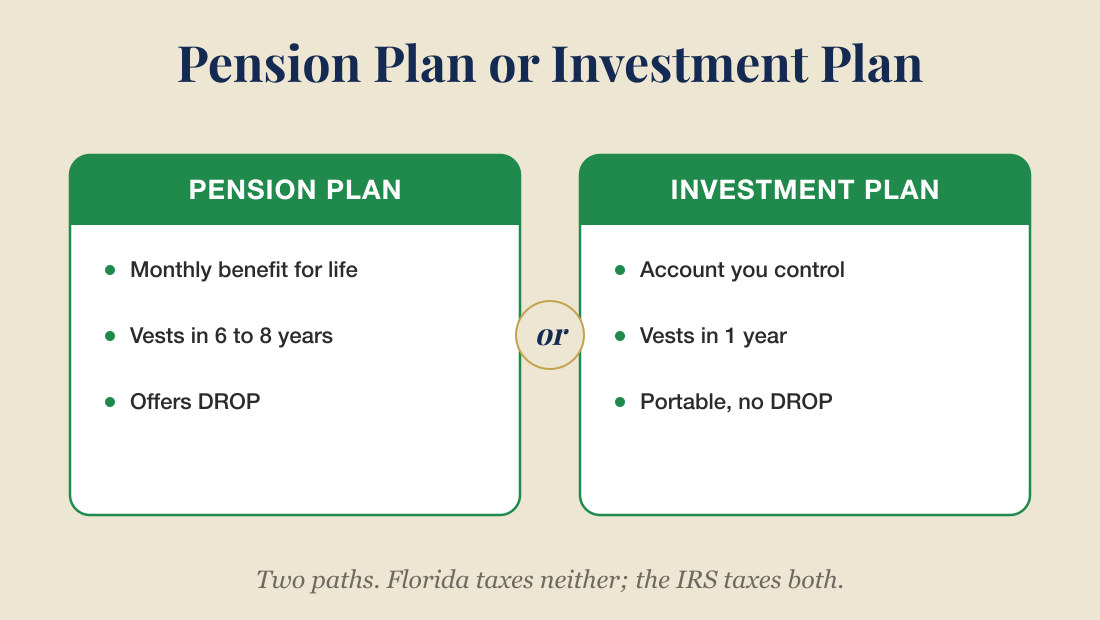
The Pension Plan is a defined benefit that pays a monthly check for life based on your years of service and salary. It vests after eight years of service if you joined the FRS on or after July 1, 2011, or six years if you joined before then. It is the plan that offers DROP.
The Investment Plan is a defined contribution account you control, similar to a 401(k), and it vests after only one year of service. For employees who may not spend a full career in Florida public service, that faster vesting can be the deciding factor. It does not offer DROP.
The choice is worth real thought, because it shapes both your retirement income and your flexibility. Whatever you choose, the tax fact underneath is the same: Florida taxes neither plan, and the federal government taxes both, the pension as ordinary income and every Investment Plan withdrawal the same way.
Switching plans and changing jobs
Two features matter for public employees whose careers may not run in a straight line. First, the Investment Plan is portable. Because it vests in a single year and the account moves with you, it fits someone who might leave FRS-covered work before a long pension would vest. Second, the FRS gives most members a one-time second election to switch between the Pension Plan and the Investment Plan while actively employed. Moving into the Investment Plan transfers the value of your pension benefit into your account. Moving into the Pension Plan requires a buy-in funded from your Investment Plan balance, and any shortfall has to come from your own money within a set window. Because you only get one, and the buy-in can be sizable, the second election is a decision to run the numbers on, not a snap choice.
Two more things to weigh in the plan choice
Beyond vesting and DROP, two differences separate the plans in ways that matter later. The first is who carries the investment risk. The Pension Plan promises a defined monthly benefit for life, so the state bears the market risk. The Investment Plan hands you the account and the market risk that comes with it, along with the upside. The second is what happens to a survivor. The Pension Plan offers survivor options that can continue a benefit to a spouse, while the Investment Plan simply passes the remaining account balance to your beneficiaries. A long-tenured employee who wants predictable lifetime income and a spousal benefit often leans Pension Plan. Someone who values control, portability, and leaving a lump sum to heirs may prefer the Investment Plan. There is no universally right answer, which is exactly why the choice, and the one-time second election that can change it, deserves real thought rather than a default. Whatever you pick, the federal tax treatment of the money coming out is the part you plan around, because Florida is not taking any of it.
A note for the Special Risk Class
If you are in the Special Risk Class, which covers many law enforcement officers, firefighters, and correctional officers, your normal retirement generally comes earlier than it does for regular class members. That earlier date changes when you can enter DROP and when your benefits begin, so the planning windows below arrive sooner for you. Confirm your specific class and normal retirement date with the FRS, because it moves everything else on the timeline.
DROP and the payout that gets taxed
DROP, the Deferred Retirement Option Program, lets a Pension Plan member keep working after reaching normal retirement while the monthly pension payments build up in a separate account rather than being paid out. General FRS members can participate for up to 96 months. When you leave, that account comes to you as a lump sum on top of your regular pension.
The lump sum is the part that surprises people. It is tax-deferred money, so the federal government taxes all of it. Taken as cash in a single year, it can stack on your other income and jump you into a higher federal bracket. Rolled into an IRA, it defers the tax but becomes a large account that drives required minimum distributions and can push your Social Security into the taxable range later. A DROP payout is often the biggest federally taxable event a public employee ever has, and it rewards planning done before you retire.
Your federal exposure, and the fix
Add it up and the pattern is clear. A career state or local employee can retire with an FRS pension, possibly a DROP lump sum, and Social Security. Florida takes nothing. The federal government taxes most of it. The accounts you were told to rely on are exactly the ones that are fully taxable on the way out, and required distributions eventually force the issue on the IRS timeline instead of yours.
The fix is to build a second layer of income the federal government cannot tax, so that when your pension and any rollover are pushing your bracket up, you have somewhere to draw from that does not add to the bill. This does not replace your FRS benefit. It sits next to it and gives you control over your tax rate in retirement.
Building the tax-free layer
- Roth accounts. Many public employers offer a Roth 457 or Roth 403(b), and a Roth IRA is available on your own. After-tax in, federally tax-free out.
- Roth conversions. Moving traditional money into a Roth in lower-income years, especially before required distributions begin, locks in a known rate now for tax-free income later.
- Cash value life insurance. For an employee who has funded the Roth options and wants additional long-horizon, federal-tax-free income, a properly structured policy can provide it, with a death benefit and, under Florida law, strong creditor protection. It is a long-term commitment best suited to people who can fund it consistently.
A simple order for a state or local employee
- Confirm your plan and class. Know whether you are Pension or Investment Plan, your vesting status, and whether you are regular or Special Risk.
- Plan your DROP payout before you enter DROP, not after it pays.
- Fund the Roth options your employer offers and a Roth IRA if you qualify.
- Build a tax-free layer so a large lump sum does not have to be drawn in the highest-tax way.
- Coordinate Social Security timing with your other income.
Frequently asked questions
Who is covered by the FRS? Most Florida public employers, including state agencies, counties, cities, school districts, the state university and college systems, and many special districts, participate in the FRS. If you get a public paycheck in Florida, you are probably a member.
Does Florida tax my FRS pension or Investment Plan withdrawals? No. Florida has no state income tax. Both are taxed federally as ordinary income.
Can I use DROP? DROP is available to Pension Plan members who reach normal retirement, for up to 96 months for general members. Investment Plan members do not have DROP.
Pension Plan or Investment Plan, which is better? It depends on your career. The Pension Plan rewards a long tenure with a lifetime benefit and access to DROP; the Investment Plan vests fast and is portable, which suits shorter or uncertain public-service careers. Either way the federal tax treatment of the payout is what you plan around.
Trying to plan an FRS pension, a DROP payout, or the Investment Plan the tax-smart way? Retirement Shield walks Florida public employees through a short qualification quiz and connects you with one licensed professional who can map your FRS benefit and your federal exposure. See if you qualify here.
This article is general education, not individualized tax, legal, or investment advice. Florida Retirement System rules, DROP provisions, vesting periods, membership classes, federal tax thresholds, and Social Security taxation change over time and vary by class and enrollment date, so confirm your own details with the FRS and a licensed professional. Cash value life insurance is subject to underwriting and carrier terms, and policy loans and withdrawals reduce cash value and death benefit and can cause a policy to lapse if not managed properly. Consult a licensed tax, legal, or insurance professional before making decisions. Retirement Shield is a marketing and education brand, not a law firm, accounting firm, or insurance carrier.