Most people in Louisiana picture life insurance as one thing: a check your family cashes after you are gone. That is the old version. A modern permanent policy can also pay you, while you are still alive and still working, and that is the part almost nobody explains.
Short answer: yes, you can use a properly structured life insurance policy while you are alive, in two very different ways. The first is the cash value that builds inside the policy, money you can access during your lifetime with tax advantages. The second is a set of living benefit riders that let you pull part of the death benefit early if you are diagnosed with a terminal, chronic, or critical illness. You do not have to die to use it. For a lot of Louisiana families, that single fact changes the whole conversation.
This is general education, not individualized tax, legal, or insurance advice. The tax treatment and the rider terms below depend on how a policy is structured and on your own situation, so confirm any move with a licensed insurance or tax professional before you make it. With that said, here is the real framework.
What are the living benefits of life insurance?
“Living benefits” is the umbrella term for every way a life insurance policy can put money in your hands before the death benefit is ever paid. There are two families of them, and they work differently, so it is worth keeping them straight.
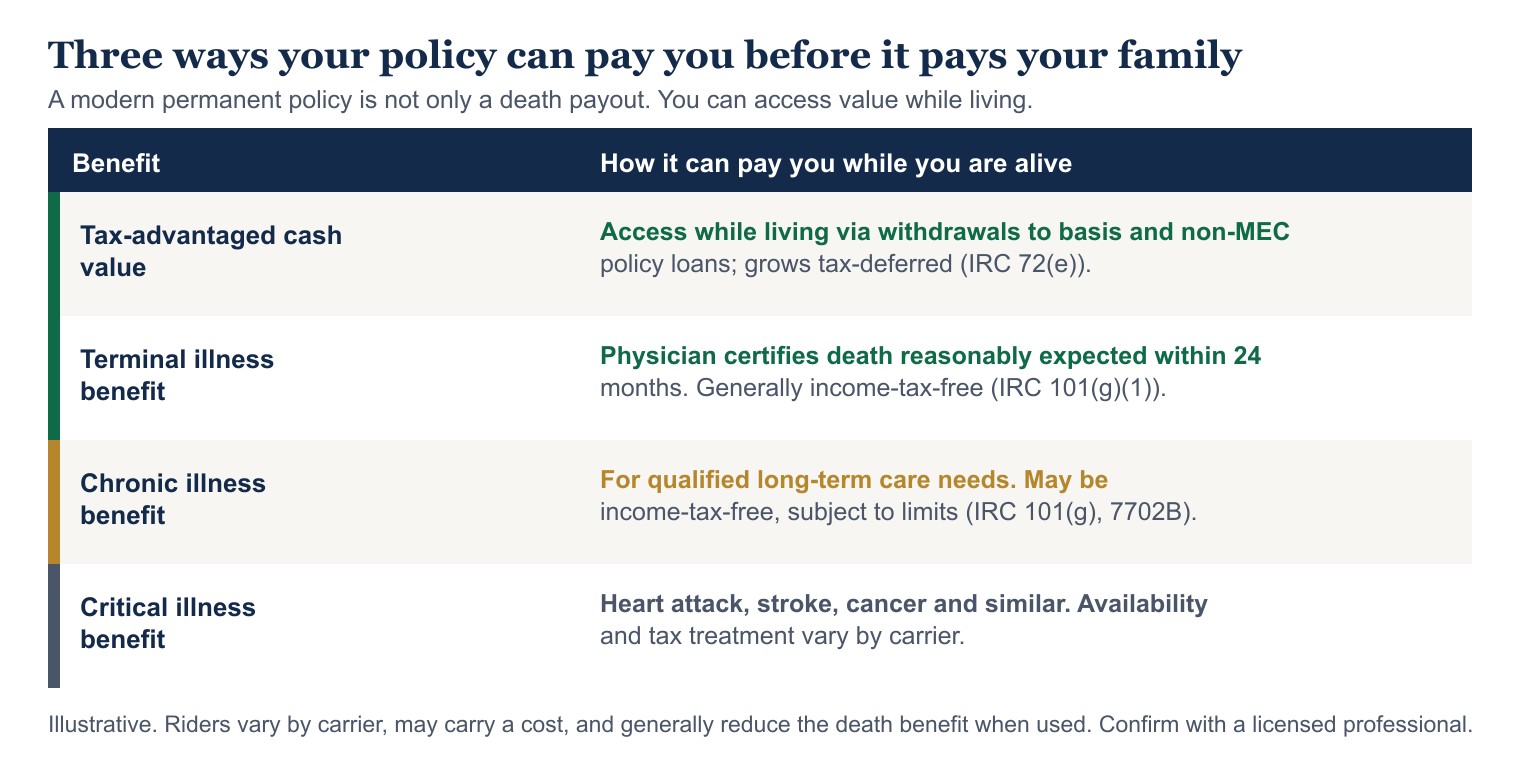
The first is cash value. Inside a permanent policy, part of what you pay builds a pool of value that grows over time and that you can access while you are living. The second is living benefit riders, sometimes called accelerated death benefit riders, which let you draw on the death benefit early if you are diagnosed with a qualifying serious illness. One is a savings feature you use on your own schedule. The other is a safety valve you hope you never need. A modern policy, what Retirement Shield calls the VAULT System, is built to carry both.
The cash value: tax-advantaged money you can use while alive
The cash value inside a properly structured permanent life insurance policy grows on a tax-deferred basis. You are not paying tax on the growth year after year the way you would on a taxable brokerage account. That deferral, compounding over a working lifetime, is a meaningful part of why these policies get used as a retirement tool and not just a death benefit.
Accessing that money is where the tax advantages really show up, and where structure matters. Under IRC 72(e), you can generally withdraw up to the amount you have paid in, your cost basis, without triggering income tax, and you can take properly structured policy loans against the cash value without those loans counting as taxable income, as long as the policy is not a Modified Endowment Contract and stays in force. That combination, tax-deferred growth plus access that is not taxed when done correctly, is the engine behind the phrase “tax-free retirement income.” Our guide to tax-free retirement income for Louisiana savers walks through how that stream is built.
Now the honest part, because the tax advantages come with rules you have to respect. If a policy is funded too fast and fails the federal 7-pay test under IRC 7702A, it becomes a Modified Endowment Contract, or MEC, and then loans and withdrawals are taxed on the gain first and can carry a 10 percent penalty before age 59 and a half, with limited exceptions. Separately, if a policy with a large outstanding loan lapses or is surrendered, the gain above your basis can become taxable in that year, which is a nasty surprise nobody should walk into blind. These are not reasons to avoid the strategy. They are reasons to have it designed correctly from the start. Confirm the structure with a licensed insurance or tax professional.
Curious what a policy like this could do for your own numbers? Retirement Shield walks Louisiana families through a short questionnaire and connects you with one licensed professional who can show you how the living benefits would actually work for your situation, with no pressure and no obligation. See how the living benefits fit →
Living benefit riders: tapping the death benefit early for a serious illness
This is the part that surprises people most. Many modern policies include, or let you add, accelerated death benefit riders. If you are diagnosed with a qualifying illness, these riders let you pull a portion of your own death benefit while you are still alive, to spend on treatment, on your mortgage, on keeping the lights on, on whatever the situation demands. The money that would have gone to your family at death can instead help you fight through the illness in front of you.
The tax treatment is governed by federal law, specifically IRC 101(g), and it breaks down by the type of diagnosis:
- Terminally ill. Under IRC 101(g)(1), accelerated benefits paid to a terminally ill insured are treated as “an amount paid by reason of the death of an insured,” which means they are generally excluded from gross income the same way a death benefit is. The law defines a terminally ill individual as someone a physician has certified as having an illness or condition that “can reasonably be expected to result in death in 24 months or less.”
- Chronically ill. Benefits for a chronically ill insured can also be income-tax-free, but the exclusion is subject to limits. The payments generally have to be for qualified long-term care costs, the contract has to meet the requirements tied to IRC 7702B, and there are per-diem and periodic-payment limitations on how much can be excluded. This is not an unlimited free pass, and the details matter.
- Critical illness. Some carriers also offer a critical illness rider for events like a heart attack, stroke, or cancer diagnosis. Availability and the exact tax treatment of these benefits vary by carrier and by policy, and they are not covered by the same terminally and chronically ill rules above. Any critical illness benefit may be income-tax-free, subject to conditions, so confirm the specifics with a licensed tax professional before you count on it.
Two caveats you should hear up front, because they are real. Living benefit riders vary widely by carrier, some are built in and some cost extra, and when you accelerate part of the death benefit, you generally reduce the death benefit your family receives later by what you took early. The dollars you use while living are dollars that will not be there at the end. That is still a powerful option to have, it is just not free money, and it is not identical from one policy to the next. Read the rider, and confirm the terms with a licensed insurance professional.
How does Louisiana treat this money?
Here is where it lands for a Louisiana resident. For tax years beginning on or after January 1, 2025, Louisiana taxes individual income at a flat 3 percent rate under R.S. 47:32(A). Louisiana builds its taxable income off your federal adjusted gross income under R.S. 47:293, which matters for a practical reason: when an amount is excluded from income at the federal level, like a properly structured policy loan or a qualifying accelerated death benefit under 101(g), it is generally not pulled back into income at the state level either. The federal treatment flows through to your Louisiana return rather than being taxed separately by the state.
Louisiana also has no state inheritance tax and no separate state estate transfer tax for deaths after 2004, so the death benefit your family eventually receives is not chipped away by a Louisiana death tax on top. If you want the detail on how payouts are taxed, our guide on whether life insurance proceeds are taxable in Louisiana covers the death benefit side in full.
The honest limits, and who this fits
No one should sell you a living policy without showing you the fences around it. These are the ones that matter:
- Structure is everything. The tax advantages on cash value depend on the policy not becoming a MEC and staying in force. A policy designed wrong, or allowed to lapse with a big loan on it, can create a taxable event instead of a tax-free one.
- Riders are not uniform. Living benefit riders differ by carrier, may carry a cost, may have waiting periods or diagnosis requirements, and generally reduce the death benefit when used. Read the actual contract.
- This is a long-game tool. Cash value takes years to build into something meaningful. This rewards families who start steadily and let it compound, not someone looking for a quick move.
Who does it fit? Generally, Louisiana families who want more than a death payout: people who want a place to build money with tax advantages they can actually use during their lifetime, and who want the peace of mind that a serious diagnosis would not have to mean draining every other account first. If that is you, the broader honest guide to the VAULT System in Louisiana lays out the full picture. None of this makes a policy right for everyone, and it is not a recommendation to buy. It is a tool worth understanding before you decide.
Want a straight answer for your own situation? Take the two-minute Retirement Shield questionnaire. You will see whether a policy with living benefits fits your goals, and get connected with one licensed professional, no pressure and no obligation. Start the questionnaire →
Frequently asked questions
Can I use my life insurance while I am still alive?
Yes, with the right kind of policy. A properly structured permanent life insurance policy builds cash value you can access during your lifetime through withdrawals and policy loans, and many policies include living benefit riders that let you draw on the death benefit early if you are diagnosed with a qualifying serious illness. A basic term policy generally does not offer either feature.
Are the living benefits of life insurance taxable in Louisiana?
It depends on the benefit and the structure. Cash value grows tax-deferred, and withdrawals to your basis and properly structured policy loans are generally not taxed under IRC 72(e) when the policy is not a MEC and stays in force. Accelerated death benefits for a terminally ill insured are generally income-tax-free under IRC 101(g), and chronically ill benefits can be too, subject to limits. Louisiana builds off federal income, so those federal exclusions generally flow through. Confirm your situation with a licensed tax professional.
What is an accelerated death benefit rider?
It is a provision that lets you receive part of your policy’s death benefit early if you are diagnosed with a qualifying terminal, chronic, or in some cases critical illness. The money can be used for treatment or any other need. Using it generally reduces the death benefit your family receives later, and the exact terms and tax treatment vary by carrier, so read the rider and confirm with a licensed insurance or tax professional.
Does using a living benefit reduce the death benefit for my family?
Generally yes. When you accelerate part of the death benefit while living, the amount you take early reduces what remains for your beneficiaries. That is the trade-off for being able to use the money when you need it most. The cash value features work differently, but outstanding policy loans that are not repaid also reduce the death benefit.
Is a term policy or a permanent policy better for living benefits?
If living benefits are what you are after, a permanent policy is the one that offers them. Term insurance is generally pure death benefit with no cash value, though some term policies do include a limited accelerated death benefit rider. A properly structured permanent policy is designed to build cash value you can use and to carry living benefit riders. Which is right for you depends on your goals and budget, so confirm with a licensed insurance professional.
Is this legal or tax advice?
No. This article is educational. The tax treatment of cash value and living benefit riders turns on how a policy is structured and on your own facts, so confirm how it applies to you with a licensed insurance or tax professional before acting.
This article is general education, not individualized legal, tax, or insurance advice, and not a recommendation to buy any product. The tax treatment of cash value access and living benefits depends on policy structure, funding, beneficiary designations, timing, diagnosis, and applicable federal and state law, including Internal Revenue Code sections 72(e), 101(a), 101(g), 7702A, and 7702B, and Louisiana Revised Statutes sections 47:32 and 47:293. A policy that becomes a Modified Endowment Contract, or that lapses or is surrendered with an outstanding loan, can create taxable income. Living benefit riders vary by carrier, may carry a cost, and generally reduce the death benefit when used. Tax laws and rates can change and are subject to interpretation. Consult a licensed insurance or tax professional about your own situation before making decisions. Retirement Shield is a marketing and education brand, not a law firm, accounting firm, or insurance carrier. Linh Tuong Nguyen is licensed in Louisiana (License #1276760).