You put money into a policy so your family gets a clean check when you are gone, not a tax bill. So the real question underneath “are life insurance proceeds taxable in Louisiana” is simple: when the benefit pays out, how much of it does the IRS keep, and how much does Baton Rouge keep?
Short answer: in the ordinary case, neither one keeps any of it. A life insurance death benefit paid because the insured died is excluded from federal income tax, and because Louisiana builds its income tax on top of your federal income figures, that same money is not taxed at the state level either. Louisiana also charges no inheritance tax and no estate transfer tax. There are a handful of specific situations where a tax can appear, and an honest guide names every one of them, so here is the full picture.
This is general education, not individualized tax advice. How these rules land depends on the specific facts of your policy, your beneficiaries, and your estate, so confirm with a licensed tax professional before you act on any of it.
The death benefit is generally tax-free, federal and state
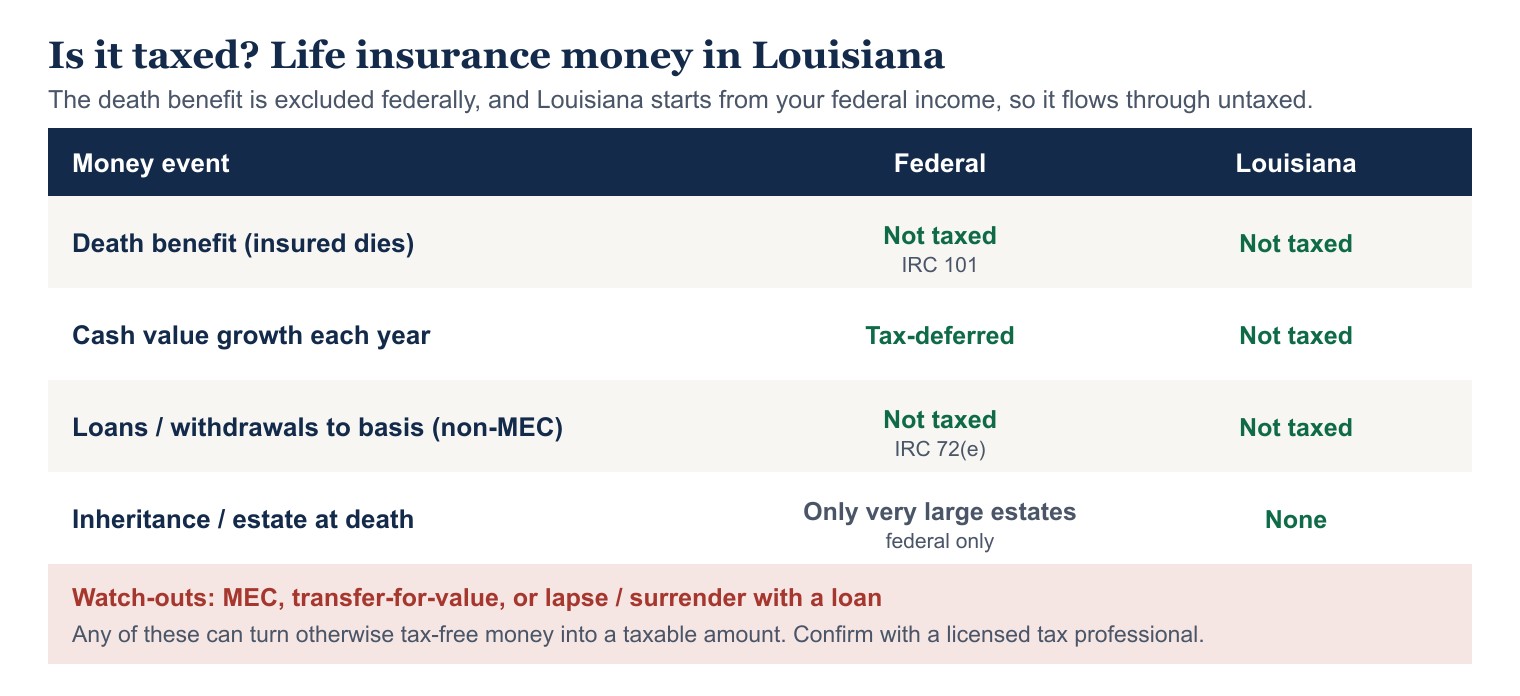
Start with the federal rule, because Louisiana is built on top of it. Under Internal Revenue Code section 101(a)(1), a life insurance death benefit paid because the insured died is excluded from the beneficiary’s gross income. That is the baseline, and it is why a beneficiary usually receives the full face amount with no income tax due. It applies whether the benefit is paid in one lump sum or spread over time, though any interest the insurer pays on top of the benefit can be taxable.
Now the Louisiana layer. Louisiana does not have a separate statute that names life insurance proceeds as exempt. Instead, Louisiana calculates your state income tax starting from your federal income (your federal adjusted gross income flows into the state return). Because the death benefit is excluded at the federal level under section 101, it never enters the federal income number that Louisiana builds on. So it is not taxed at the state level either. The protection here is a flow-through effect, not a dedicated Louisiana exemption, but the practical result is the same: in the ordinary case the death benefit reaches your family free of both federal and Louisiana income tax.
The cash value grows tax-deferred inside the policy
The second thing people mean by “taxable” is the money that builds up inside a permanent policy while you are still alive. Inside a properly structured permanent life insurance policy, what Retirement Shield calls the VAULT System, the cash value grows without being taxed each year. You do not get a 1099 for the growth the way you would with a taxable brokerage account. When you access that value the right way, through withdrawals up to what you have paid in or through a properly structured policy loan, it generally comes out without income tax as well, under the rules in Internal Revenue Code section 72(e).
That combination, tax-deferred growth and tax-advantaged access, is the reason a properly structured life insurance policy is used as a source of retirement income that can stay free of income tax. Two things can change that treatment, and we cover them in the exceptions below: if the policy becomes a modified endowment contract, or if it lapses or is surrendered while a loan is still outstanding. Short of those, the money inside the policy works for you without an annual tax drag.
Where a tax can actually appear
Tax-free is the general rule, not an absolute one, and honest planning names the exceptions instead of hiding them. A few situations change the outcome:
- A policy transferred for value. Under IRC section 101(a)(2), if a policy is sold or transferred to someone for valuable consideration, part of the death benefit can become taxable. There are important carve-backs: the rule generally does not bite on a transfer to the insured, to a business partner of the insured, to a partnership in which the insured is a partner, or to a corporation where the insured is a shareholder or officer.
- A modified endowment contract (MEC). If a policy is funded so fast that it fails the federal seven-pay test, it becomes a MEC, and then loans and withdrawals are taxed on the gain first, with a possible 10 percent penalty before age 59 and a half. Proper structuring is how you stay on the right side of this line.
- A lapse or surrender with a loan outstanding. If a policy lapses or you surrender it while a loan is still on the books, gain above what you paid in can become taxable. This is one of the most common ways a “tax-free” plan turns into a surprise tax bill, and it is avoidable with management.
- Federal estate tax on a very large estate. A large death benefit can count toward the federal estate tax for estates above the federal exemption. That is a separate federal tax from income tax, and most families never reach it, but it belongs in the fine print.
Most families never touch any of these. They matter because the difference between a policy that pays out clean and one that generates a tax bill often comes down to how it was built and how it is managed, not luck. Confirm your own situation with a licensed tax professional.
Want to see how much of your retirement income could come out tax-free? Retirement Shield walks Louisiana savers through a short questionnaire and connects you with one licensed professional who can put the numbers in front of you, then points you to your own tax professional to confirm the details. See where your income stands →
Louisiana has no inheritance or estate tax
Separately from income tax, some states charge an inheritance or estate tax that can reach assets passing at death. Louisiana does not. Louisiana repealed its inheritance tax, and no inheritance tax has applied to Louisiana deaths in recent years. Louisiana also has no state estate transfer tax due for deaths after 2004. So at the state level, Louisiana adds neither an income tax on the death benefit nor a death tax on top of it.
A very large estate can still face the federal estate tax, which is a federal matter with a high exemption and is unrelated to anything Louisiana does. For most Louisiana families, the state side of the ledger is clean on both counts, income tax and death tax alike. If creditor protection is also on your mind, our companion guide on whether life insurance is protected from creditors in Louisiana walks through the statute that shields policy money from lawsuits.
How Louisiana’s flat income tax fits the picture
Here is the mechanism behind the “Louisiana does not tax it” answer, because it is worth understanding rather than taking on faith. For tax years beginning on or after January 1, 2025, Louisiana moved to a flat individual income tax rate of 3 percent. More important than the rate itself is what it is applied to: Louisiana starts from your federal income figures, so anything the federal code excludes from income never shows up on the state return to be taxed at any rate.
That is exactly why the death benefit flows through untaxed. The federal exclusion under section 101 removes it from federal income, and Louisiana only taxes what is left. The same logic protects the tax-deferred growth and the properly structured access inside the VAULT System. The flat 3 percent rate is current as of this writing, and because Louisiana has been actively changing its tax rates, confirm the rate in effect for your tax year with a licensed Louisiana tax professional. For the full picture of how a policy stacks up against a workplace plan, see our comparison of the VAULT System versus a 401(k) for Louisiana retirement, and for who the strategy actually fits, our honest guide to the VAULT System in Louisiana.
Want a straight answer for your own numbers? Take the two-minute Retirement Shield questionnaire. You will see whether tax-free retirement income through the VAULT System fits your situation, and get connected with one licensed professional, no pressure and no obligation. Start the questionnaire →
Frequently asked questions
Are life insurance proceeds taxable in Louisiana?
Generally no. A death benefit paid because the insured died is excluded from federal income tax under Internal Revenue Code section 101(a)(1), and because Louisiana starts its income tax from your federal income, that money is not taxed at the state level either. Interest the insurer pays on top of the benefit can be taxable.
Does Louisiana tax the cash value inside my policy?
Not as it grows. Cash value in a properly structured permanent policy grows tax-deferred, and accessing it through withdrawals up to what you paid in or through a properly structured loan is generally not taxed under section 72(e). That changes if the policy becomes a modified endowment contract or if it lapses or is surrendered while a loan is outstanding.
Does Louisiana have an inheritance or estate tax?
No. Louisiana repealed its inheritance tax and has no state estate transfer tax due for deaths after 2004. A very large estate could still face the separate federal estate tax, which is unrelated to Louisiana.
When is a life insurance death benefit actually taxable?
Mainly in specific situations: a transfer of the policy for value under section 101(a)(2), distributions from a modified endowment contract, a lapse or surrender with an outstanding loan, or federal estate tax on a very large estate. Confirm your situation with a licensed Louisiana tax professional.
How does Louisiana’s flat income tax affect my death benefit?
Louisiana uses a flat individual income tax rate of 3 percent for tax years beginning on or after January 1, 2025, applied to income that starts from your federal figures. Because the federal code excludes the death benefit from income in the first place, there is nothing for the state rate to apply to. Confirm the current rate for your tax year with a licensed Louisiana tax professional.
Is this tax advice?
No. This article is general education. How the rules apply depends on the specific facts of your policy and estate, so confirm your situation with a licensed tax professional before acting.
This article is general education, not individualized tax, legal, or investment advice, and not a recommendation to buy any product. Federal tax rules, including the income exclusion for death benefits under Internal Revenue Code section 101, the transfer-for-value rule under section 101(a)(2), modified endowment contract treatment under sections 72(e) and 7702A, and the federal estate tax, are set by the Internal Revenue Code and can change. Louisiana income tax conforms to federal income figures and Louisiana’s individual income tax rate and other tax law can change. Confirm the tax treatment and the current Louisiana rate for your situation with a licensed Louisiana tax professional, and consult a licensed insurance professional before making decisions. Insurance products are offered through appropriately licensed professionals in your state. Retirement Shield is a marketing and education brand, not a law firm, accounting firm, or insurance carrier. Linh Tuong Nguyen is licensed in Louisiana (License #1276760).