Louisiana quietly gives its residents one of the strongest asset protections in the country, and almost nobody plans around it. If you own a business, work in a liability-heavy trade, or simply want your retirement shielded from a lawsuit, this is worth understanding.
Most people think about growing their retirement savings and taxing their retirement savings. Far fewer think about protecting it, until a lawsuit, a business failure, or a judgment puts it at risk, and by then the planning window has usually closed. Louisiana is unusually generous here. State law shields several kinds of savings from creditors more strongly than most states do, and for the right person, knowing this changes where money should be held long before any trouble appears.
This is a general briefing, not legal advice, and the details of asset protection are genuinely technical. But the headline is worth every Louisianan’s attention: here, how you hold your money can determine whether a creditor can reach it.
What does Louisiana law protect from creditors?
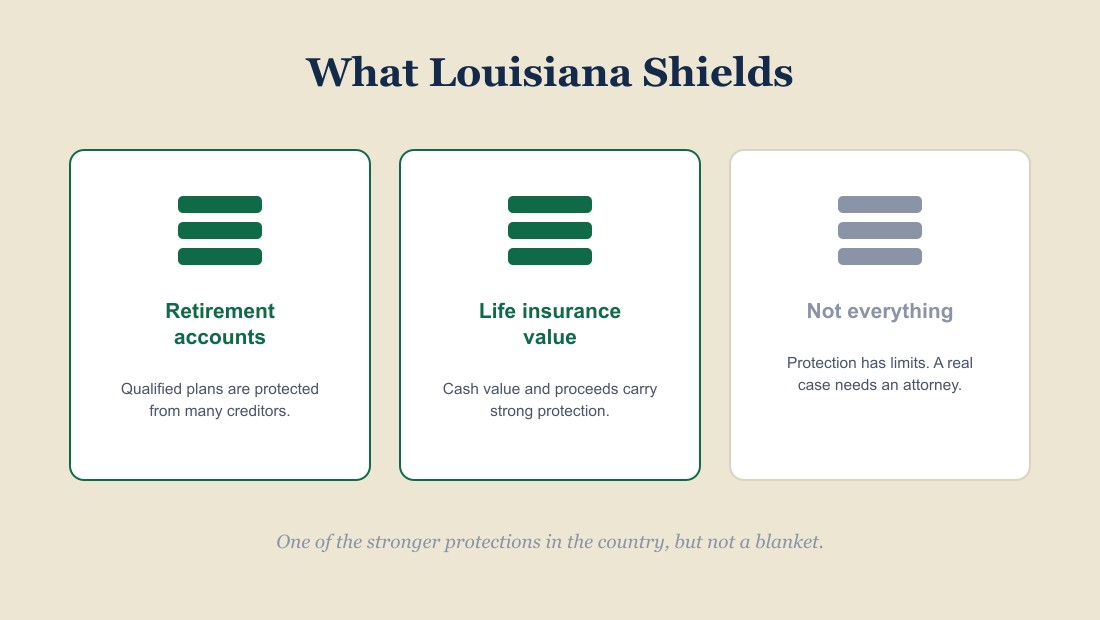
Asset protection in Louisiana comes from specific statutes that exempt certain property from seizure to satisfy debts and judgments. Two categories matter most for retirement planning: the cash value and proceeds of life insurance, and qualified retirement accounts. Both are protected far more robustly than an ordinary bank or brokerage account, which a judgment can generally reach.
The practical consequence is that two people with the exact same net worth can have very different exposure, purely based on where that money sits. Money in a taxable brokerage account is exposed. The same money inside a protected structure may be shielded. The difference is not the amount. It is the container.
How does the life insurance exemption work?
Louisiana law broadly exempts the proceeds and cash value of life insurance from the claims of the insured’s creditors, subject to how the policy is owned and other limits. This is one of the stronger such protections in the country. It means that, structured correctly, the money accumulating inside a permanent life insurance policy can be shielded in a way an ordinary savings account is not.
In Louisiana, the same dollar can be exposed or protected depending only on the container you keep it in.
This is the quiet reason a properly structured life insurance policy carries an extra layer of value in Louisiana that it would not carry in many other states. It is not the reason to buy one, tax-free income and the fit to your situation come first, but for someone weighing where to hold long-term savings, it is a genuine advantage. We cover the whole honest picture of that structure in our guide to indexed universal life in Louisiana.
Are retirement accounts protected in Louisiana?
Qualified retirement accounts, employer plans like 401(k)s and, under Louisiana law, IRAs, also receive strong protection from creditors. This is one more reason not to casually cash out a retirement account: beyond the enormous tax cost, moving money out of a protected account and into an ordinary one can strip away asset protection you did not know you had.
The interaction between these exemptions and events like bankruptcy, divorce, and specific types of claims is where the technical detail lives, and where an attorney earns their fee. But the general principle is stable and favorable: Louisiana protects retirement money held in the right structures.
Who should care most about this?
Asset protection is not equally urgent for everyone. It matters most for:
- Business owners, whose personal assets can be exposed to business claims.
- Liability-heavy professionals and trades, including medical, construction, and offshore and industry contractors, where the risk of a claim is a fact of working life.
- Anyone with significant savings outside protected structures who would be devastated by a single judgment.
Getting it right
Two cautions. First, asset protection has to be set up before a claim arises; moving money to dodge a creditor you already know about can be unwound as a fraudulent transfer. This is planning done in calm times, not a rescue done in a crisis. Second, the details of ownership, beneficiary designation, and titling determine whether the protection actually applies, which is why this is a conversation to have with a Louisiana attorney alongside your financial planning.
The takeaway is simple even if the law is not: in Louisiana, protecting your retirement is not only about how much you save or how it is taxed. It is also about the container. Choose it on purpose.
Where protected, tax-free savings fits your plan.
The free masterclass covers the structure that combines tax-free income with Louisiana’s asset protection. The 60 second quiz afterward checks whether it fits your situation.
Watch the MasterclassWhat this protection does and does not cover
Louisiana has long been known for treating certain savings kindly when creditors come calling. In general terms, the state tends to shield specific retirement accounts, along with the cash value and proceeds of certain life insurance, from many kinds of creditor claims. For a resident who has built up savings and worries about what a lawsuit or a business setback could reach, that is genuinely reassuring. It is also, if you stop reading here, easy to misunderstand.
The reassuring part first. Money held in the right retirement vehicles is often difficult for many creditors to reach under Louisiana law, and the same tends to be true for certain life insurance values held for the benefit of a spouse or children. This is one reason these tools show up so often in careful planning. They can serve their primary purpose, providing income or protection for a family, while also sitting in a form that many claims struggle to touch. That combination is part of why people who understand the rules use them on purpose.
Now the honest limits, because a half-told story here does real harm. This protection is not a blanket shield against everything. It does not turn your accounts into a place to hide from obligations you genuinely owe. Certain claims, obligations, and circumstances can change the picture entirely, and the details depend heavily on the specific type of account, how and when it was funded, and the nature of the claim against you. Timing matters too. Moving money into a protected form at the moment trouble arrives is treated very differently from long-standing, ordinary planning done well in advance.
There are also boundaries that surprise people. Family obligations, certain government claims, and specific legal situations can each cut through protections that would otherwise apply. The word “certain” is doing heavy lifting throughout this section, and that is deliberate. Whether a particular account or policy is protected in a particular dispute is not a question a general article can answer, and anyone who tells you otherwise is overselling.
So treat this as a map, not a guarantee. The general shape of Louisiana’s protection is real and worth building around, but the boundaries are specific, fact-driven, and occasionally counterintuitive. If you are facing an actual claim, or planning around a real risk, that is exactly the moment to sit down with a qualified Louisiana attorney who handles these matters. They can look at your accounts, your exposure, and current law, and tell you what is actually protected in your situation rather than what usually tends to be.
Why this matters most for professionals and business owners
Creditor protection sounds abstract until you are the person with something to lose and a reason to worry. For a salaried employee with a modest asset base and little liability exposure, these rules are a nice background feature. For people whose work puts them in the path of lawsuits and claims, they can be one of the more important structural decisions they ever make. If that describes you, this topic deserves more than a passing glance.
Think about who carries real liability exposure. Physicians and other medical professionals face malpractice risk simply by practicing. Contractors and tradespeople carry the risk that a job, a subcontractor, or an accident turns into a claim. Business owners sign personal guarantees, employ people, and stand behind their companies in ways that can reach their personal savings. Attorneys, accountants, and other licensed professionals live with the standing possibility of a claim tied to their work. For all of them, the question is not just how much they save, but what form those savings take.
Here is the practical insight. Two people can have identical net worth and radically different exposure, based purely on where the money sits. Savings parked in ordinary accounts may be more reachable by a future claim, while the same dollars held in retirement vehicles and certain life insurance structures may enjoy the protections Louisiana generally extends. For someone with genuine liability risk, choosing protected forms is not paranoia. It is ordinary prudence, the financial equivalent of carrying the right insurance.
This is also why the timing point from earlier matters so much for this group. Protection built into a long-standing, deliberate savings plan stands on far firmer ground than a scramble to shelter assets once a claim is already looming. The professionals who benefit most are the ones who set their structure up quietly over years, as a normal part of how they hold money, long before any specific trouble appears on the horizon. Protection is something you build in calm weather.
None of this is a reason to avoid your obligations or to treat these tools as a fortress against everything, and none of it is specific legal advice for your situation. It is a reason to take the question seriously if your work carries risk. A qualified Louisiana attorney, ideally one who works with people in your profession, can help you understand your real exposure and structure your savings in forms that hold up. If you have something to protect, that conversation is worth having before you think you need it.
Does Louisiana protect life insurance from creditors?
Louisiana law broadly exempts the proceeds and cash value of life insurance from the insured’s creditors, subject to ownership rules and limits. It is one of the stronger protections in the country. Confirm your specifics with an attorney.
Are IRAs and 401(k)s protected from creditors in Louisiana?
Qualified retirement accounts receive strong creditor protection under Louisiana law. Cashing them out and moving the money to an ordinary account can remove that protection.
Can I move money to protect it after I am sued in Louisiana?
No. Asset protection must be arranged before a claim arises. Transfers made to avoid a known creditor can be reversed as fraudulent. Plan in calm times.
Do I need a lawyer for asset protection in Louisiana?
For asset protection specifically, yes. Ownership, titling, and beneficiary details determine whether the exemptions apply, and those are legal questions best handled by a Louisiana attorney.