Cashing out a 401(k), whether early or all at once in retirement, can hand nearly half of it to taxes and penalties in a single year. Here is exactly how the bill is built, and how the people who avoid it saw it coming.
One of the most expensive moments in a financial life is the day a large 401(k) comes out all at once. It happens two ways: someone under retirement age cashes out early because they need the money, or someone at retirement takes a big lump sum without a plan. Both can lose a shocking share of the balance to taxes and penalties in a single year, and both are almost entirely avoidable once you see how the bill is actually built.
The early withdrawal penalty
Money in a traditional 401(k) or IRA is meant to stay put until retirement age. Pull it out before the qualifying age and, in most cases, you owe a ten percent early withdrawal penalty on top of ordinary income tax. That penalty is just the beginning of the damage, because it sits on top of a tax bill that is often larger than people expect.
How the tax bill stacks up
A 401(k) withdrawal is ordinary income. When you take a large amount in one year, that entire sum is added to your income for the year, and it can push you into much higher tax brackets than your normal salary would. Layer the possibilities together and the real cost comes into focus:
- Federal income tax on the full amount, at brackets inflated by the size of the withdrawal.
- The ten percent early penalty, if you are under the qualifying age.
- Higher taxation of other income, because a big withdrawal can make more of your Social Security taxable and raise Medicare costs.
Between inflated brackets, the penalty, and the ripple effects, a large one-year cash-out can quietly cost close to half the amount withdrawn.
That is not a hypothetical. Take a person who cashes out a six-figure 401(k) in one year to buy something or cover a shock. The withdrawal stacks on their other income, most of it lands in the highest brackets they will ever touch, the penalty applies, and the effective bite on that money approaches figures most people would not believe until they saw the tax return.
The retirement version of the same mistake
The trap does not disappear at retirement age. It just loses the penalty. A retiree who takes a large lump sum in a single year, to pay off a house, help a child, or simply because they were not advised otherwise, does the same damage with taxes alone: one enormous year of income, brackets pushed to the top, and more of their Social Security taxed in the process. The money they spent decades building gets a large, unnecessary haircut on the way out, purely because of how it was withdrawn.
How to avoid it
The fix is almost always the same word: don’t take it all in one year. The people who avoid this bill do one of a few things:
- Roll it over rather than cash it out when leaving a job, keeping the money tax-deferred and the penalty off the table.
- Spread withdrawals across multiple years so no single year spikes into the top brackets.
- Build a tax-free source alongside the 401(k), so in retirement they can draw from the bucket that does not add to a taxable year at all.
That last point is the durable fix. The whole reason a lump-sum withdrawal is so costly is that every dollar of a traditional 401(k) is taxable income. A retiree who also has a tax-free source can control the timing and the tax entirely. We explain why that balance matters in why your 401(k) was not built for income, and how to build the tax-free side in the Louisiana tax-free income guide.
The retirees who never face the big tax year planned for it.
The free masterclass covers how to build tax-free income you control, and the 60 second quiz afterward checks whether it fits your situation.
Watch the MasterclassWhat it looks like in real dollars
Percentages are easy to shrug off. Dollars are not. Put a real number on it and the cost of cashing out early stops sounding like a technicality.
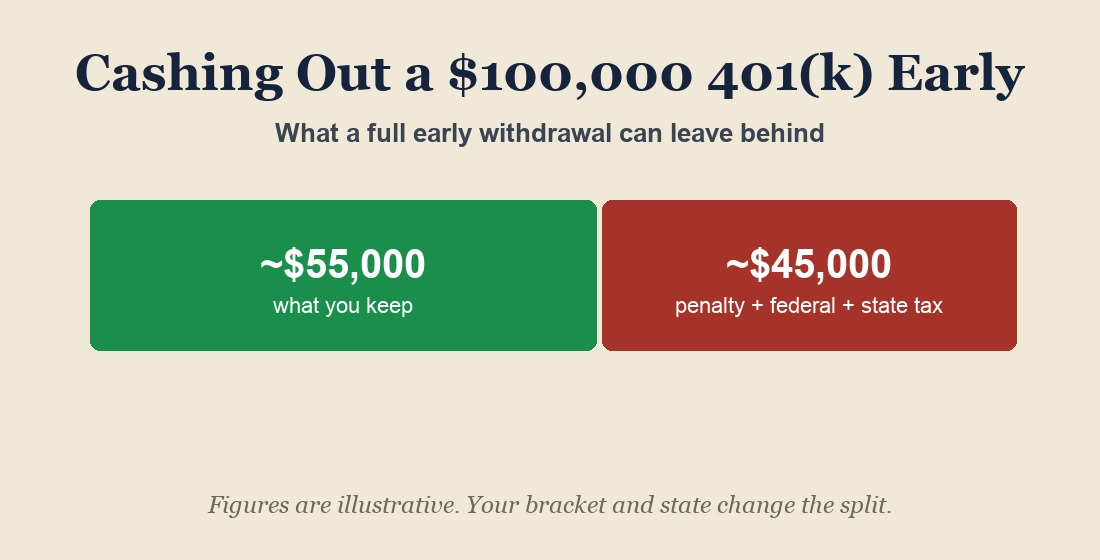
Take a hundred thousand dollars in a 401(k) and cash it out before retirement age. The ten percent early-withdrawal penalty comes off the top. The full amount is then added to your income for the year, which can push you into a higher federal bracket, and Louisiana takes its own cut on top of that. By the time the penalty and the combined tax are done, a six-figure account can hand back closer to fifty-five thousand dollars than a hundred. You did not lose it in a market crash. You handed roughly half of it to the government for the privilege of touching your own money early.
This is not a rare mistake. People do it to cover an emergency, pay off a credit card, or bridge a gap between jobs, moments when the money feels urgent and the tax bill feels far away. It is exactly the outcome a structured, accessible plan is designed to avoid, and it is why where you keep your money matters as much as how much of it you keep.
Better moves when you actually need the money
Most people who cash out a 401(k) early are not being reckless. They are staring at a real problem, an emergency, a stretch of unemployment, a debt that will not wait, and the account feels like the only lever they can pull. The good news is that it is almost never the only one, and the alternatives usually cost a fraction of the penalty-plus-tax hit.
If the money is in a plan at a job you still hold, a 401(k) loan is often the least-bad option. You borrow from yourself, there is no penalty and no immediate tax, and you repay it on a schedule. The real cost is the one covered earlier in this article: the borrowed dollars stop earning while they are out, and if you leave the job the balance can come due fast. It is a bridge, not a habit, but it beats a permanent withdrawal.
If you have left the employer, rolling the account into an IRA keeps the money tax-deferred and out of reach of the penalty, and it usually opens up more flexibility than the old plan allowed. A true hardship withdrawal exists for specific emergencies, and while it still gets taxed, it can sometimes sidestep the penalty for a qualifying event. And if the pressure is high-interest debt, running the real math often shows that almost anything beats surrendering forty percent of a retirement account to reach it.
The deeper fix, though, is structural, and it is the reason this site exists. People raid retirement accounts because those accounts are the only meaningful pool of money they have, and that pool happens to be the one wrapped in penalties. The households that never face this decision are usually the ones who built a separate, accessible bucket on purpose, money they can reach without asking the government’s permission or paying it a toll. Where you keep your money decides whether an emergency becomes a setback or a catastrophe.
What is the penalty for cashing out a 401(k) early?
In most cases a ten percent early withdrawal penalty applies if you are under the qualifying age, on top of ordinary income tax on the full amount.
Why can cashing out cost nearly half?
Because the full withdrawal is added to your income for the year, pushing it into high brackets, plus any penalty, plus ripple effects like more of your Social Security being taxed and higher Medicare costs.
Is a lump sum in retirement also a problem?
Yes. There is no early penalty at retirement age, but a large one-year withdrawal still spikes your income into top brackets and increases the tax on other income.
How do I avoid the big tax bill?
Roll the money over instead of cashing out, spread withdrawals across years, and build a tax-free income source so you are not forced to pull everything from the taxable bucket.