You make real money in the good stretches and carry real liability every shift. The question most oil and gas guys never get a straight answer to: if you got sued tomorrow, which of your dollars could a creditor actually take?
Short answer: it depends entirely on where you keep the money. If you turn wrenches offshore, run a board at a plant, or chase footage on a rig, you already know your paychecks do not come smooth. In Louisiana, the dividing line between money a creditor can seize and money a creditor cannot comes down largely to one law, La. R.S. 22:912, and it treats your savings very differently depending on the account they sit in.
This is general education, not legal advice. Asset protection turns on the specific facts of your situation, so confirm any move with a licensed Louisiana attorney before you make it. With that said, here is the real framework every high-income tradesman in this state should understand.
What does Louisiana law actually protect?
Louisiana Revised Statute 22:912 protects the “proceeds and avails” of life insurance and annuity contracts from the creditors of both the insured and the beneficiary. In plain terms, money that lives inside a properly structured life insurance policy or annuity is shielded from lawsuits and most creditor claims in a way that money sitting in a bank or a brokerage account simply is not.
That matters most for people in a high-liability line of work. You cannot control whether a contractor’s attorney names you in a suit, whether a vehicle incident turns into a judgment, or whether a two-year downturn drains your reserves. What you can control is where your savings sit, and whether that location gives you legal cover. For oilfield trades with no pension and boom-and-bust income, that is leverage worth having.
Does it cover the cash value, or just the death benefit?
This is where most people get it wrong, and it is the single most important point in this article. The protection is not limited to the death benefit your family receives after you are gone. R.S. 22:912 states, in its own words, that “the proceeds and avails of the policy include the cash surrender value of the policy,” meaning the money you have built up inside the policy and can access while you are alive.
So the cash you accumulate inside a properly structured permanent life insurance policy, what Retirement Shield calls the VAULT System, is money that can grow tax-advantaged and, at the same time, sit behind this creditor shield. That is the combination that makes it worth a serious look for a tradesman: a vehicle that builds value you can use and that Louisiana law treats as exempt from most creditor claims. A brokerage account does neither of those things.
Is there a dollar cap on the protection?
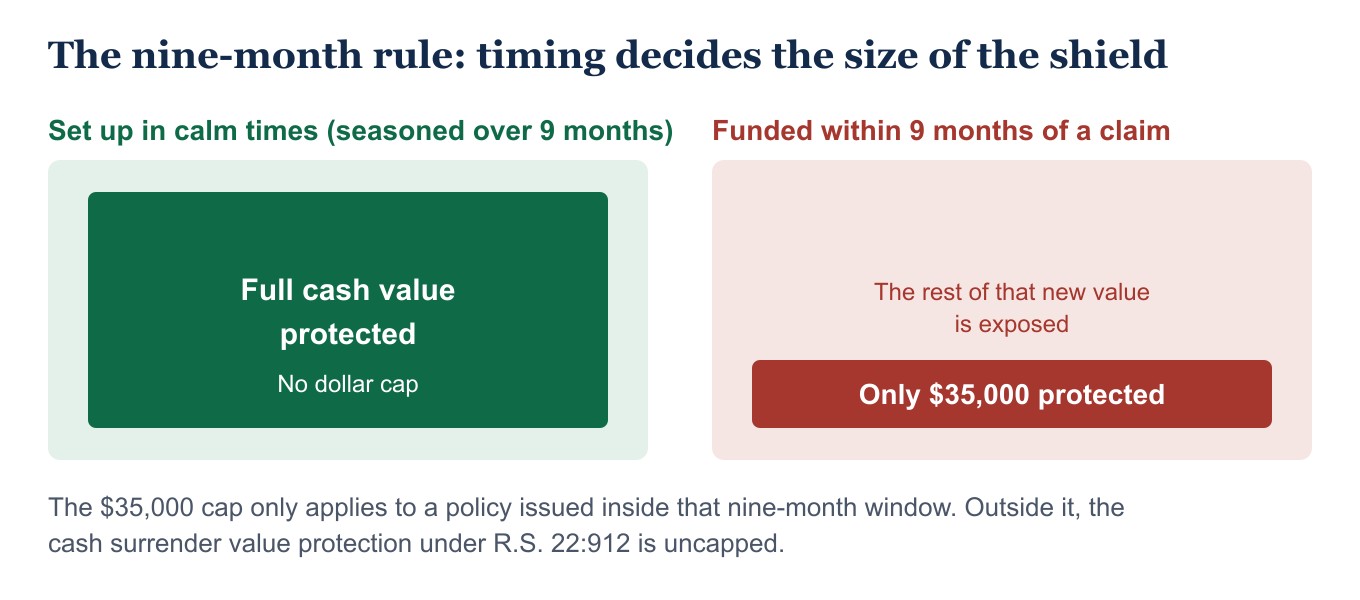
Here is the honest version, because you should hear the limits, not just the upside. In most cases the protection under 22:912 is uncapped. There is no dollar ceiling on how much of your cash surrender value and proceeds the law can shield.
There is one important exception, written into the statute as an anti-abuse rule. The exemption does not apply to cash surrender or loan value above $35,000 when the policy or contract “was issued within nine months of issuance of such writ, mandate, or process or the filing of a voluntary or involuntary bankruptcy proceeding.” In plain terms: if the policy was issued within nine months before a creditor’s writ or a bankruptcy filing, only $35,000 of that recently created value is protected. Once the policy has been in place longer than that nine-month window, the protection goes back to being uncapped.
The practical takeaway is simple. This is a tool you set up before trouble shows up, not the week after you get served. You cannot buy a policy on Monday to dodge a lawsuit on Friday and expect full protection. Set it up early, let it season past nine months, and the shield is at its strongest. A licensed Louisiana attorney can tell you how this applies to your timeline.
Not sure which compartment your money is sitting in? Retirement Shield walks Louisiana oil and gas workers through a short questionnaire and connects you with one licensed professional who can give you a straight answer for your numbers, then points you to your own attorney to confirm the structure. See where your savings stand →
What about an actual lawsuit or a bankruptcy?
The protection is not just theory on paper. Louisiana has opted out of the federal bankruptcy exemptions under La. R.S. 13:3881(B)(1), which means Louisiana residents use the state’s own exemption rules in bankruptcy. The courts have applied 22:912 in that setting. In In re Bordelon (Bankruptcy Court, Middle District of Louisiana, 2011), the court confirmed that the Bankruptcy Code does not preempt R.S. 22:912, so the statute’s protection of the proceeds and avails of these contracts carries into a bankruptcy case.
That same case also shows a real limit, so it is worth knowing both sides. The statute protects proceeds from a beneficiary’s own creditors only as to debts “existing at the time the proceeds or avails are made available for his own use.” In Bordelon, the creditor’s debt arose after the beneficiary had already received the proceeds, so the court held those proceeds were not exempt as to that later debt, and the beneficiary lost. The lesson for you: this is protection you build into your life in the ordinary course, well ahead of a claim, not a switch you flip once a creditor is already at the door.
There is one more Louisiana-specific wrinkle. Louisiana is a civil-law state, so a creditor who wants to undo a transfer you made does not use the fraudulent-transfer rules you may have read about from other states. Here the tool is the revocatory action under La. Civ. Code art. 2036, which lets a creditor annul a transfer that caused or deepened your insolvency. Intent to defraud is not even required. That is one more reason to fund these vehicles steadily over time, not as a last-second reaction to a claim.
Annuities get the same treatment under the statute. R.S. 22:912 covers immediate, deferred, fixed, equity-indexed, and variable annuities, so the protection is not limited to one narrow product type.
How is this different from my 401(k) or savings account?
This is the comparison that makes the whole thing click for working guys, because the rules are genuinely different depending on the account:
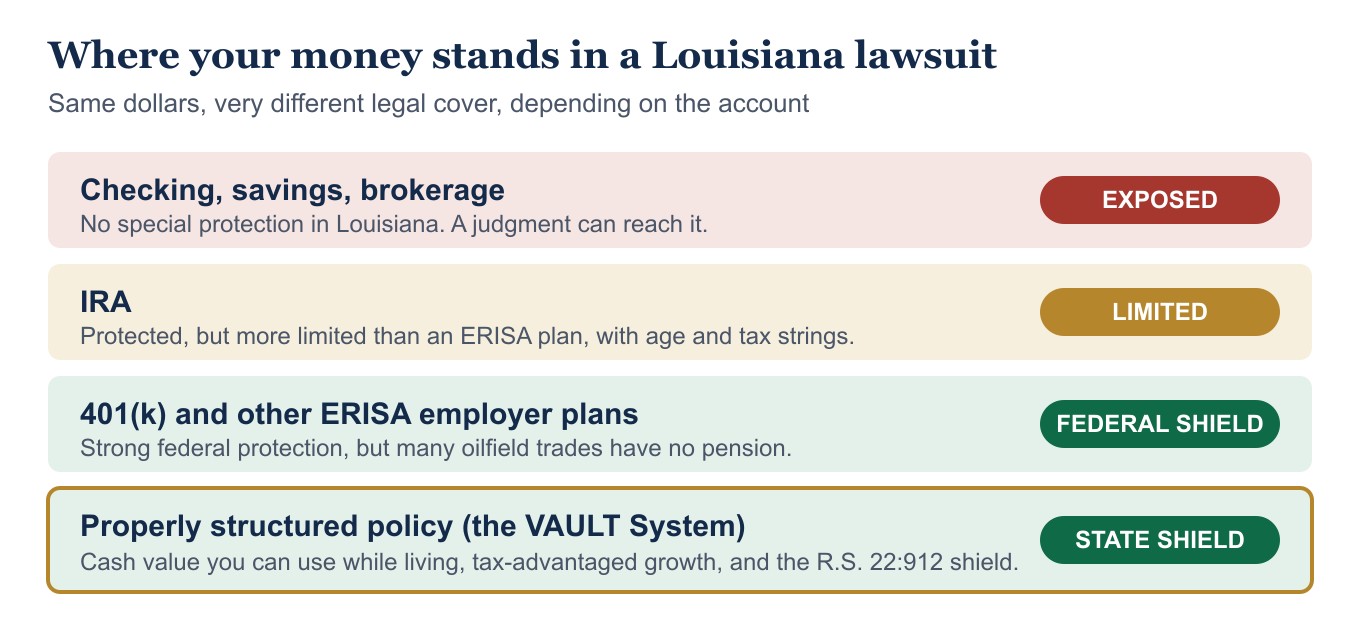
- Bank savings or a plain brokerage account: no special creditor protection in Louisiana. A judgment can reach it. This is where most people keep their “safe” money, and legally it is the most exposed.
- 401(k) and other ERISA employer plans: strong federal protection from creditors. The catch for oil and gas trades is that many of you do not have a real pension and may bounce between operators and contractors, so you cannot lean on an employer plan to carry your whole picture.
- IRAs: protected, but more limited than an ERISA plan, and the money is locked up with age and tax strings attached.
- A properly structured life insurance policy or annuity (the VAULT System): cash value you can access while living, tax-advantaged growth, and the 22:912 creditor shield described above.
Put bluntly, the dollars sitting in your checking and brokerage accounts are the ones a creditor can most easily reach. Moving a portion of your savings into a vehicle that Louisiana law treats as exempt is how you change that math. If you want the deeper, citation-by-citation version of how 22:912 works, our full guide to Louisiana life insurance creditor protection walks through the statute line by line, and our IUL versus 401(k) comparison for Louisiana savers digs into the tax side.
Where it does NOT protect you
No honest agent should sell you a shield without showing you the gaps. This law does not make anyone untouchable, and the following carve-outs are real:
- Pledged or assigned policies. If you pledge or assign the policy as collateral, for example to secure a loan, you lose the protection to the extent of that pledge. The part you signed over is no longer shielded.
- The beneficiary’s own later debts. As Bordelon showed, proceeds are exempt from a beneficiary’s creditors only for debts that existed when the proceeds were made available for the beneficiary’s own use. A debt that arises afterward can reach them.
- Federal claims. State exemptions do not stop everything. A federal IRS tax lien (26 U.S.C. 6321 and 6334) can reach assets that state law would otherwise protect, and a bankruptcy filing carries a look-back under 11 U.S.C. 548 for transfers made to defraud creditors.
None of this erases the value of the protection. It just means the shield is powerful, not absolute, and it works best when it is set up correctly and early. No agent can honestly call it lawsuit-proof. Confirm the specifics for your situation with a licensed Louisiana attorney.
Who this matters most for
If you are a Louisiana machinist, offshore technician, process operator, engineer, electrician, welder, or roughneck pulling a strong income, this is built for your reality:
- High income, high liability. You earn well and you work in an environment where claims and suits are part of the landscape. Exposed money is a problem you can actually fix.
- Boom-and-bust pay with no pension. You need a place to stack cash in the good years that you can reach in the lean ones, and that a bad year or a lawsuit cannot wipe out.
- You want leverage, not a lecture about “retirement.” The VAULT System is an asset you build and control, that grows tax-advantaged and carries this legal shield. That is a different conversation than a 401(k) match. If retirement income is also on your mind, see our guide to the offshore and oilfield retirement plan for Louisiana workers and the broader honest guide to the VAULT System in Louisiana.
Want a straight answer for your own numbers? Take the two-minute Retirement Shield questionnaire. You will see whether the VAULT System fits your income and your liability, and get connected with one licensed professional, no pressure and no obligation. Start the questionnaire →
Frequently asked questions
Is my life insurance cash value protected from creditors in Louisiana?
Yes. La. R.S. 22:912 shields the proceeds and avails of life insurance, and the statute says that includes the living cash surrender value, not just the death benefit paid to your family. Money kept inside a properly structured policy is treated very differently than money in a bank or brokerage account.
Can a lawsuit or judgment take money inside the VAULT System?
In most cases the creditor protection under 22:912 is uncapped, and courts have applied it even in bankruptcy. The main exceptions are a $35,000 cap on a policy issued within nine months of a writ or bankruptcy filing, policies pledged as collateral, and certain federal claims like an IRS lien. It can protect your money, but no agent can honestly call it lawsuit-proof.
Does Louisiana protect my 401(k) and savings the same way?
No. A 401(k) and other ERISA employer plans have strong federal creditor protection, but plain bank savings and brokerage accounts have no special protection in Louisiana, and IRA protection is more limited. The cash inside a properly structured life insurance policy or annuity is where the 22:912 shield applies.
What is the nine-month rule I keep hearing about?
If a policy is issued within nine months before a writ, legal process, or bankruptcy, protection for that recently created cash surrender or loan value is capped at $35,000. Once that nine-month seasoning period passes, the protection becomes uncapped. The lesson is to set this up early, well before any trouble appears.
Are annuities covered too?
Yes. The statute covers immediate, deferred, fixed, equity-indexed, and variable annuities, so the creditor protection is not limited to traditional life insurance.
Is this legal advice?
No. This article is educational. Asset-protection rules turn on the specific facts of your situation, so confirm how 22:912 applies to you with a licensed Louisiana attorney before acting.
This article is general education, not individualized legal, tax, or insurance advice, and not a recommendation to buy any product. Creditor and asset-protection outcomes depend on the specific facts, ownership structure, beneficiary designations, timing, and applicable exceptions under Louisiana Revised Statutes section 22:912 and other law, including La. R.S. 13:3881, La. Civil Code article 2036, 26 U.S.C. 6321 and 6334, and 11 U.S.C. 548. Statutory protections can change and are subject to court interpretation. Consult a licensed Louisiana attorney about any asset-protection strategy and a licensed tax or insurance professional before making decisions. Retirement Shield is a marketing and education brand, not a law firm, accounting firm, or insurance carrier. Linh Tuong Nguyen is licensed in Louisiana (License #1276760).