The term-versus-permanent argument is one of the most heated in personal finance, and most of the heat comes from people comparing the two as if they solve the same problem. They do not. Here is the honest version, including when the popular advice is right and when it misses the point.
Ask the internet whether you should buy term or permanent life insurance and you will get a shouting match. One camp says permanent insurance is a rip-off and everyone should buy cheap term and invest the rest. The other says permanent insurance is a secret wealth tool. Both are describing real things and both are overstating their case, because term and permanent insurance are not competitors. They are different tools for different jobs, and the honest question is not which is better but which problem you are solving.
What is term life insurance?
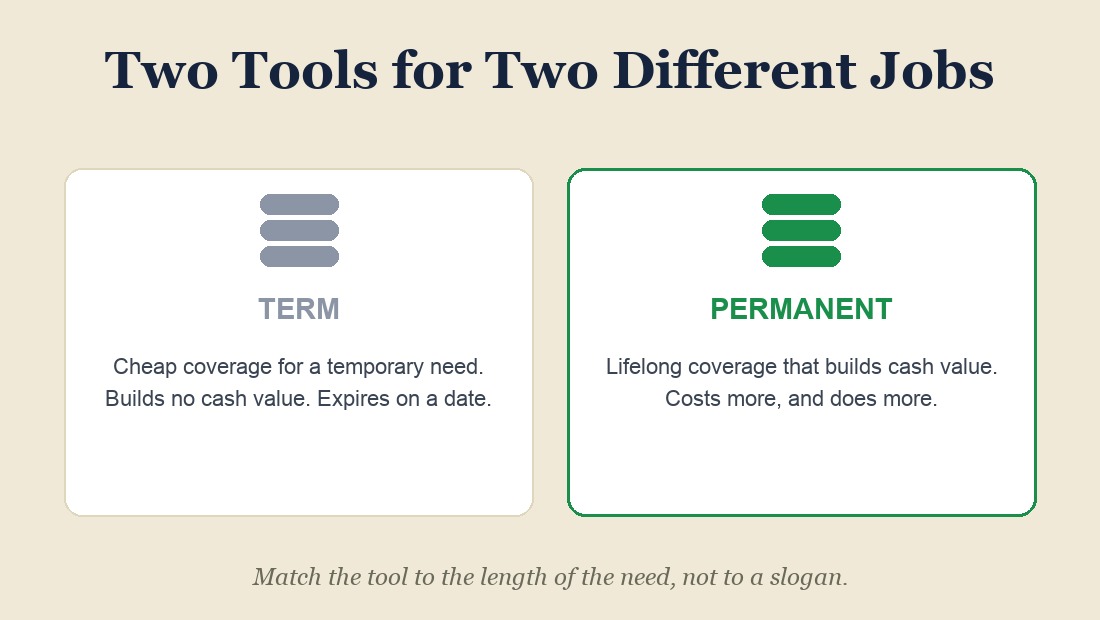
Term insurance is the simplest form of life insurance. You pay a premium for a set period, commonly 10, 20, or 30 years, and if you die during that term, it pays a death benefit. If you outlive the term, the coverage ends and there is nothing to collect. It has no cash value and no savings component. In exchange for that simplicity, it is inexpensive: for a healthy person, a large term death benefit costs a fraction of what permanent coverage costs.
Term is superb at one job: covering a temporary, defined need. A mortgage. The years until the kids are grown. Replacing your income during your working life. For that job, it is usually the right and cheapest answer, and an honest agent will tell you so.
What is permanent life insurance?
Permanent insurance, including whole life and indexed universal life, is designed to cover you for your entire life, and it builds cash value alongside the death benefit. That cash value grows tax-deferred and can be accessed during your lifetime, and in Louisiana it carries meaningful creditor protection. For the same death benefit, it costs considerably more than term, because you are funding both lifelong coverage and the cash value.
Permanent insurance is not good at the job term is good at, cheap temporary coverage. It is good at a different set of jobs: lifelong needs, tax-advantaged accumulation and income, leaving a guaranteed benefit, and living benefits you can use if you become ill.
The problem each one solves
Term insures a temporary need. Permanent builds a lifelong, tax-advantaged asset. Comparing their price alone compares two different things.
This is the crux. If you only need to protect your family during your working years, permanent insurance is an expensive way to buy something term does better. But if your goal includes tax-free income, a guaranteed benefit for heirs, creditor protection, or access to money while living, term simply cannot do those things at any price, because it has no cash value. Judging them on premium alone is like judging a rental and a house purchase by the monthly payment.
Is “buy term and invest the difference” good advice?
Often, yes, and we will say so plainly. For someone whose need is temporary and whose alternative is a poorly structured, underfunded permanent policy sold on a rosy illustration, buying cheap term and investing the savings is sound. Much of the criticism of permanent insurance is really criticism of bad permanent insurance, and that criticism is fair.
Where the advice misses is when the goal is specifically the things only cash value provides: tax-free income you cannot get from a taxable investment account, the Louisiana creditor protection, the living benefits, the guaranteed death benefit. For those goals, “invest the difference” does not reach the same destination. The honest rule is: buy term for temporary protection, and consider permanent insurance only for the specific long-term jobs it uniquely does, and only if you can fund it properly. Our honest IUL guide covers exactly when that second condition is and is not met.
How to choose
- Temporary need, lowest cost: term.
- Lifelong need, tax-free income, creditor protection, living benefits, and you can fund it consistently: permanent may fit.
- Not sure you can fund a permanent policy for the long haul: term now, revisit later. An underfunded permanent policy is worse than a well-chosen term one.
Many people are best served by owning both over a lifetime: term for the years of maximum temporary need, permanent for the specific long-term goals. The mistake is treating it as a war to be won rather than two tools to be used.
Which job are you actually solving for?
The free masterclass covers when permanent, cash-value insurance earns its place, and the 60 second quiz afterward checks whether it fits your situation, honestly.
Watch the MasterclassThe catch the term pitch leaves out
“Buy term and invest the difference” rests on two claims: term is cheaper, and you will invest what you save. The first is true. The second is where it usually falls apart, because most people never invest the difference. They buy the cheaper policy, spend the savings, and end up with neither the coverage nor the account. Studies of how people actually behave have said the same thing for years.
There is a sharper problem hiding in the math. An insurance company will only sell you a term policy it is highly confident you will outlive, because that is how term is priced to make money. So a healthy thirty-five-year-old buying a ten-year term is, by the insurer’s own numbers, very likely to pay every premium and never collect a dollar. Put a figure on it. A policy at a hundred and twenty dollars a month runs about fourteen thousand four hundred dollars over ten years, and the most probable outcome is that you pay all of it and walk away with nothing but the peace of mind. If the entire case rests on letting the numbers decide, the honest version of that case would tell you to skip the term too. It almost never does.
None of that makes term a bad product. It makes “buy term and invest the difference” a personal preference dressed up as a proof.
Where term still earns its place
Term is the right tool more often than permanent-insurance salespeople like to admit. It is inexpensive, and for a young Louisiana family with a mortgage and small children, a large term policy for a low monthly cost is exactly the protection they need during the years when losing a paycheck would be financially catastrophic. Used as a bridge, while you are building, or while permanent coverage is not yet in the budget, it does real work. Worst case, something happens and your family is hundreds of thousands of dollars better off for having it.
Two cautions before you buy. First, a lot of modern term can carry living-benefit riders that let you pull a large share of the death benefit forward if you are diagnosed with something like a heart attack, stroke, or cancer, so ask whether yours includes them. Second, read the marketing carefully. Some policies are sold as coverage “to age ninety-five” when the premium quietly steps up every ten years and eventually becomes unaffordable, which means the coverage disappears exactly when you are old enough to need it. Find the column in the illustration where the premium jumps, and make sure you know what you actually bought.
When permanent coverage earns its keep
Term is the right answer for a temporary need, and most needs are temporary. The mortgage gets paid off, the kids grow up and move out, the retirement accounts fill in. When the need has an expiration date, so should the policy. But some needs never expire, and that is exactly where permanent coverage stops being a luxury and starts being the tool that fits.
A few situations make the case cleanly. If you have a dependent who will rely on you for life, a child with special needs, for example, the need does not end at sixty-five, and a policy that does is the wrong shape. If part of your goal is a cash value you can use while you are alive, term cannot do that at all, because it never builds any. If you are planning around a legacy or an estate, a permanent death benefit that pays income-tax-free and arrives no matter when you pass is doing a job term was never designed for. And for a business owner, permanent coverage can fund a buy-sell agreement, protect against the loss of a key person, or become a pool of accessible capital, roles that require the policy to still be there in thirty years.
There is also the quieter case: the person who wants forced, tax-advantaged savings with protection wrapped around it, and who values the discipline of a plan they cannot casually raid. For them the point is not the death benefit at all. It is what the policy makes them do with their money while they are alive.
The mistake in the whole debate is treating it as term versus permanent, as if one has to win. In a real plan they often work together: term to cover the big temporary risks cheaply while you are building, permanent to hold the piece of the need that never goes away. Matching the tool to the length of the need, rather than to a slogan, is the entire skill.
What is the difference between term and permanent life insurance?
Term insurance covers you for a set period, such as 20 or 30 years, and pays a death benefit only if you die during that term. It has no cash value. Permanent insurance covers your whole life and builds cash value you can access, but costs more for the same death benefit.
Is term life insurance better than permanent?
For pure, temporary death-benefit protection at the lowest cost, term is usually better. Permanent insurance is better when you have a lifelong need or want the tax-advantaged cash value and living benefits. They solve different problems, and many people benefit from term while young and permanent for specific long-term goals.
Should I buy term and invest the difference?
For many people, buying term and investing the difference is sound advice, especially if the alternative is an underfunded or poorly structured permanent policy. Permanent insurance makes sense for the specific reasons cash value provides, tax-free income access, creditor protection in Louisiana, and living benefits, not as a simple substitute for investing.
Does term life insurance build cash value?
No. Term insurance has no cash value. You pay for the death benefit only. When the term ends, the coverage ends, and there is no savings component to access.