Offshore and industry work pays well and ends early. There is no pension waiting, the income comes in waves, and the body has an expiration date the paycheck does not warn you about. This is the retirement guide written for the way Gulf work actually works.
The retirement advice you find online was written for someone with a steady salary, an employer 401(k) with a match, and a career that ends politely at sixty-five. If you work offshore, in the oilfield, or in a plant, none of that describes you. You make more than that person in a good year and nothing in a bad one, no employer is quietly funding your retirement, and your career may end not when you choose but when your body or the industry decides. That is not a disadvantage. It just means the standard playbook does not fit, and following it anyway is how good money disappears.
Why the usual advice does not fit
Three facts about Gulf work change everything about how retirement should be built:
- There is usually no pension. Unlike a Louisiana teacher or state employee, you are not owed a defined monthly income for life. Whatever you retire on, you have to build yourself.
- The income is lumpy. Overtime-heavy hitches, boom years, and dry spells mean your ability to save swings hard from year to year. A plan that assumes a steady monthly contribution breaks the first slow season.
- The career can end early. Offshore and industrial work is physically demanding. Many workers are done, by choice or by injury, well before traditional retirement age, which means the money has to last longer and start sooner than the average plan assumes.
Saving on wave income
The single biggest mistake Gulf workers make is treating good years like they will last. A strong year offshore can produce more disposable income than many professionals see, and without a system, it gets absorbed by lifestyle and gone by the next downturn.
The fix is a structure that lets you fund heavily in strong years without being punished in weak ones. That rules out some rigid vehicles and favors flexible ones. It also argues for a forced-savings component, something that makes the good-year money hard to casually spend, because discipline in a boom is what funds the retirement.
The retirement of a Gulf worker is decided in the good years, by whether that money was captured or spent.
Planning for a career that ends early
If your working life may end in your fifties rather than your sixties, two things follow. First, the retirement money has to stretch across more years, so it needs to be larger and it needs protection from a bad market at the wrong moment. Second, the gap between when the paycheck stops and when Social Security or other income begins can be long, and it has to be bridged with your own savings.
This is exactly why a tax-free, market-protected income source is worth more to a Gulf worker than to almost anyone else. When your income has to start early and last long, you cannot afford to hand a large slice of it to taxes, or to watch it fall in a market drop the year you stop working.
Severance and shutdown money
Plant shutdowns, layoffs, and end-of-project payouts put large lump sums in workers’ hands, often with little warning and less guidance. A severance check or a rolled-over 401(k) from a job that ended is a pivotal moment: handled well, it becomes the seed of a real retirement; handled carelessly, it is taxed heavily and spent within a year.
The key is deciding, before the money arrives, where it will go. A tax-advantaged rollover, a structured savings vehicle, or a mix, chosen in advance, is the difference between a lump sum that compounds for twenty years and one that is gone by the next hitch.
Building a retirement no employer will
Because no one is doing this for you, the structure has to do the work. For many Gulf workers, the right foundation has a few features: it accepts uneven funding, so a big year can catch up for a slow one; it protects the money from market crashes, so an early retirement is not derailed by bad timing; and it produces income that is not taxed, so the money you worked offshore for actually reaches you.
Those features describe why a properly structured life insurance policy fits this profile better than almost any other. It is not the right answer for someone who cannot fund it, and we say so plainly in our honest guide to indexed universal life. But for a high-earning worker with no pension, irregular income, and an early finish line, it is one of the few tools built for exactly that shape. It also carries a Louisiana-specific advantage, strong protection of the money from creditors under state law, that matters for contractors and anyone with liability exposure.
Built for high, irregular income and an early finish line.
The free masterclass shows how to turn good-year money into tax-free, market-protected income. The 60 second quiz afterward checks whether it fits your situation, honestly.
Watch the MasterclassTurning Irregular Income Into a Real Plan
Most retirement advice is written for someone with a flat paycheck, the same number every two weeks, year after year. That is not your life. Offshore work and plant work pay well, often very well, but the money arrives in a rhythm that a salaried person never has to think about. There are stretches when the checks are big and the hitches are steady, and there are stretches when a project winds down, a turnaround ends, or the schedule thins out and the income drops for a while. If you try to run a flat monthly savings plan on top of lumpy income, you end up doing one of two things: saving too little because you planned around a lean month, or overcommitting because you planned around a fat one and then scrambling when the fat month does not repeat.
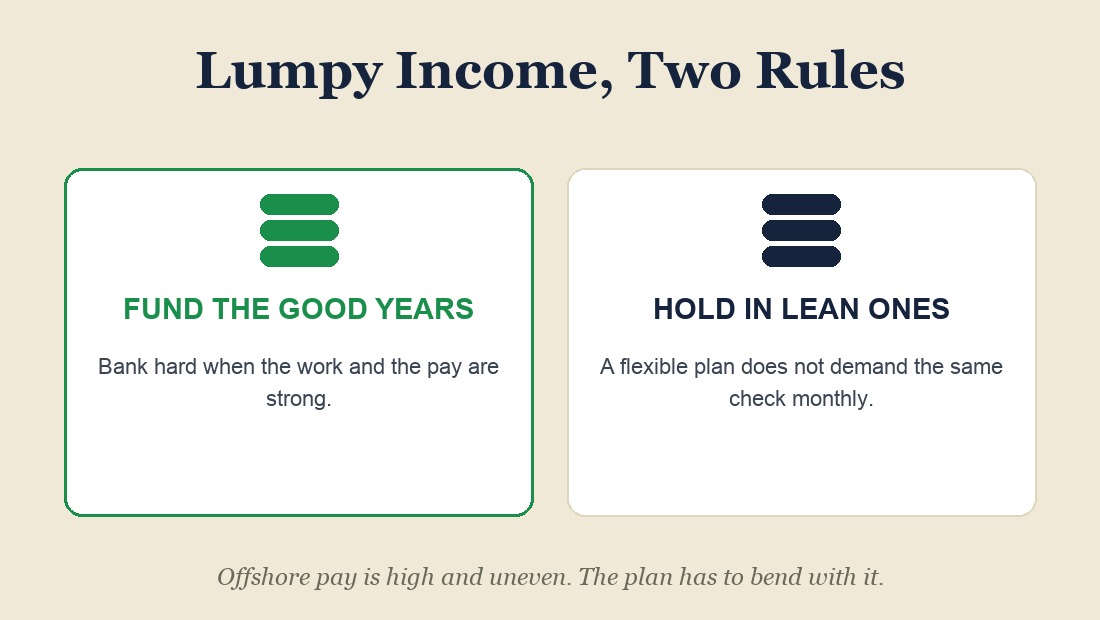
The better mental model is to build the plan around the rhythm instead of pretending the rhythm is not there. The principle is simple to say and takes discipline to live: fund hard in the good stretches, and hold steady in the lean ones. When the money is flowing, that is the moment to move meaningful amounts into your retirement and savings, more than a flat monthly number would ever capture, because that is when the capacity is real. When the work thins out, you are not trying to force the same contribution out of a smaller check. You are protecting what you already set aside and letting the good-year momentum carry you. The heavy lifting happens when the lifting is easy.
What this requires is knowing your own baseline honestly. Look back across a couple of years and find the floor: the income level you can genuinely count on even in a slow stretch. Build your fixed obligations and your steady, minimum saving around that floor, not around your best year. Then treat everything above the floor as capacity to fund hard on purpose, rather than as extra spending money that quietly disappears. This is not about a specific dollar figure, and I am not going to hand you one, because your floor is yours and no one else’s. It is about the shape of the plan matching the shape of your income. A flat contribution schedule fights your paycheck. A plan built around funding hard in the good years and holding steady in the lean ones works with it. When you are ready to put real numbers to this, confirm the details of your own accounts and situation with a professional, because the structure is general but the amounts have to be yours.
The Severance or Buyout Question
Sooner or later, a lot of offshore and industry careers include a moment nobody plans for: a project ends, a plant announces a closure, or a company offers a buyout, and a lump sum lands in front of you. It can be a large number. And in that moment, under stress and often with a deadline, the default choice is the most tempting one and frequently the most expensive: just take the cash. Before you do, it is worth understanding what the default actually costs, because the headline amount and the amount you keep are not the same thing.
Here is the general principle. If a severance or buyout includes retirement-plan money, taking it as cash usually triggers taxes, and because it all arrives in a single year, it can stack on top of your other income for that year and be taxed more heavily than your normal earnings. That is the trap hiding inside a big check. There is often an alternative: rolling eligible funds into an IRA or another eligible retirement account, which can keep that money tax-deferred instead of turning it into a one-year taxable event. Rolling it does not make the money disappear or lock it away forever. It preserves it in a tax-deferred form so you decide later how and when to use it, rather than handing a large slice to taxes right now simply because that was the path of least resistance.
I want to be careful and honest here, because not every dollar in a payout is the same kind of money. Some of a package might be retirement-plan money that is eligible to roll. Some might be severance pay or other compensation that is simply taxable wages and works differently. The right first move is not to assume, and definitely not to cash the whole thing on reflex. It is to find out what type of money each part is before you touch it, and to understand your rollover options for the portion that qualifies. I am keeping this conceptual on purpose and not quoting rates or limits, because those depend on the specifics and on current rules. When a lump sum shows up, slow down long enough to ask the two questions that matter: what kind of money is this, and what does cashing it actually cost me versus rolling it. Then confirm the answers with a tax professional before the deadline pressure makes the decision for you.
I have no pension. Where do I even start?
With a structure that fits irregular income: one you can fund heavily in strong years, that protects the money from market drops, and that produces tax-free income. The right specific tool depends on your income, age, and health.
What should I do with a severance or plant-shutdown payout?
Decide where it goes before it arrives. A tax-advantaged rollover or structured savings vehicle can turn a one-time lump sum into decades of retirement income; taken as cash, much of it is lost to tax and spending.
Why does an early retirement change the plan?
Because the money has to start sooner and last longer, and it cannot afford a bad market year at the start or a heavy tax bill. Protection and tax treatment matter more when the timeline is longer.
Is life insurance really a retirement tool for oilfield workers?
A properly structured policy can be, because it accepts uneven funding, protects against market loss, produces tax-free income, and is shielded from creditors under Louisiana law. It is not right for everyone; funding consistency is the deciding factor.
Building the savings is only half the job. Protecting it from lawsuits and creditors is the other half: see how Louisiana law shields an oil and gas worker’s money.
Earning big with no pension? See how to turn it into tax-free retirement income as a Louisiana oil and gas worker.
Related reading on protecting your money in Louisiana: Is life insurance protected from lawsuits and creditors in Louisiana? and our complete guide to Louisiana life insurance creditor protection.