You already hand over a fortune in taxes during your big years. The retirement question almost nobody frames honestly for oilfield hands: do you want to be taxed on the money going in, or taxed again on every dollar, plus all of its growth, when you finally pull it out decades from now at a rate nobody can predict?
Short answer: if you are a high earner with no pension, the account that saves you a little tax today can quietly cost you far more in retirement. A traditional 401(k) or IRA does not erase your tax bill. It postpones it, and it hands the rate-setting power to a future Congress. Tax-free retirement income turns that around. When a policy is structured and managed correctly, the money you draw in retirement is not added to your taxable income at all. For a worker who earns well in the booms, has no pension waiting, and has either maxed out or stopped trusting tax-deferred accounts, that difference is the whole ballgame.
This is general education, not individualized tax or financial advice. How any of this applies to your income, your brackets, and your goals depends on your specific facts, so confirm every move with a licensed tax or financial professional before you make it. With that said, here is the framework every high-income oil and gas worker in Louisiana should understand.
What “tax-free retirement income” actually means
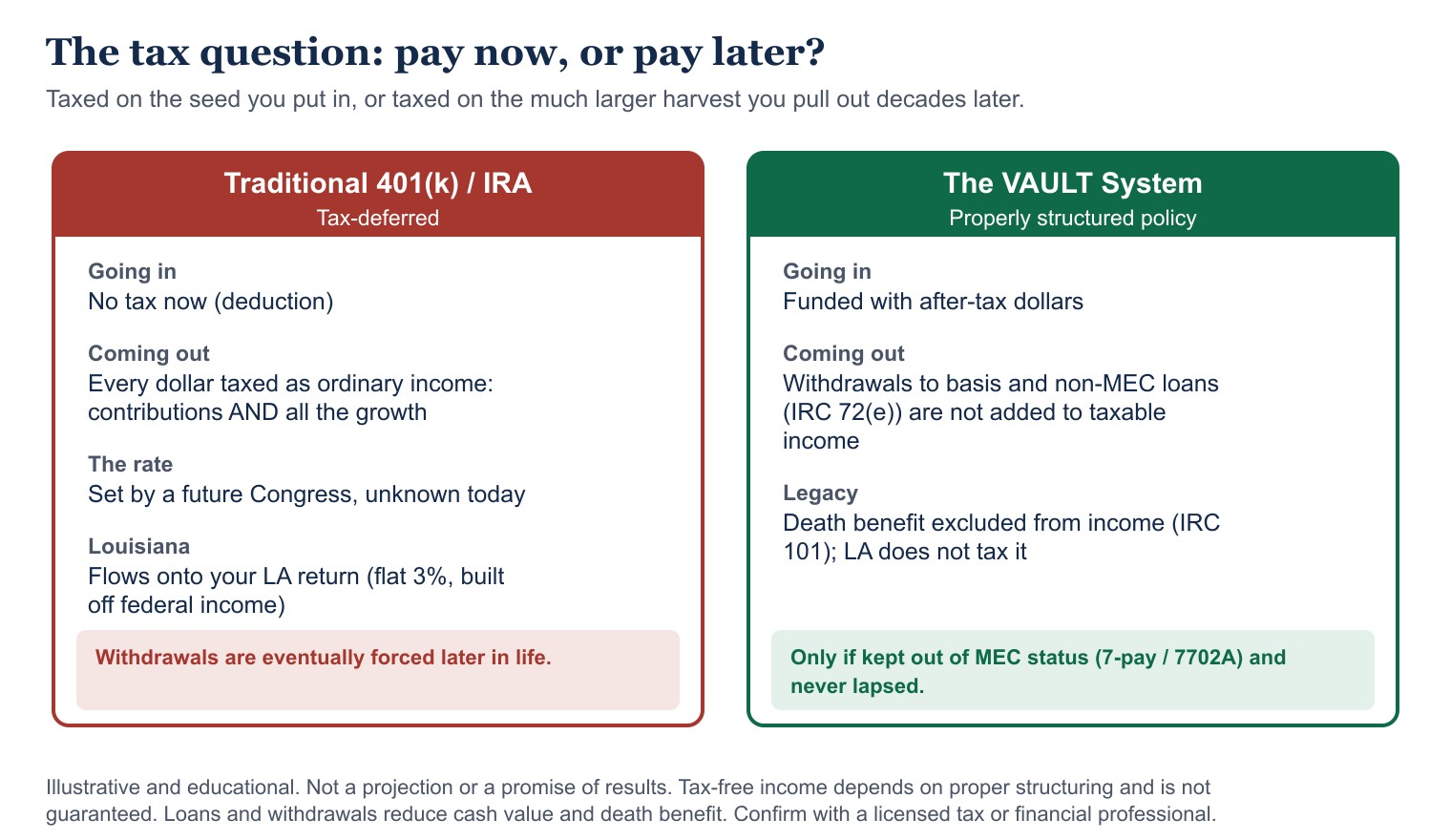
Most retirement accounts you have heard of are tax-deferred. A traditional 401(k) or IRA gives you a deduction the year you contribute, lets the balance grow without annual tax, and then taxes every dollar you withdraw in retirement as ordinary income. You did not avoid the tax. You moved it to later and let it grow right along with your balance.
Tax-free retirement income is money you can draw in retirement that is not added to your taxable income when you take it. That is a fundamentally different deal for a high earner, because the amount coming out in retirement, after years of growth, is usually far larger than the amount that went in. Being taxed on the smaller seed instead of the much larger harvest is the entire point.
Why “defer the tax” can be the wrong bet for a big earner
Deferring tax feels like a win in a boom year, and sometimes it is. But stack up what you are actually agreeing to when a large share of your retirement sits in tax-deferred accounts:
- You lock in an unknown future rate. You take the deduction at today’s rate, but you pay the bill at whatever rate exists when you withdraw, decades out, set by a Congress that has not been elected yet. You are betting rates will be lower later. For a high earner with a growing balance, that is not a safe bet.
- You pay ordinary income tax on the growth too, not just your contributions. Every dollar of market gain inside a traditional account comes out taxed as ordinary income. The bigger the account grows, the bigger the eventual bill.
- Louisiana taxes it on the way out. Louisiana’s individual income tax is a flat 3% for tax years on or after January 1, 2025, and the state builds its tax off your federal adjusted gross income. A large traditional-account withdrawal is taxed federally and then flows straight onto your Louisiana return, so it gets taxed on both lines.
- Eventually the withdrawals are forced. Tax-deferred accounts require you to start taking money out later in life whether you need it or not, which can push taxable income up in years you were trying to keep it down.
- There is a ceiling on how much you can even shelter. Contribution limits cap what a high earner can put into these accounts each year, so for a lot of oilfield guys the 401(k) was never going to carry the whole retirement anyway.
None of this makes a 401(k) worthless. A company match is still close to free money and worth taking. The point is narrower and more honest: for a high earner, leaning on tax-deferred accounts alone means betting your whole retirement on future tax rates staying friendly. A second bucket that is not taxed on the way out is how you stop making that bet with all of your chips. Our side-by-side of the VAULT System versus a 401(k) for Louisiana savers walks through that tax math in detail.
How the VAULT System creates income the IRS does not tax
At Retirement Shield we call the strategy the VAULT System, which is a properly structured permanent life insurance policy used as a tax-advantaged place to build and later draw money. It creates income two ways, and both rest on established federal tax rules rather than any loophole.
First, withdrawals up to your basis. The premiums you paid in are your own after-tax money, so taking that money back out is not taxed. Second, properly structured policy loans. Under Internal Revenue Code section 72(e), a loan taken against the cash value of a policy that is kept in force is not treated as income, because borrowed money is not income. You did not sell anything and you did not realize a gain. Combine the two, draw your basis first and then borrow against the growth, and you can pull a stream of money that does not land on your tax return as income. Paired with that, the death benefit your family receives is excluded from gross income under IRC section 101(a)(1), and because Louisiana starts from federal income, the state does not tax it either. Louisiana also has no inheritance tax and no state estate transfer tax.
Now the part most sales pitches skip, because you deserve the limits, not just the upside. This treatment only holds when the policy is built and managed correctly:
- The policy must not become a modified endowment contract (a MEC). Overfunding a policy past the federal 7-pay limit under section 7702A turns it into a MEC, and then loans and withdrawals are taxed gains-first, with a possible 10% penalty before age 59½. Proper structuring is what keeps a policy out of MEC status.
- Loans and withdrawals reduce your cash value and your death benefit. This is real money coming out, not free money. Borrow too aggressively and you starve the policy.
- A lapse or surrender with an outstanding loan can trigger tax. If the policy collapses while you owe a loan, gain above your basis can become taxable in that year, which is the opposite of what you were going for.
So the honest framing is this: the income can be tax-free, but only when the policy is structured right, funded steadily, and watched over the years so it never lapses or tips into MEC status. This is not a set-it-and-forget-it product, and it is not guaranteed. Confirm the specifics with a licensed tax or financial professional before you rely on any of it.
Wondering what a tax-free bucket would actually look like on your income? Retirement Shield walks Louisiana oil and gas workers through a short questionnaire and connects you with one licensed professional who can run the numbers for your situation, with no pressure and no obligation. See what your numbers say →
Why this fits the Louisiana oil and gas worker
Tax-free income is useful for a lot of people, but it fits the high-earning oilfield, offshore, and plant worker almost perfectly, for reasons that have nothing to do with a sales script:
- You have maxed out or stopped trusting tax-deferred accounts. Either you have already hit the annual limits, or you have looked hard at the idea of locking more money behind age rules and a future tax bill and decided you want a different kind of bucket. A properly structured policy is that different bucket.
- No pension is coming. Nobody is mailing you a lifetime check for your years on the rig. The income has to be something you build and control yourself, and this is a vehicle you own.
- Your pay comes in waves. A policy can be funded heavily in the strong years rather than forced into a flat monthly number, which suits income that does not come smooth. The mechanics of saving on that boom-and-bust rhythm are covered in our guide to the offshore and oilfield retirement plan for Louisiana workers.
- Tax diversification. If every retirement dollar you own is tax-deferred, your whole future is exposed to one thing: rates going up. A bucket that is not taxed on withdrawal lets you choose which account to draw from each year to manage your bracket.
- Access without the same age handcuffs. Properly structured loans and withdrawals to basis from a non-MEC policy are generally not bound by the age-59½ rules that fence in a 401(k), which matters for a trade where careers can end early.
If you want the plain-English version of the whole strategy before you talk to anyone, start with our honest guide to the VAULT System in Louisiana.
The honest limits, and the bonus most people miss
No straight-talking agent should hand you a strategy without the fine print, so here it is in one place. This is life insurance first, which means it carries costs and requires that you qualify through underwriting. The tax-free income is not guaranteed and depends entirely on correct structuring, steady funding, and keeping the policy in force for the long haul. Borrow too hard or let it lapse with a loan outstanding and you can create the exact tax bill you were trying to avoid. It is a tool you set up early and tend over time, not a quick move you make the year before you retire.
There is one bonus worth naming. In Louisiana, the cash value inside a properly structured life insurance policy also sits behind a strong creditor shield under state law, which matters in a high-liability line of work. We cover that in our guide to asset protection for Louisiana oil and gas workers. Tax-free income is the reason most clients start the conversation. The protection is the part that makes them glad they did. For every piece of this, confirm the specifics with a licensed tax or financial professional.
Want to see whether a tax-free bucket fits your income? Take the two-minute Retirement Shield questionnaire. You will see whether the VAULT System makes sense for your earnings and your goals, and get connected with one licensed professional, no pressure and no obligation. Start the questionnaire →
Frequently asked questions
What makes retirement income from a life insurance policy tax-free?
Two things working together, when the policy is structured and managed correctly. Withdrawals up to your basis, the premiums you already paid in, are your own after-tax money and are not taxed. Policy loans against the cash value of a policy kept in force are not treated as income under Internal Revenue Code section 72(e), because borrowed money is not income. Drawing basis first and then borrowing against growth can produce a stream that does not land on your return as income. This only holds for a policy that stays out of modified endowment contract status and does not lapse, so confirm your plan with a licensed tax or financial professional.
Is a 401(k) or the VAULT System better for a Louisiana oilfield worker?
It is usually not either-or. A company match in a 401(k) is still worth taking. The issue is relying on tax-deferred accounts alone, which bets your whole retirement on future tax rates staying low. Adding a bucket that is not taxed on withdrawal gives you tax diversification and lets you manage your bracket in retirement. Our comparison of the VAULT System versus a 401(k) for Louisiana savers walks through the trade-offs.
Will Louisiana tax the income I draw from a properly structured policy?
Louisiana builds its individual income tax off your federal adjusted gross income, at a flat 3% for tax years on or after January 1, 2025. Properly structured policy loans and withdrawals to basis from a non-MEC policy are generally not federal income, so they do not flow onto your Louisiana return as income the way a traditional-account withdrawal does. Louisiana also does not tax life insurance death benefits and has no inheritance or state estate tax. Confirm how this applies to you with a licensed tax professional.
Can I lose the tax benefit?
Yes, which is why structuring matters. If the policy is overfunded past the federal 7-pay limit it becomes a modified endowment contract, and then loans and withdrawals are taxed gains-first with a possible penalty before age 59½. If the policy lapses or is surrendered with an outstanding loan, gain above your basis can become taxable. A policy that is built correctly, funded steadily, and kept in force is how you avoid those traps.
Do I have to wait until 59½ like a 401(k)?
Properly structured policy loans and withdrawals to basis from a non-MEC policy are generally not bound by the age-59½ rules that restrict a 401(k), which is one reason the strategy suits a trade where careers can end early. Note that distributions from a policy that has become a MEC can carry a 10% penalty before 59½. Confirm the details for your policy with a licensed tax or financial professional.
Is this guaranteed, or is this tax advice?
Neither. The tax-free income is not guaranteed and depends on correct structuring, steady funding, and keeping the policy in force. This article is general education, not individualized tax or financial advice. Confirm how any of it applies to your situation with a licensed tax or financial professional before acting.
Changing operators or contractors? Here is what to do with your 401(k) when you change oilfield jobs.
This article is general education, not individualized tax, legal, or insurance advice, and not a recommendation to buy any product. Tax outcomes depend on the specific facts, how a policy is structured, funded, and maintained, and on applicable federal and state law, including Internal Revenue Code sections 101, 72(e), and 7702A, and Louisiana Revised Statutes sections 47:32 and 47:293. Loans and withdrawals reduce cash value and the death benefit, and a lapse or a modified endowment contract can create taxable income. Tax rates and rules can change and are subject to interpretation. Consult a licensed tax or financial professional about your own situation, and a licensed Louisiana attorney on any asset-protection question. Retirement Shield is a marketing and education brand, not a law firm, accounting firm, or insurance carrier. Linh Tuong Nguyen is licensed in Louisiana (License #1276760).