Hundreds of thousands of people retire to Florida every year, and most of them come partly for the same reason: no state income tax on top of the weather. That instinct is right. But a move made for taxes only pays off if you do two things that many new arrivals skip. You have to make Florida your real legal home, and you have to deal with the federal side of your retirement that followed you down here. Get both right and Florida becomes one of the best places in the country to retire. This is the plan.
For the full strategy, start with our pillar, Tax-Free Retirement Income in Florida.
First, make the residency real
Florida’s zero income tax only protects you if Florida is genuinely your domicile, your true legal home. Snowbirds who split the year, and anyone who moves without cutting ties to a high-tax state, can find that their old state still claims a share of their retirement income. Several high-tax states audit former residents and look closely at where you actually spend your time, where you vote, and where your life is based.
The good news is that establishing Florida residency is straightforward, and the paperwork is what makes the tax win stick. Do these soon after you arrive:
- File for the Florida homestead exemption on your primary residence. It removes up to 50,000 dollars of assessed value and starts the Save Our Homes cap that limits future assessment increases.
- Get a Florida driver’s license and register your vehicles here.
- Register to vote in Florida.
- Move your banking, your mailing address, and your primary doctors and advisors to Florida.
- Update your will, trust, and powers of attorney to Florida law, and file a Declaration of Domicile if it fits your situation.
- If you keep a home in another state, be mindful of how many days you spend there, since day counts are exactly what a former state looks at.
What a residency audit actually looks at
When a high-tax state believes a former resident still owes it money, it looks past the address on your license and examines where your life actually happens. The common factors are the number of days you spend in each state, where you are registered to vote, where your cars are registered, where your doctors and dentists are, where your bank and financial accounts are based, where your closest family ties are, and where you keep the possessions that matter most to you. No single item decides it. The state weighs the whole pattern. That is why a clean break works better than a half move: the more of these that clearly point to Florida, the less room another state has to make a claim. If you split your time, keep good records of your days, because in a dispute the burden often lands on you to show where you were.
Why Florida is the best place to do a Roth conversion
Here is the move most transplants miss, and it is a big one. A Roth conversion means moving money from a traditional 401(k) or IRA into a Roth, paying the tax now, so it grows and comes out federal-tax-free later. The tax you pay on a conversion has two parts, federal and state. In a state with an income tax, you pay both. In Florida, you pay only the federal part, because there is no state income tax on the conversion.
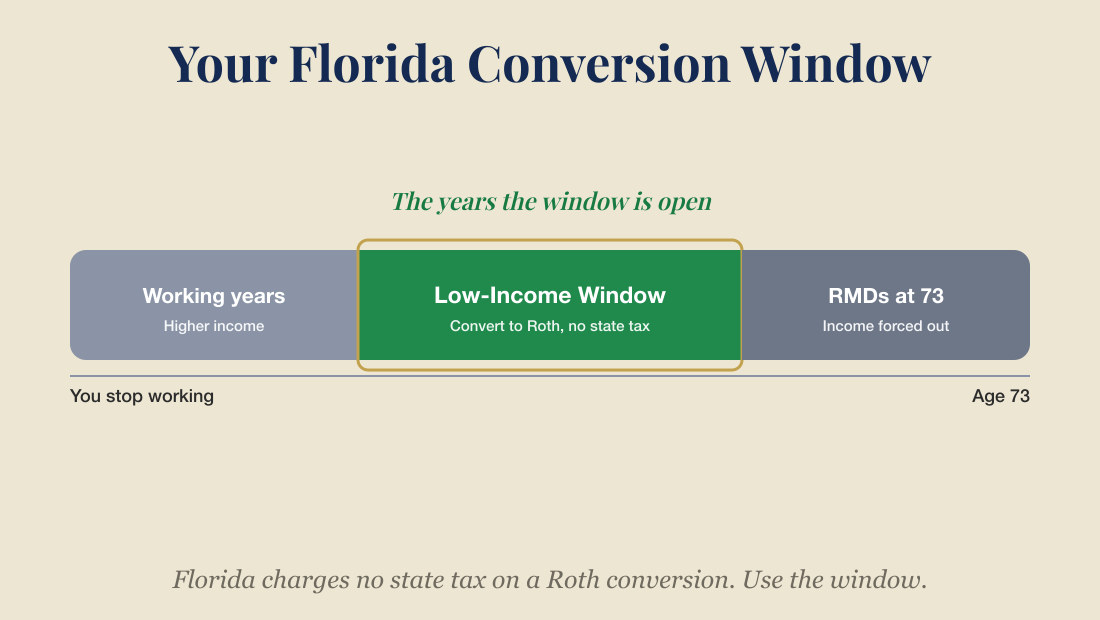
That makes Florida one of the most tax-efficient places in the country to convert. If you spent your career in a high-tax state and are now a Florida resident, the years between when you retire and when required distributions begin can be a golden window: relatively low income, no state tax on the conversion, and a chance to move a large amount of tax-deferred money into the tax-free column at a discount you would not have gotten back home. This single point can be worth more than the weather.
The federal gap you brought with you
The money you saved during your working years came to Florida with its federal tax treatment attached. Your traditional 401(k) and IRA are still fully taxable federally when you draw them, up to 85 percent of your Social Security can be taxed at the federal level, and required minimum distributions at 73 will force income out on the government’s schedule. Florida changed your state bill to zero. It did not change any of that.
So the plan for a transplant is not to celebrate the state win and stop. It is to use the state win, especially the free Roth conversions, to shrink the federal gap while your income is low and before required distributions start.
How much the move actually saves
It helps to put a rough number on it. This is a hypothetical illustration, not a projection of your results. Picture a retired couple drawing 80,000 dollars a year from a pension, traditional accounts, and Social Security, who moved from a state with a five percent income tax on that income. In the old state they were handing over roughly 4,000 dollars a year, every year. Across a twenty-five year retirement, before counting the growth they could have earned on that money, that is about 100,000 dollars kept in Florida instead of paid out. Add the free Roth conversions Florida allows, the homestead protections, and the absence of a state estate tax, and the true value of the move is larger than most people estimate when they pack the truck. The weather gets the credit. The tax code quietly does the heavy lifting.
Building tax-free income as a new Floridian
- Roth conversions, done deliberately in your lower-income years, are the headline move for exactly the reasons above.
- Roth contributions if you still have earned income.
- Cash value life insurance for long-horizon, federal-tax-free income, which also carries strong creditor protection under Florida law. It suits people with a long time horizon who can fund it consistently, and it is worth knowing that Florida Statute 222.14 shields the cash value of a policy, and annuity proceeds, from creditors with no dollar cap.
A conversion plan for your first Florida decade
The years right after a move to Florida are often the best conversion window you will ever have, and they do not last. If you retire before Social Security and required distributions begin, your taxable income can drop sharply for several years, and every one of those years is a chance to convert traditional money to Roth at a low federal rate with no state tax attached. A simple approach is to estimate how much room you have inside a target federal bracket each year, convert up to that amount, and repeat annually through the low-income window. Done across a decade, that steady, deliberate filling of the lower brackets can move a large share of your tax-deferred savings into the tax-free column before required distributions ever start, which shrinks those future distributions along with the Social Security taxation and Medicare surcharges that ride with them. The window closes as Social Security switches on and required distributions arrive at 73, so the value of starting early, in your first Florida years, is hard to overstate. It is one of the most powerful things a new Florida retiree can do, and the state charges nothing for it.
A simple order for a new arrival
- Establish domicile properly and promptly, so the state tax win is airtight.
- Map your buckets and find out how much you carried in from tax-deferred accounts.
- Use your low-income window to convert to Roth while there is no state tax on the conversion.
- Coordinate Social Security timing so withdrawals do not needlessly make your benefit taxable.
- Add a long-horizon tax-free layer if you want income and protection beyond your Roth.
Frequently asked questions
How do I establish Florida residency? File for the homestead exemption, get a Florida driver’s license and register your vehicles, register to vote, move your banking and mailing address, update your estate documents to Florida law, and consider filing a Declaration of Domicile. The more your life points to Florida, the more secure the tax benefit.
Will my old state still tax my retirement income? It can if you keep your domicile there or fail to establish Florida residency, especially if you split your year. Several high-tax states audit former residents, so make the move clean and keep records of your days.
Why are Roth conversions better in Florida? A conversion is taxed federally and, in most states, by the state too. Florida has no state income tax, so you pay only the federal part. That makes the low-income years after you move an unusually good time to convert.
Does Florida tax Social Security or pensions? No. Neither is taxed at the state level. The federal government can still tax up to 85 percent of Social Security and taxes pension and traditional-account withdrawals as ordinary income.
Just moved to Florida, or planning to? Retirement Shield walks new Florida residents through a short qualification quiz and connects you with one licensed professional who can help you make the residency stick and plan the Roth conversions and tax-free income that Florida makes possible. See if you qualify here.
This article is general education, not individualized tax, legal, or investment advice. Residency and domicile rules, state and federal tax law, required distribution ages, and Social Security taxation change over time and depend on your own situation, so confirm the details with a licensed tax or legal professional. Cash value life insurance is subject to underwriting and carrier terms, and policy loans and withdrawals reduce cash value and death benefit and can cause a policy to lapse if not managed properly. Consult a licensed tax, legal, or insurance professional before making decisions. Retirement Shield is a marketing and education brand, not a law firm, accounting firm, or insurance carrier.