A Roth conversion can be one of the smartest tax moves in retirement, or an expensive mistake dressed up as a smart one. The difference is not the strategy. It is the math for your specific situation, and the pitch almost never shows you the math that makes it backfire.
A Roth conversion is being pitched harder than almost any other retirement move right now, and for a real reason: for some people, it is genuinely powerful. But it is also being sold to people it will quietly hurt, because the sales version leaves out the part where you write a large check to the IRS today on a bet about the future. This briefing gives you the honest both-sides version, so you can tell which one you are.
What a Roth conversion actually is
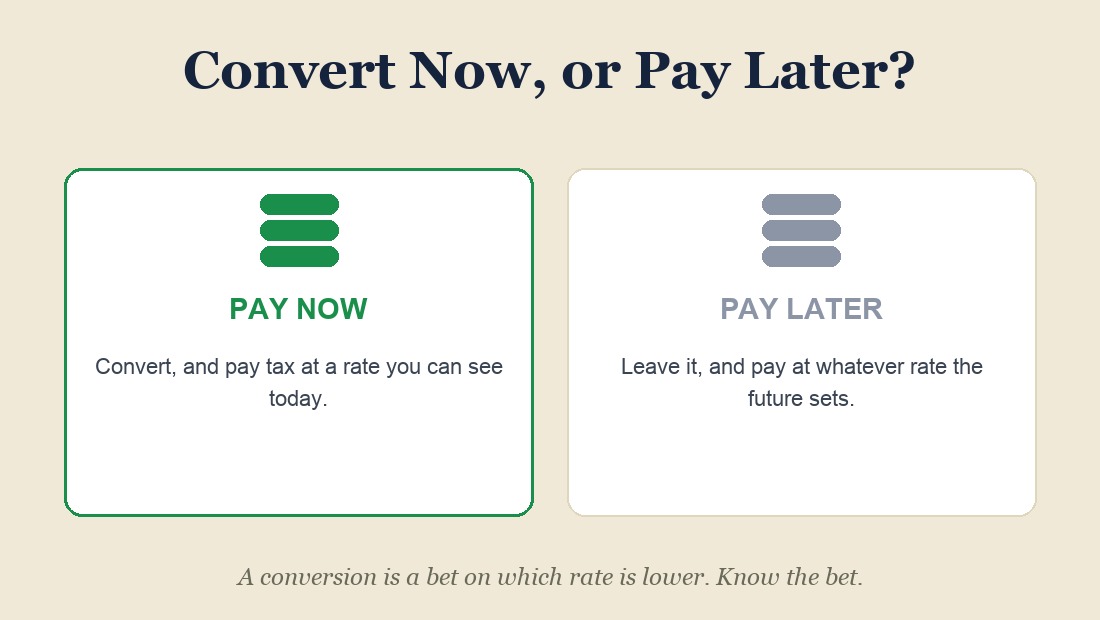
A conversion moves money from a traditional IRA or 401(k), where it grew tax-deferred, into a Roth, where it will grow and come out tax-free. The catch is that you pay ordinary income tax on every dollar you convert, in the year you convert it. You are voluntarily triggering the tax bill you had been deferring, in exchange for never paying tax on that money again.
Done at the right time, that trade is brilliant: you pay tax at a low rate now to escape a higher rate later. Done at the wrong time, you hand the government a large sum today to avoid a tax that might have been smaller. Everything depends on the rates, the timing, and where the money to pay the tax comes from.
When it genuinely helps
A conversion tends to make sense when several of these are true:
- You are in a temporarily low tax bracket, such as the years after you retire but before Social Security and required withdrawals begin. This gap is often the best conversion window of a lifetime.
- You expect your future tax rate to be higher, whether from your own rising income, larger required withdrawals later, or higher rates generally.
- You can pay the conversion tax from money outside the account, so the full balance keeps growing tax-free.
- You are planning for heirs, since a Roth passes to them without the tax drag a traditional account carries.
When it backfires
The same move can be a mistake when:
- The conversion pushes you into a higher bracket now, so you pay a top rate today to avoid a rate that may have been lower.
- It raises your income enough to trigger Medicare surcharges, known as IRMAA, which can quietly add costs for years.
- You have to pay the tax out of the converted money itself, shrinking the balance and undercutting the whole point.
- You will need the money soon, leaving no time for the tax-free growth to make the upfront tax worthwhile.
A conversion done in the wrong year can cost more in today’s taxes and Medicare surcharges than it ever saves.
The assumption buried in every projection
Every rosy conversion illustration rests on one assumption: that you will live long enough, and rates will move the way projected, for the math to pay off. Push the timeline in or move the rates, and a six-figure projected benefit can shrink dramatically. That does not make conversions bad. It makes the projection a starting point, not a promise.
There is also a quieter point worth making. A Roth conversion is one way to build the tax-free bucket, but it is not the only one, and it comes with a large, immediate tax bill. For some people, especially those over Roth income limits or wanting protection and a death benefit alongside tax-free income, other structures reach the same goal without converting a lifetime of savings at once. We lay out the whole framework in the Louisiana tax-free income guide, and the tax problem conversions try to solve is the same one we describe in why your 401(k) was not built for income.
Building the tax-free bucket without converting it all at once.
The free masterclass covers the structures that produce tax-free retirement income, and the 60 second quiz afterward checks what fits your situation.
Watch the MasterclassThe five-year clocks most people miss
Most people hear “Roth” and think of a single five-year rule. There are actually two, they run on separate stopwatches, and confusing them is one of the quieter ways a good conversion turns into an unexpected tax bill. The first clock governs the earnings inside your Roth. It starts on January 1 of the first year you funded any Roth IRA, and once it has run its course and you are past the standard retirement age, the growth comes out with no federal tax. Here is the part that trips people: this clock starts once for you, not once per account. If you opened a small Roth years ago, that old clock may already be satisfied, which is a pleasant surprise for some savers.
The second clock is different. Every amount you convert from a traditional account starts its own separate five-year window, and each year’s conversion gets its own window. This rule exists to stop people from using a conversion as a side door around the early-withdrawal penalty. You already paid income tax on the money the year you converted it. But if you are under the standard early-withdrawal age and you pull that converted principal back out before its own five years are up, you can be hit with the penalty on it anyway. That is the trap: no new tax, but a penalty on money you thought was already cleared. If you are in your sixties, this rarely bites you, because your age already excuses the penalty. If you are converting in your fifties and might need that specific money soon, the timing matters a great deal, so confirm where each conversion sits before you touch it. Order of withdrawal helps you here. The tax rules generally treat Roth dollars as coming out contributions first, then converted amounts, then earnings, which means your true after-tax contributions are reachable before the layers with strings attached. None of this is a reason to avoid converting. It is a reason to write down the date of each conversion and keep it with your records, so that a move you made for good reasons in a calm year does not surprise you in a year you are not expecting.
Filling the bracket: partial conversions done on purpose
A Roth conversion does not have to be all or nothing. You can convert a slice, and the smartest version of this move is deliberate: convert only enough in a given year to fill up your current tax bracket and not one dollar more. Picture the federal brackets as buckets stacked on top of each other. Your income fills the lower buckets first. If you have room left in a lower bucket before the rate steps up, you can convert exactly enough to top it off, paying tax at that lower rate, and stop before the conversion spills into the next bucket at a higher rate. Do it again the next year. Over several years, you move a meaningful amount into Roth without ever paying the top rate on it.
The window where this works best is the gap years. For many Louisiana savers that is the stretch after you stop working but before required minimum distributions begin and, often, before you have turned on Social Security. In those years your taxable income can be unusually low, which means unusually large amounts of empty room in your lower brackets. That empty room is the opportunity. Fill it on purpose instead of letting it go to waste, and you shrink the traditional balance that would otherwise be taxed later at whatever rates apply then, possibly alongside Social Security and larger required withdrawals. Be honest about who this does not fit. If converting pushes your income up in a year you are claiming a premium tax credit for health coverage, or if it later affects income-based Medicare surcharges, the “cheap” bracket space can cost you elsewhere. It also assumes you can pay the conversion tax from money outside the retirement account, because paying it out of the converted funds undercuts the whole point. And it leans on a guess about future rates that no one can promise. Confirm your current bracket thresholds before you act, since these figures adjust over time. Done with eyes open, filling the bracket is one of the few retirement moves where patience and a spreadsheet genuinely pay off. This is education, not advice, so run your own numbers or sit down with someone who will.
Do I pay tax on a Roth conversion?
Yes. You pay ordinary income tax on the amount converted, in the year you convert it. That is the trade for never paying tax on that money again.
When is the best time to convert?
Often in a low-income window, such as after retiring but before Social Security and required withdrawals begin, and when you can pay the tax from outside funds.
Can a Roth conversion hurt me?
Yes, if it pushes you into a higher bracket, triggers Medicare IRMAA surcharges, forces you to pay the tax from the converted balance, or you need the money too soon to benefit.
Is a conversion the only way to get tax-free income?
No. Roth contributions, and for the right person a properly structured life insurance policy, also build tax-free income, without converting a lifetime of savings in one taxable event.