The zero percent floor is the feature that makes indexed strategies interesting and the feature most often misunderstood. Here is exactly how it protects your money, exactly what it costs you, and the one thing it does not do that people assume it does.
Ask someone who owns an indexed policy why they like it, and most will say the same thing: “I can’t lose money in the market.” That is close to true, and the part that is not quite true is where people get hurt. The zero percent floor is a genuine, valuable feature. It is also frequently oversold into something it is not. This briefing takes it apart honestly, because understanding the floor is the difference between using an indexed strategy well and being disappointed by it.
How the floor actually works
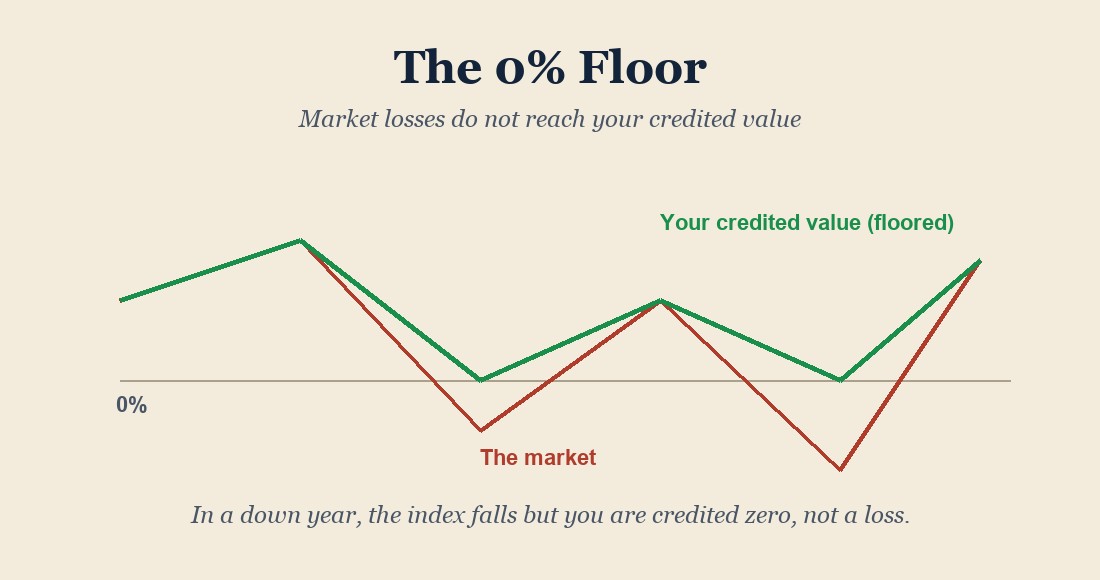
In an indexed strategy, your credited return is tied to a market index, usually the S&P 500, but it is not invested in the index. Instead, the insurer credits you a return based on the index’s movement, bounded on the bottom by a floor and on the top by a cap. The floor is typically zero percent.
Here is what that means in practice. In a year the index rises, you are credited a positive return, up to the cap. In a year the index falls, ten percent, thirty percent, any amount, you are credited zero. Not a negative number. Zero. The money that was credited to your account in prior years does not get clawed back by a market drop. That is the protection: your gains lock in, and market losses do not reach them.
What you give up for it
Nothing in finance is free, and the floor is paid for with the cap. In exchange for never taking a market loss, you accept a limit on your gains in strong years. If your cap is ten percent and the index returns twenty-five, you are credited ten. Over a long run of years, that trade means you will not capture the full upside of a roaring market. You are buying protection, and protection has a price.
There is a second cost people miss: the floor protects against market loss, but the policy still has internal costs, insurance charges and fees, that come out regardless. In a zero percent year, those costs can cause your cash value to dip slightly even though the market did not touch it. The floor is real, but it is a floor on the index credit, not a guarantee that your account never moves down at all. An honest agent tells you this. Our full IUL guide covers how underfunding those costs is the classic way these policies fail.
The floor protects your money from the market. It does not protect it from a policy that was underfunded or oversold.
Why it matters most near retirement
The floor is worth the most to someone close to or in retirement, and here is the reason. A younger investor with decades ahead can ride out a market crash; they have time to recover. Someone who is about to start drawing income cannot. A large market drop in the first years of retirement, while you are withdrawing money, can do permanent damage, because you are selling low to fund your living. This is called sequence-of-returns risk, and we explain it in detail in why your 401(k) was not built for income.
The floor removes that specific risk from the money inside the policy. You give up some of the best years to be certain the worst ones cannot arrive at the exact wrong moment. For the portion of your money that has to produce income you can count on, that trade is often worth making.
The thing the floor does not do
The floor does not make an indexed policy a substitute for growth investing, and it does not make one automatically a good deal. A policy with an aggressive illustration, a low cap, and heavy fees can protect you from market loss while still being a poor place for your money. The floor is a feature, not a verdict. Judge the whole structure, the caps, the costs, the funding, and the fit to your situation, not the single feature that sounds the best in a sales pitch.
See how the floor fits into a real plan, not a pitch.
The free masterclass walks through protected, tax-free income structure honestly. The 60 second quiz afterward checks whether it fits your situation.
Watch the MasterclassThe zero that beats a good year
People underrate the floor because a zero sounds like nothing happened. In retirement, a zero can be worth more than a strong year, and the reason is the brutal math of recovering from a loss.
A loss and a gain of the same size are not equal. Lose thirty percent, and you do not need thirty percent to get back; you need roughly forty-three percent, just to return to where you started. Lose half, and you need to double. The deeper the hole, the more the climb costs you, and every year spent climbing back is a year that was supposed to be paying you income. A portfolio that swings up and down can post an impressive average and still leave you behind, because the losses dig holes the gains have to fill before a single dollar of real progress happens.
The floor sidesteps the hole entirely. In a down year it credits zero, so there is no forty-three percent climb waiting for you the next year, no lost ground to recover, no sequence of bad years compounding against you at the worst possible time. You give up some of the market’s best years in exchange, and that trade is real and worth understanding. But the quiet truth is that avoiding the deep losses, year after year, often does more for a retirement than chasing the highs ever did.
The cap, told honestly
A floor with no ceiling would be too good to be true, and it is. The price you pay for never taking a market loss is that you do not get the market’s full gains either, and anyone selling the floor without explaining the cap is selling you half the story.
Here is the mechanism, plainly. Your money is not actually invested in the index; it earns interest tied to how the index moves, and that interest is limited on the upside. Depending on the policy, that limit shows up as a cap, a stated maximum for the year, or as a participation rate, a percentage of the index’s gain that you receive. In a strong market year, an account with a floor will trail an account that was fully invested, sometimes by a lot. That is the trade in one sentence: you give up some of the best years to be protected in the worst ones.
Two honest points make the picture complete. First, the insurer generally has the ability to adjust caps and participation rates over time, within contractual limits, which means the exact upside is not fixed forever and is worth asking about directly. Second, the illustrations you are shown are governed by regulation, the current rules are known as AG 49-A, precisely because the industry has a history of showing rosy projections; a number on a page is not a promise, and you should treat it as a scenario, not a guarantee.
None of this cancels the value of the floor. It frames it. The strategy is not a way to capture every market boom, and if that is what you are after, this is the wrong tool. It is a way to grow with meaningful downside protection, trading some upside for the certainty of never digging out of a deep hole. Understanding both sides is the difference between using the floor for what it does well and being disappointed that it did not do something it was never designed to do.
Can I really not lose money in the market with a zero percent floor?
The index credit cannot go below zero, so market losses do not reduce the credited value. However, internal policy costs still apply, so the cash value can dip slightly in a flat year. The floor protects against market loss, not against all costs.
What is the catch with the floor?
The cap. In exchange for the floor, your gains are limited in strong years. It is protection bought with upside.
Who benefits most from the floor?
People close to or in retirement, who cannot afford a market crash while they are drawing income. Younger investors with time to recover benefit less from it.
Does the floor make an indexed policy a good deal?
Not by itself. The floor is one feature. The caps, the fees, the funding, and the fit to your situation decide whether the whole policy is worth it.