Florida is one of the best states in the country to retire for taxes, and that reputation quietly costs people money. Because there is no state income tax, most Florida retirees assume the tax question is already answered. It is only half answered. The state layer is handled. The federal layer is still standing, and it lands hardest on the exact accounts most Florida retirees have the most money in. This is the complete guide to keeping more of what you saved.
In this guide: How Florida taxes retirement income · The three tax buckets · The federal gap that costs Florida retirees · Who this hits hardest here · Building the tax-free bucket · A closer look at Roth conversions in Florida · Where Florida law works in your favor · Common mistakes Florida retirees make · A simple order of operations · Frequently asked questions
How Florida taxes retirement income
The short answer is that it does not. Florida’s constitution prohibits a state income tax on individuals, so your Social Security, your pension, your 401(k) and IRA withdrawals, and your annuity income are all free of Florida income tax. There is also no Florida estate tax and no Florida inheritance tax. For a retiree, that is a real head start most states do not offer.
Because it is written into the state constitution and not just the tax code, that protection is far harder to take away than an ordinary tax break. A retiree in Georgia, North Carolina, or almost any income-tax state pays their state a slice of every pension check and every IRA withdrawal for life. In Florida that slice is zero. Over a thirty-year retirement, the difference runs into six figures for a household with a normal nest egg.
Here is the part that trips people up. “No state tax” is not the same thing as “tax-free.” Every dollar sitting in a traditional 401(k), a traditional IRA, or a rolled-over Florida Retirement System account is still fully taxable at the federal level the day you take it out. Florida solved one layer of the problem for you. The federal layer is untouched, and that is where the money quietly leaks.
The three tax buckets
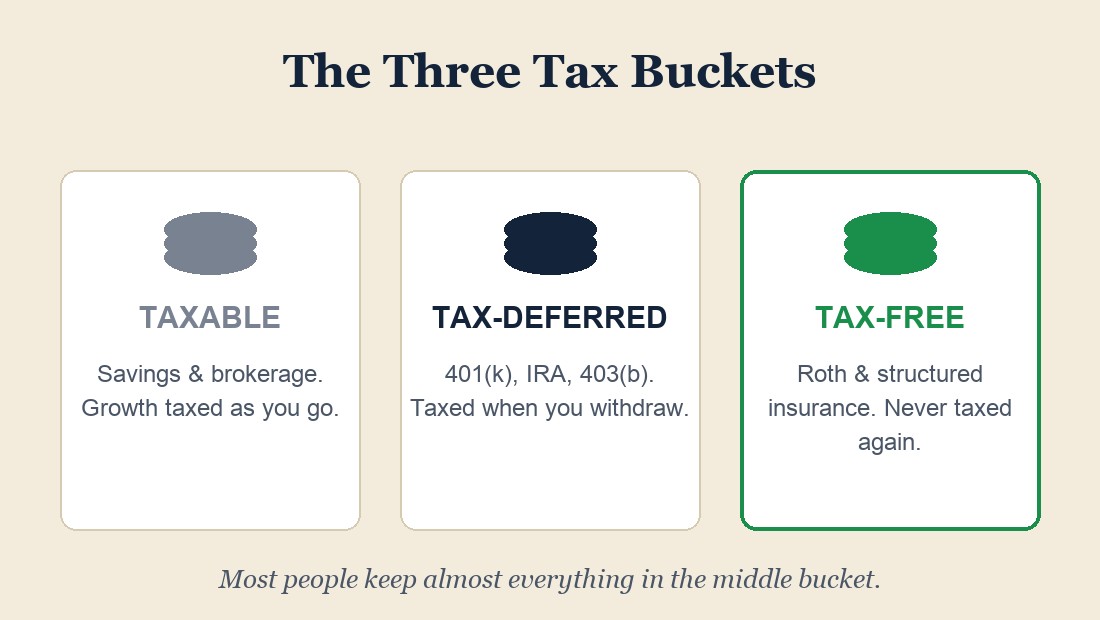
Every dollar you have saved lives in one of three buckets. In Florida none of them are taxed by the state, so the only thing that matters is how the federal government treats each one.
- The taxable bucket. Brokerage accounts, savings, CDs. You pay federal tax on the interest and gains as they happen, year after year.
- The tax-deferred bucket. Traditional 401(k), 403(b), traditional IRA, the FRS Investment Plan, and a DROP payout rolled into an IRA. It grows without tax along the way, but every withdrawal counts as ordinary federal income, and starting at age 73 the IRS forces money out through required minimum distributions whether you need it or not.
- The tax-free bucket. Roth IRA, Roth 401(k), a properly structured cash value life insurance policy, and an HSA used for medical costs. Handled correctly, the money comes out with no federal income tax at all.
Most Floridians reach retirement with nearly everything stacked in the middle bucket. That is the setup that looks fine on a statement and gets expensive on a tax return.
The federal gap that costs Florida retirees
Because the state side is free, the entire cost of a poorly planned retirement in Florida shows up on the federal side. It shows up in three specific ways.
Your Social Security gets taxed. Up to 85 percent of your Social Security benefit can be taxed at the federal level once your combined income crosses the federal thresholds. What pushes you over those thresholds? Withdrawals from that tax-deferred bucket. So the account you were told was the smart place to save can quietly turn your Social Security into a taxable event.
Required minimum distributions force your hand. At 73 the IRS makes you pull money from traditional accounts on its schedule, not yours. Those forced withdrawals stack federal income on top of everything else, and they often drag more of your Social Security into the taxable column at the same time.
Medicare surcharges follow the income. Higher income from those forced withdrawals can trigger IRMAA, the income-related surcharge on Medicare Part B and Part D. It is a stealth tax on the same dollars, and many retirees never see it coming until the bill arrives.
Underneath all three sits the bet nobody talks about. A large tax-deferred balance is a wager that federal tax rates stay where they are for the rest of your life. Today’s federal rates are historically low. Betting your entire retirement on them staying that way is a risk, not a plan.
Here is how the three leaks compound in practice. Picture a Florida couple with 800,000 dollars in traditional 401(k) and IRA money and a combined 45,000 dollars a year in Social Security. This is a hypothetical illustration, not a projection of your results. At 73 their required distributions push their income high enough that a large share of that 45,000 dollars in Social Security becomes federally taxable, their withdrawals are taxed as ordinary federal income, and their higher total income nudges them into an IRMAA surcharge on Medicare. None of it is a Florida tax. All of it is federal, and all of it traces back to one thing: nearly everything they saved sits in the middle bucket. A retiree who had moved even part of that money into the tax-free bucket in the years before would have controlled every one of those outcomes.
Who this hits hardest here
This is not an everybody problem in equal measure. In Florida it concentrates on a few groups.
- Career FRS members. Teachers, state workers, county and city employees who spent a career in the Florida Retirement System often finish with a large DROP payout or a sizable Investment Plan balance rolled into an IRA. That is a six-figure tax-deferred pile that becomes federal required distributions later. It is worth knowing which FRS path you are on, because it changes the shape of the problem. The Pension Plan vests at eight years of service if you enrolled on or after July 1, 2011, or six years if you enrolled before that, and it is the plan that offers DROP once you reach your normal retirement date. The Investment Plan vests in just one year, and DROP is not available in it, although a Pension Plan member can roll a DROP payout into the Investment Plan after leaving DROP. Either way the state does not tax the payout, but the federal government fully will, and a DROP lump sum or a rolled-over Investment Plan balance is exactly the kind of account that drives required distributions and Social Security taxation years down the road.
- Private-sector 401(k) savers. The same story with a different logo on the statement. Decades of pre-tax contributions, all of it taxable federally on the way out.
- Transplants and snowbirds. People who moved to Florida specifically for the tax break, then left the federal side of their retirement on autopilot. They captured the state win and walked right past the federal one.
Building the tax-free bucket
The fix is not complicated, but it has to be deliberate. The goal is to build a pool of money the IRS cannot tax on the way out, so that you, not your required distributions, decide what your federal bracket looks like each year. There are a few ways to fill that bucket.
- Roth conversions. You move money from the tax-deferred bucket to a Roth, pay the federal tax now at a rate you can see, and let it grow and come out federal-tax-free later. Done in lower-income years, before required distributions start, this is one of the most powerful moves available.
- Roth contributions. A Roth 401(k) or Roth IRA builds the tax-free bucket from the start.
- Cash value life insurance. A policy structured for income grows tax-deferred, and when it is built and managed correctly you can access the money through withdrawals to your basis and policy loans that are not treated as taxable income. It is the tool for people who want a long-horizon, federal-tax-free income stream on top of their Roth.
- The HSA. For medical costs it is the only account that is deductible going in and tax-free coming out.
A closer look at Roth conversions in Florida
Of all the ways to fill the tax-free bucket, the Roth conversion deserves its own section, because Florida makes it work better than almost any state in the country. A conversion means moving money out of a traditional 401(k) or IRA and into a Roth, paying the income tax on the amount you move, so that it grows and later comes out with no federal tax at all.
Here is the Florida advantage. The tax on a conversion normally has two parts, a federal part and a state part. Someone converting in Georgia, New York, or any income-tax state pays both. A Florida resident pays only the federal part, because Florida does not tax the conversion at all. Convert 50,000 dollars in a state with a five percent income tax and you hand the state 2,500 dollars on that move alone. In Florida that number is zero. Over a multi-year conversion plan, that difference adds up quickly.
Timing is the other half. The most powerful years to convert are the low-income years, often the stretch between when your paycheck stops and when Social Security and required minimum distributions begin. In that window your taxable income can be unusually low, which means you can convert a meaningful amount while staying in a low federal bracket. The goal is to fill up the lower brackets on purpose, year after year, moving money into the tax-free column at a known and modest rate rather than letting it all sit in the tax-deferred pile until required distributions force it out at whatever the rates are then. A Florida resident who plans conversions well can reshape their entire future tax picture during those quiet years, and the state charges nothing for the privilege.
Where Florida law works in your favor
Florida does more for a retirement plan than skip the income tax. A few pieces of state law quietly reward the person who plans well.
- No state income tax, by constitution. Every bucket, every withdrawal, every dollar of Social Security avoids Florida tax. That is a permanent structural advantage, not a temporary break.
- No state estate or inheritance tax. Florida’s estate tax statutes are on the books but inoperative, so what you leave behind passes without a state death tax.
- Strong creditor protection on cash value life insurance and annuities. Under Florida Statute 222.14, the cash surrender value of a life insurance policy and the proceeds of an annuity are exempt from creditors for Florida residents, with no dollar cap. That means the same cash value policy that builds federal-tax-free income also sits in one of the most protected asset classes in the state. That combination is stronger in Florida than in most places in the country.
- Homestead protection shields your primary residence, which frees you to be more intentional with the rest of the plan.
Common mistakes Florida retirees make
Most of the money lost in a Florida retirement is not lost to bad luck. It is lost to a handful of avoidable assumptions. These are the ones that come up again and again.
- Assuming no state tax means the tax question is solved. It is the single most common mistake in the state. Florida handled the state layer, but the federal layer is untouched, and for most retirees the federal layer is the bigger one.
- Leaving everything in the tax-deferred bucket. A retirement built entirely on a traditional 401(k) or IRA looks fine on a statement and hands the IRS the timing and the rate through required distributions later. Spreading money into the tax-free bucket before then is what puts you back in control.
- Taking a lump sum, such as a DROP payout, all in one year. A large tax-deferred payout collected in a single year can stack on your other income and jump you into a much higher federal bracket. It almost always deserves a plan before you take it.
- Ignoring the ripple effects. Withdrawals do not just get taxed on their own. They can make your Social Security taxable and trigger IRMAA surcharges on Medicare, so a withdrawal can cost more than its own tax bill.
- Moving to Florida without making the residency real. If you split your year or keep ties to a high-tax state, that state may still tax your retirement income. The zero-tax win only holds when Florida is genuinely your legal home.
- Waiting too long to act. The best planning years, the low-income window before required distributions, are finite. Every year you wait is a conversion year you cannot get back.
A simple order of operations
If you do nothing else, do these in order.
- Lock in the guaranteed base. Decide your Social Security timing and, if you are an FRS member, your pension and DROP choices. These are the floor everything else sits on.
- Measure your bucket mix. Find out honestly how much of your money is in the tax-deferred federal pile. That number is the size of the problem.
- Fill the tax-free bucket on purpose. Use Roth conversions in your lower-income years and cash value life insurance for long-horizon income. Do it before required distributions start, not after.
- Sequence your withdrawals. Pull from the right bucket in the right year to control your federal bracket and keep Social Security out of the taxable zone.
- Review it every year. Tax law changes, your income changes, and the plan should move with them.
Frequently asked questions
Does Florida tax Social Security, pensions, or 401(k) withdrawals? No. Florida has no state income tax, so none of it is taxed at the state level. The federal government still taxes pension and traditional 401(k) or IRA withdrawals as ordinary income, and up to 85 percent of your Social Security can be taxed federally.
Does Florida have an estate tax or an inheritance tax? No. Florida’s estate tax statutes exist but are inoperative, and there is no inheritance tax, so what you leave behind passes without a state death tax.
Is a Roth conversion really worth it in Florida? For many retirees it is, because you pay only the federal tax on a conversion and nothing to the state, and the low-income years before required distributions begin are an ideal window to do it. Whether it makes sense for you depends on your bracket, your balances, and your timeline, which is exactly the kind of thing to model before you convert.
When do required minimum distributions start? Under current federal rules they begin at age 73 for traditional accounts. A Roth IRA has no lifetime required distributions for the original owner, which is part of what makes the tax-free bucket so flexible.
I just moved to Florida. What should I do first? Establish your Florida residency properly, file for homestead, change your license and voter registration, and update your estate documents, then map your account buckets and look hard at Roth conversions while your income is low.
More Florida retirement guides
- Does Florida Tax Retirement Income? A Line-by-Line Answer
- Indexed Universal Life in Florida: An Honest Guide to Who It Fits
- The Florida Teacher’s Retirement Guide: FRS, DROP, and the Tax-Free Layer
- The FRS Retirement Guide for Florida State and Local Employees
- Retiring in Florida: A Tax Plan for Transplants and Snowbirds
Want to see whether the tax-free strategy actually fits your situation? Retirement Shield walks Florida savers through a short qualification quiz and connects you with one licensed professional who can map your buckets and your federal exposure. See if you qualify here.
This article is general education, not individualized tax, legal, or investment advice. Florida Retirement System rules, federal tax thresholds, and Social Security taxation change over time, and how any strategy applies depends on your own situation. Cash value life insurance is subject to underwriting and carrier terms, and policy loans and withdrawals reduce cash value and death benefit and can cause a policy to lapse if not managed properly. Consult a licensed tax, legal, or insurance professional before making decisions. Retirement Shield is a marketing and education brand, not a law firm, accounting firm, or insurance carrier.