Louisiana is one of the friendliest states in the country for retirement income, and one of the least understood. This is the complete guide to keeping more of what you saved, from the state tax rules that already favor you to the federal gap that quietly costs Louisiana retirees the most.
Most retirement advice is written for a national audience, which means it ignores the two things that decide how comfortable your retirement actually is: the state you live in and the exact way your income is taxed. Louisiana is unusual on both counts. The state itself treats retirees generously. The federal government does not, and the gap between those two facts is where most Louisiana retirement plans quietly lose money they did not have to lose.
This guide walks through the whole picture. It is long on purpose, because the details are where the money is. If you take one idea from it, take this: in Louisiana, the problem is almost never how much you saved. It is how that money is taxed when you finally spend it.
How Louisiana taxes retirement income
Start with the good news, because Louisiana gives retirees several real advantages that people often do not realize they have.
- Social Security is not taxed by Louisiana. Whatever you collect, the state takes none of it.
- Public pension income is exempt from Louisiana income tax. If you draw a pension from TRSL, LASERS, or another Louisiana public system, or from a federal government pension, that income is not subject to state income tax.
- Other retirement income gets a further break for seniors. Louisiana exempts a portion of other retirement income for residents age sixty-five and older.
- Louisiana’s income tax rate is low and, as of recent reform, flat. The state is not where your retirement tax burden comes from.
Rates and exemption amounts change, so confirm the current numbers for your situation. But the structure is stable and it is favorable: Louisiana is not the government taking the largest bite of your retirement income. That distinction belongs to the one most people forget to plan around.
The three tax buckets
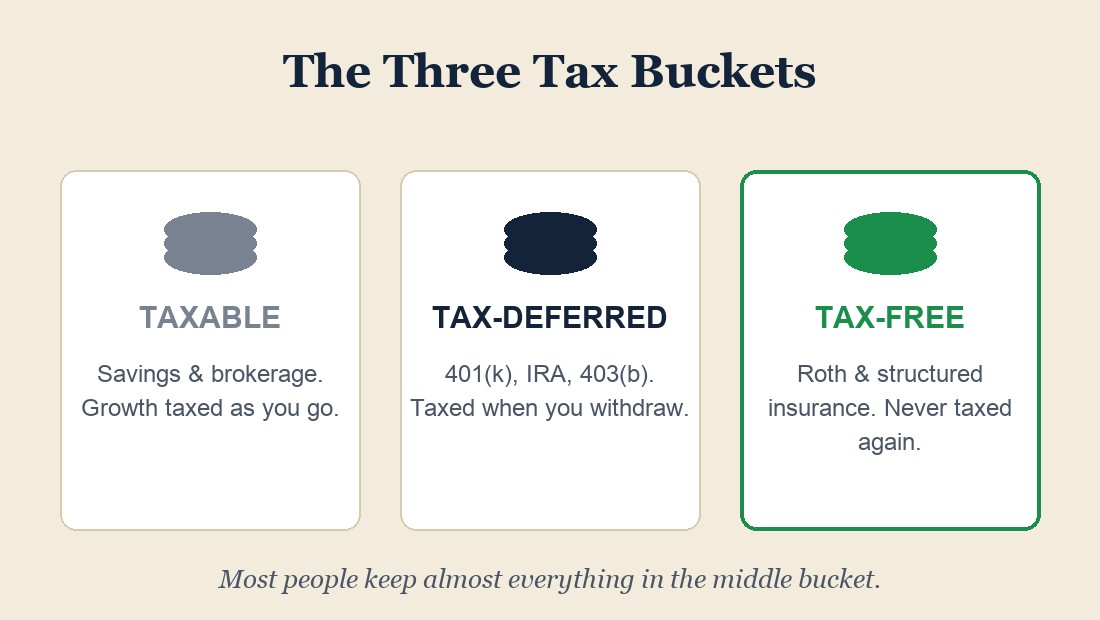
Every dollar you have saved for retirement sits in one of three buckets, defined entirely by how it is taxed. Understanding which bucket your money is in is the single most useful thing you can do for your retirement.
Bucket one: taxable. Ordinary savings, brokerage accounts, CDs. You have already paid tax on the principal, but you owe tax on the growth, interest, and dividends as you go. Money here is flexible but tax-inefficient.
Bucket two: tax-deferred. This is where most Americans keep the bulk of their retirement money: the 401(k), the 403(b) that many Louisiana school and hospital workers use, the traditional IRA. You got a tax deduction when the money went in. In exchange, every dollar you take out in retirement is taxed as ordinary income, at whatever rate exists in the year you withdraw it. You do not know that rate yet. Neither does anyone else.
Bucket three: tax-free. Money that has already been taxed and will never be taxed again, including the growth and the income it produces. Roth accounts live here. So, structured correctly, does the cash value inside certain life insurance policies. Most Americans have almost nothing in this bucket, and it is the one that matters most in retirement.
The average pre-retiree in Louisiana has the majority of their savings in bucket two, the one where a future Congress decides how much they actually keep.
The gap that costs Louisiana retirees
Here is where the state and federal pictures collide. Louisiana does not tax your TRSL or LASERS pension. The federal government does. Louisiana does not tax your Social Security. The federal government can, once your total income crosses certain thresholds. And a public pension plus Social Security plus a 401(k) withdrawal can stack up quickly, pushing more of your income into higher federal brackets and making more of your Social Security taxable in the process.
The result is a quiet irony. A Louisiana teacher or state employee who did everything right, worked thirty years, earned a solid pension, saved in a 403(b), can end up with a larger federal tax bill in retirement than they expected, precisely because they have several taxable income streams landing at once. The state got out of the way. The federal government did not.
This is the gap. It is not a savings problem. These are people who saved well. It is a tax-structure problem, and it is fixable, but only before the income starts.
Who this hits hardest here
The gap is universal, but it lands hardest on a few groups that Louisiana has in large numbers:
- Teachers and school employees whose TRSL pension is fully taxable federally and who often have a 403(b) on top of it.
- State employees in the LASERS system, in the same position.
- Offshore, oilfield, and plant workers who earned high incomes with no pension at all, and who need to build their own tax-diversified retirement from scratch.
- Anyone with a large 401(k) or IRA and no tax-free bucket to balance it.
Building the tax-free bucket
The fix is not exotic. It is simply deciding, before retirement, to route some of your savings into the third bucket so that in retirement you can choose which bucket to draw from and control your own tax bill year by year.
For many people, a Roth IRA or Roth 401(k) is the first and best step, and if you have access to one and can fund it, start there. For higher earners who have hit Roth income limits, for people who want creditor protection under Louisiana law, or for those who want a death benefit and living benefits alongside tax-free growth, a properly structured life insurance policy can serve the same role. We cover the honest version of that, including who it is wrong for, in our guide to indexed universal life in Louisiana.
The right tool depends entirely on your income, your age, your health, and how consistently you can save. But the principle does not change: if all of your retirement money is in the bucket a future Congress controls, you have handed away a decision you could have kept.
See where your own money sits, and what the tax-free bucket could look like.
The free masterclass walks through the structure the big banks use for tax-free income, and how the same approach works starting around $500 a month. No cost, no obligation.
Watch the MasterclassWhere Louisiana law quietly works in your favor
Most conversations about taxes and retirement focus on what the government takes. That is fair, because the bill is real. But if you only look at what you owe, you miss a quieter truth: Louisiana treats retirees better than many residents realize, and several of those advantages sit unused because nobody ever pointed them out. When you line them up on purpose, they start to look less like scattered breaks and more like a package the state has handed you.
Start with Social Security. Louisiana does not tax Social Security benefits at the state level. That alone changes the math for a large share of retirees, because a meaningful piece of monthly income arrives without a state tax bite on top of it. Then look at public pensions. Louisiana gives favorable state treatment to many public retirement benefits, the kind earned by teachers, state employees, and other public servants across the state. If you or your spouse spent a career in public service, that treatment is worth understanding rather than assuming the worst.
Add to that Louisiana’s long tradition of protecting certain assets from many creditors. The state has historically taken a strong stance on shielding specific retirement accounts and certain life insurance values from the reach of many claims. That protection is a separate topic from taxes, but it belongs in the same conversation, because it shapes how confidently you can keep money in the very places that also carry tax advantages. Security and tax treatment reinforce each other here.
None of this is a loophole, and none of it is a promise about your specific return. It is simply how the rules generally work for Louisiana residents, and the people who benefit most are the ones who plan around these features on purpose rather than stumbling into them by accident. The retiree who knows Social Security is protected at the state level, understands how a public pension is treated, and keeps savings in forms the state tends to shield is playing with information most of their neighbors never gathered.
The honest caveat: rules change, and your situation is yours alone. Public pension treatment, creditor protection, and tax details all carry conditions, and a general article cannot tell you how they apply to your household. Treat this section as a reason to ask better questions, not as a final answer. A conversation with a qualified Louisiana tax professional or estate attorney is where these general advantages turn into a plan that actually fits your life.
Curious what your own numbers look like? Try the free Tax-Free Retirement Calculator to see what steady saving could grow into tax-free, and compare the VAULT System against a 401(k) or a brokerage account.
A simple order of operations
When people feel behind on retirement, they often reach for whatever product a friend mentioned or an ad promoted. That is backward. Before any specific tool, there is a sequence that serves most people well, and following it in order tends to matter more than any single decision inside it. Think of it as an order of operations, the same way arithmetic has one. Skip a step and the answer comes out wrong.
Step one: capture any employer match you have access to. If you are still working and your employer offers to match contributions to a retirement plan, contributing at least enough to receive the full match is usually the first move. That match is part of your compensation. Leaving it on the table is walking away from money you already earned. This step comes before almost everything else because nothing else on the list starts you off with an immediate benefit like this one does.
Step two: diversify across tax buckets. Earlier in this guide we described the three buckets: taxable, tax-deferred, and tax-free. The goal is not to cram everything into one. It is to build meaningful balances across more than one, so that in retirement you have choices about where each dollar of income comes from and how it is taxed. Concentration in a single bucket, especially the tax-deferred one, is common and it quietly limits your options later, exactly when flexibility matters most.
Step three: build the tax-free bucket deliberately. Once the match is captured and you are spreading contributions across buckets, you can give focused attention to the tax-free side, which many people neglect entirely. This is where certain accounts and certain properly structured life insurance strategies can play a role for the right person. The point is that this step comes third, on purpose, after the foundation is set, not first because a sales pitch pushed it to the front.
This sequence is general education, not personalized advice, and your circumstances may reorder it. Someone with high-interest debt, no emergency savings, or unusual tax exposure might need a different first move. Age, income, health, and family situation all bend the path. Use the order of operations as a starting framework, then sit down with a qualified Louisiana professional who can look at your full picture and tell you which step you are actually on and what belongs next.
Does Louisiana tax Social Security or pensions?
Louisiana does not tax Social Security benefits, and it exempts Louisiana public pension income, including TRSL and LASERS, from state income tax. Federal tax can still apply to both.
Why do Louisiana retirees still face a tax problem?
Because the federal government taxes the income the state exempts. Several taxable streams landing at once, a pension, Social Security, and 401(k) withdrawals, can push you into higher federal brackets and make more of your Social Security taxable.
What is the tax-free bucket?
Money that has already been taxed and will not be taxed again, including its growth and the income it produces. Roth accounts and, when structured correctly, certain life insurance cash value both live here. Most people have very little in this bucket.
Is it too late to fix this after I retire?
Some strategies still help after retirement, but the most effective ones are set up before the income starts. The earlier the planning, the more control you keep.
- Indexed universal life in Louisiana: an honest guide
- What is bank-owned life insurance?
- The Louisiana teacher’s retirement guide
- The LASERS retirement guide for state employees
- Retiring from the Gulf: offshore and industry workers
- Your 401(k) wasn’t built for income
- Does Louisiana Tax Retirement Income?
- The Homestead Exemption and Senior Property Tax Freeze in Louisiana
- Forced Heirship and Estate Planning in Louisiana
Related reading on protecting your money in Louisiana: Is life insurance protected from lawsuits and creditors in Louisiana? and our complete guide to Louisiana life insurance creditor protection.