An indexed universal life policy is one of the most oversold and most misunderstood tools in retirement planning. Here is the honest version: what it actually does, the Louisiana law that makes it different here, and the people it is wrong for.
Search “IUL” for ten minutes and you will find two internets. One says indexed universal life is the secret the wealthy use to grow money tax-free with no market risk. The other says it is an overpriced product sold by commission-hungry agents to people who would be better off with a simple index fund. Both are describing the same thing. The difference is not the product. It is whether it was structured correctly and sold to the right person.
This briefing is the version a licensed Louisiana agent would give a family member. It names the real advantages, the real Louisiana-specific edge, and the ways these policies genuinely hurt people when they are done wrong. If you leave thinking an IUL is not for you, that is a good outcome. It is not for most people.
What an IUL actually is
An indexed universal life policy is permanent life insurance with a savings component. Part of every premium pays for the insurance itself. The rest goes into a cash value account whose growth is linked to a market index, usually the S&P 500, with two guardrails:
- A floor, usually zero percent. In a year the index falls, your cash value does not lose money to the market. It is credited zero, not a negative.
- A cap or participation rate. In a year the index rises, your credit is limited. If the cap is ten percent and the index returns twenty, you are credited ten. This is the trade for the floor.
The cash value grows tax-deferred. You can access it during your lifetime through policy loans, which are not treated as taxable income because a loan is not income. When you die, the death benefit passes to your family income-tax-free under longstanding tax law. That combination, tax-free access while living and a tax-free benefit at death, is the entire reason the structure exists.
Universal life insurance in Louisiana, and where indexed fits
Indexed universal life is one branch of a larger family. Universal life insurance is permanent coverage with a flexible premium and a cash value account, and in Louisiana it comes in three main forms. Guaranteed universal life holds the premium and death benefit fixed and builds little cash value, so it behaves like lifelong term. Variable universal life invests the cash value directly in market subaccounts, with full upside and no floor under a bad year. Indexed universal life sits between them: the cash value is credited from a market index, a cap limits the upside, and a floor, usually zero percent, keeps a losing year from cutting into what you have. For a full side by side, see our comparison of whole life, IUL, VUL, and term.
For most Louisiana savers who want tax-free retirement income without putting principal at market risk, indexed universal life is the version that fits. It keeps the flexible-premium structure of universal life insurance and adds the floor that guaranteed universal life does not need and variable universal life does not offer. The rest of this guide stays on indexed universal life for that reason, and the Louisiana creditor protection and tax treatment below apply across the universal life family.
The three real advantages
1. Tax-free income you control. A 401(k) and a traditional IRA give you a tax deduction now and a tax bill later, at whatever rates exist when you retire. An IUL is the opposite: you fund it with money you have already paid tax on, and structured properly, the income comes out tax-free. In a country with a rising national debt, betting that tax rates will be lower in twenty years is a real bet. This is a way not to make it.
2. A zero percent floor. The 2008 and 2022 market drops did real damage to retirees who were withdrawing income at the same time their accounts were falling. A floor removes that specific risk from the money inside the policy. You give up some of the best years to protect against the worst ones.
3. Benefits you can use while alive. Most modern policies include riders that let you access the death benefit early if you become chronically or terminally ill. For a family whose biggest fear is a long-term care event draining everything, that living benefit can matter more than the tax treatment.
A plain-English walkthrough of what Louisiana R.S. 22:912 actually shields, the nine-month timing rule, the four mistakes that quietly void your protection, and a 60-second self-audit to see where you stand. Free, no obligation.
Get the free blueprint →The Louisiana law that changes the math
Here is the part almost no national article mentions, and it is the reason an IUL can make more sense in Louisiana than in most states. Louisiana law, at Revised Statute 22:912, protects the cash value and proceeds of life insurance from most creditors. Money inside a properly owned life insurance policy is, broadly, shielded in a way an ordinary brokerage account is not.
For a Louisiana small business owner, a contractor, a nurse or a physician, anyone whose work carries liability exposure, that protection is not a footnote. It is a genuine, state-specific reason to hold savings inside this structure rather than beside it. This is worth reviewing with an attorney for your exact situation, because ownership and beneficiary details determine how the protection applies. But the underlying statute is real, and it is one of the strongest in the country.
The risks nobody sells you
This is the section the aggressive sales pitches skip, and it is the reason to read the whole thing before you sign anything.
The caps can move, and the illustrations can lie by omission. The insurer can lower the cap over time, and a policy illustrated at a rosy rate can underperform badly. Regulators created actuarial rules, known as AG49 and AG49-A, specifically because illustrations were being used to promise returns the products could not reliably deliver. Treat any projection above a modest rate with suspicion, and never buy on the illustration alone.
The single most common way an IUL destroys value: it is underfunded or over-borrowed, the rising cost of insurance eats the cash value, the policy lapses, and the outstanding loan becomes a taxable event on gains you never actually pocketed.
The cost of insurance rises as you age. Every year, the insurance portion costs more. A policy funded too lightly, or one a person borrows against too aggressively, can reach a point where the rising cost outpaces the cash value and the policy collapses. If there is an outstanding loan when that happens, the IRS can treat the forgiven loan as taxable income. A product sold as tax-free can end in a tax bill. This is not a rare edge case. It is the classic failure mode.
The early years are expensive. Premium loads, insurance costs, and surrender charges that often last ten to fifteen years mean the cash value in the first several years is low. This is a long-horizon commitment, not a flexible savings account. If there is any chance you cannot fund it consistently, it is the wrong tool.
Who it fits, and who it does not
It can fit someone who has income to commit consistently for the long term, who has a genuine reason to want tax-free income later, and who values the Louisiana creditor protection. In practice, that describes a specific set of Louisiana workers well:
- Offshore, oilfield, and plant workers with high, irregular income and no pension. They can fund in strong years, they need a forced-savings structure, and they have no employer plan doing this for them.
- Business owners and liability-exposed professionals who want the creditor protection alongside the tax treatment.
- Teachers and state employees whose TRSL or LASERS pension is fully taxable, who need a source of income that is not, to balance the tax bill in retirement.
It does not fit someone who cannot reliably fund it, someone who has not yet captured an employer 401(k) match (take the free money first), or someone whose real need is simple, cheap death-benefit protection, in which case term insurance is the honest answer. If money is tight and consistency is uncertain, a Roth IRA is usually the better path to tax-free retirement income, and it is the one an honest agent will point you to.
Tax now, tax later, tax never
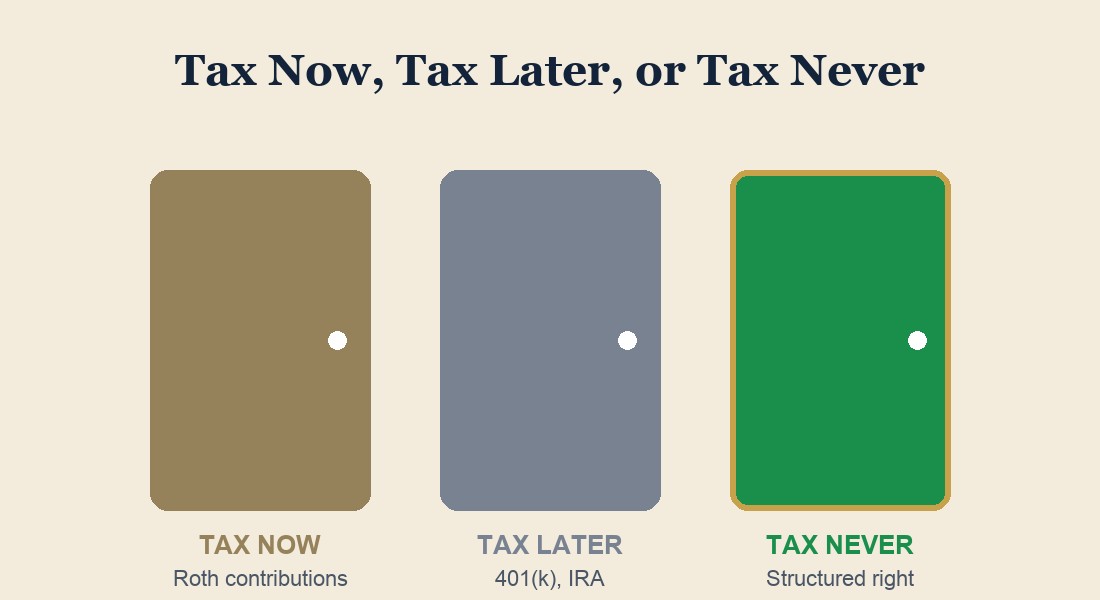
Every dollar you save for retirement lands in one of three tax buckets, and most Louisiana savers only ever use two of them.
There is a Louisiana wrinkle worth naming up front. Louisiana has a state income tax, now a flat 3 percent on individual income for tax years beginning on or after January 1, 2025. That 3 percent falls on the money you pull from the tax-later bucket, such as a traditional 401(k) or IRA, on top of the federal bill. It does not fall on properly structured policy loans and withdrawals to basis, because those are not treated as income at all. So in Louisiana the tax-never bucket does double duty: it sidesteps the federal tax and the state’s 3 percent both. Business owners feel this most, which is why we cover it in IUL for Louisiana Business Owners, and if you have not filled the cheaper buckets yet, start with IUL vs Roth IRA for Louisiana Savers.
The first bucket is tax now. A regular brokerage account, a savings account, a CD. You already paid income tax on the money going in, and you pay tax again every year on the interest, dividends, and gains it throws off. It stays liquid, but the tax meter never stops running.
The second bucket is tax later. This is where almost everything sits: your 401(k), your 403(b), a traditional IRA, a TSP, the DROP account a Louisiana teacher or state employee builds. You get a deduction today, the money grows without a yearly tax bill, and then the IRS collects when you withdraw, at whatever rates happen to apply decades from now. That is the part people gloss over. Tax deferred does not mean tax free. It means the bill is still coming, and you do not get to know the rate in advance.
Here is the plain way to see it. There has never been a bill in your life that got cheaper because you paid it late. A tax-later account is a tax bill you agreed to settle later, on a balance that grew, at a rate someone else sets after the fact. With the federal government carrying trillions in debt, betting that your future rate will be lower than today’s is a real wager, not a safe assumption.
The third bucket is tax never, and it is the one most people never build. There are only two places the tax code lets money grow and come back out with no income tax: a Roth account, and the cash value of a properly structured life insurance policy. A Roth carries income limits and contribution caps. Cash value life insurance does not, which is the main reason it enters this conversation at all. It is not better than the other two buckets. It is the bucket that balances them, so that not every dollar of your retirement income is exposed to a future tax rate you cannot control.
Why the structure decides everything
If you have searched IUL online, you have found the horror stories: policies that lapsed, cost more than expected, or never came close to the illustration. Most of those stories share one cause, and it is not the product. It is the structure.
Every life insurance premium splits into two parts: the actual cost of the insurance, and the cash value. A policy sold commission first is built upside down. It carries the largest death benefit the premium can buy, which maximizes the cost of insurance and the agent’s commission and leaves the smallest slice for cash value. Fund it lightly, or borrow against it carelessly, and the rising cost of insurance eventually eats the account. That is the lapse-and-tax-bomb story people warn about, and the warning is fair.
A policy built for tax-free income is structured the opposite way. The death benefit is set as low as the tax code allows for the premium, so the cost of insurance is held to a minimum and most of each dollar goes to cash value. Built this way, the agent’s commission is smaller, on purpose. That is a large part of why the average agent does not lead with it.
The product is not the risk. The wrong structure, and the wrong agent, are the risk.
Which gives you a simple test when you sit across from anyone selling this. Ask whether they own one themselves, and ask to see it. An agent who has structured a policy on their own life, cash first, can walk you through the design. One who cannot is selling you something they did not buy.
Curious what your own numbers look like? Try the free Tax-Free Retirement Calculator to see what steady saving could grow into tax-free, and compare the VAULT System against a 401(k) or a brokerage account.
What “be your own bank” really means
The phrase attached to this strategy is “be your own bank.” Stripped of the marketing, here is what it actually means, and what it does not.
Once a policy has cash value, you can borrow against it. The loan is not a withdrawal, so under current tax law it is not taxable income, and the money you borrowed against generally keeps growing as if you never touched it. You do not fill out an application, wait for a bank’s approval, or explain what the money is for. For someone who wants access to their own money before age 59 and a half without the penalty a 401(k) charges, that liquidity is real, and it is the honest appeal.
Now the part the hype leaves out. A policy loan is still a loan. It accrues interest, and any balance you never repay is subtracted from the death benefit your family receives. Borrow aggressively, underfund the policy, and you can push it toward the same lapse that triggers a tax bill on gains you already spent. The infinite banking pitches that promise free money ignore this. Used with discipline, the loan feature is a genuine tool. Used as a gimmick, it is how policies blow up.
That is the throughline of every honest version of this strategy. The tax-free growth, the zero floor, the liquidity, and the family protection are real. They hold up only when the policy is funded properly and left to work, which is a conversation about your specific numbers, not a promise that fits on a billboard.
See whether the structure fits your situation, not a sales pitch.
The free masterclass walks through how this is structured to work, and the 60 second quiz afterward checks your age, health, and monthly number honestly. If it is not a fit, you will hear that.
Watch the MasterclassIs IUL income really tax-free?
Structured correctly and kept in force, income taken as policy loans is not treated as taxable income, and the death benefit passes income-tax-free. The key words are “structured correctly and kept in force.” A policy that lapses with a loan outstanding can trigger a tax bill, which is why funding and structure matter more than the sales illustration.
Is an IUL better than a Roth IRA?
Different tools. A Roth IRA is simpler, cheaper, and better for most people who can fund it, but it has income limits and contribution caps. An IUL has no income limits, no contribution cap in the same sense, adds a death benefit and living benefits, and in Louisiana adds creditor protection. It only wins for someone who can fund it consistently and values those extra features.
What is the catch with the zero percent floor?
The cap. In exchange for never losing money to the market, you give up part of the upside in strong years, and the insurer can adjust the cap over time. It is protection, not a way to capture full market returns.
Does Louisiana really protect life insurance from creditors?
Louisiana Revised Statute 22:912 broadly exempts the proceeds and cash value of life insurance from creditors, subject to how the policy is owned and other limits. It is one of the stronger protections in the country and should be confirmed with an attorney for your specific situation.
More Louisiana life insurance guides
- Are annuities protected from creditors in Louisiana?
- Can you borrow against life insurance in Louisiana?
- Does life insurance go through probate in Louisiana?
- Are life insurance proceeds taxable in Louisiana?
- The living benefits of life insurance in Louisiana
- What to do with your 401(k) when you change oilfield jobs
- Key person and buy-sell life insurance for Louisiana business owners
Related reading on protecting your money in Louisiana: Is life insurance protected from lawsuits and creditors in Louisiana? and our complete guide to Louisiana life insurance creditor protection.